
Collecting by Design
Collecting by Design
July 9 – November 15, 2026
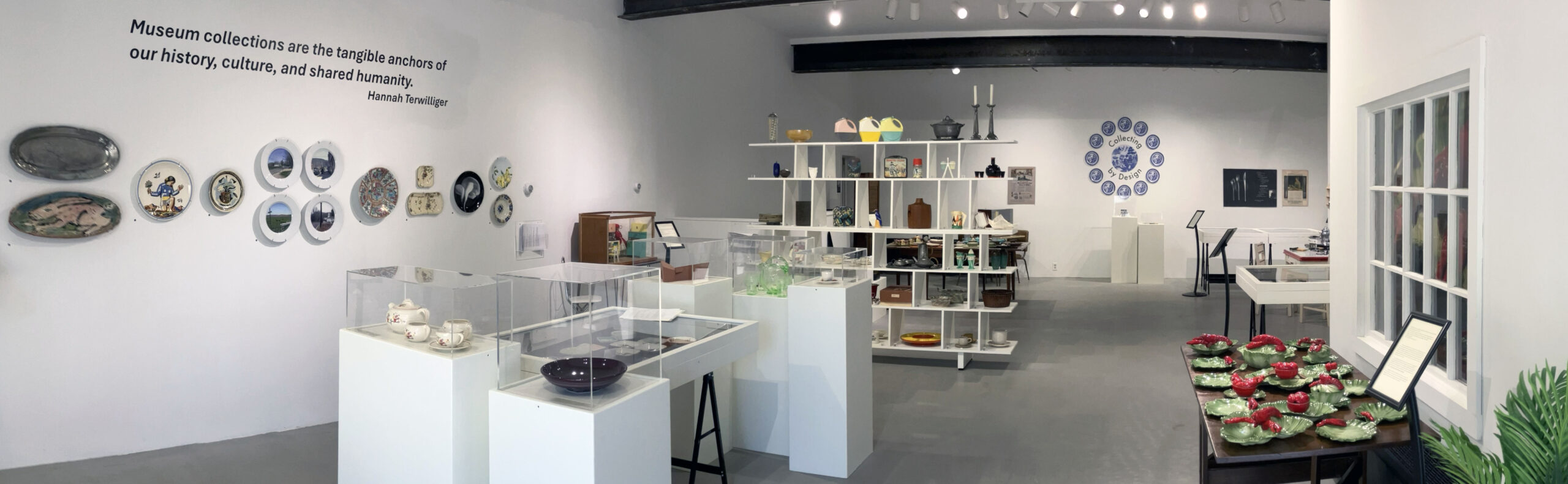
It is often said that “museums are known for their collections and their buildings.” The International Museum of Dinnerware Design does not yet own its own dedicated facility, therefore a great emphasis has been placed on the development of the collection since the museum was established in 2012. Collections are what makes a museum unique. IMoDD relocated to the Hudson Valley two years ago in May 2024, and opened to the public on November 2, 2024. This special exhibition, celebrates the objects and donors that have enhanced our collection during this honeymoon period in Kingston.
The International Museum of Dinnerware Design is celebrating its second year in Kingston with a special exhibition of a selection of dinnerware and dining-related objects that have been acquired by the museum, either through purchase, donation, or bequest, since relocating to the Hudson Valley in 2024. Collecting by Design includes thoughtful and beautifully designed dinnerware, one of a kind artwork created by contemporary artists, and work that is best described as quirky and fun. Inspired by Brad Keeler’s 1950-51 Lobster ware, dishes flaunting glossy red ceramic lobsters posed on a bed of cabbage, the opening reception July 9th from 4:30 to 7:30 invited visitors to purchase refreshments from the Cousins Maine Lobster truck parked in front of the museum at 524 Broadway.
The exhibition includes an eclectic mixture of dinnerware, flatware, glassware, paper napkins and even a vintage Barbie kitchen. Among the pieces not to miss is a slice of cake hand-embroidered with the famous Chinese Blue Willow pattern to match the plate beneath the cake. Constantin Boym’s Upstate Plates may remind one of familiar nearby scenes and cause the viewer to look again. Selected designs from the extraordinary Jerryll Habegger flatware collection are displayed for the first time as is a paper napkin collection saved from parties and holidays in the early 1900s. Most of the napkins are complete with handwritten notes with the date and the party where the napkins were used. One can almost guess the menu based on the stains that remain along with stories shared.
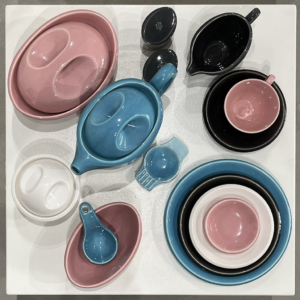
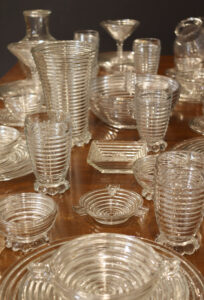
When work is catalogued in a museum, some groupings are catalogued as a unit, as in a selection/group/place setting by a noted designer such as Brad Keeler. There might be 20-100 pieces in the group and it could be counted as one grouping or the 35 separate items that it is. That makes it ambiguous to talk about the “number” of new items acquired by the museum in a given time period, especially relating to dish sets, flatware, and such. The number of donors is more easily computed. Only a selection of donors and works donated are included in this exhibition. Some donated or purchased art work was included in the recent Ashtray exhibition (and therefore not included in this exhibition), such as the magnificent and complete collection of Epicure dinnerware designed by Don Schreckengost and donated by Matthew Whalen and Frederick Sanders, and the many dozens of pieces of Anchor Hocking Manhattan glassware donated by Harriet Flehinger. Similarly teapots are the focus of an upcoming exhibition, so few were selected for this exhibitiion featuring recent acquisitions.
This exhibition was generously sponsored by Harris Safier
Flatware from the Jerryll Habegger Collection
Scholar and collector Jerryll Habegger was a friend of the museum for many years before he generously donated his flatware collection, books, and research materials to IMoDD in the summer of 2025. Imagine over 9,000 pieces of flatware arriving at your doorstep in nearly 100 boxes! This exhibition is our first opportunity to begin unpacking these treasured utensils and begin sharing them with visitors. The focus on the collection is good design, and the objects tell the history of international flatware from ancient Rome, 40 BCE, well into the early 21st century. The knives, forks, spoons, and related dining utensils included in this exhibition were selected by the donor and the descriptions are largely his own. The collection highlights were photographed by Joseph Osman and Jerryll Habegger.
Jerryll Habegger is a 1968 graduate of the Cranbrook Academy of Art and taught at the Harrington College of Design for 37 years. In 1976 he received an NEA grant to study the photography of American Architecture. He received a Master of Arts degree from the California State University Domiguez Hills in 2002. He authored the Sourcebook of Modern Furniture 1st-3rd editions, 1989, 1997, and 2005. His flatware collection has been a focus for 50 years, and he has authored a book on the topic and is in search of a publisher.
Thirteen groupings of flatware were selected by Jerryll Habegger for this initial forage into the collection. The earliest is a German set designed in 1898-1899, Tulipan/Tulip, an Art Nouveau design considered the most iconic pattern by Heinrich Vogeler (1872-1942). A silversmith from Bremen, he was the prominent designer of flatware for Wilkens & Söhne at the turn of the century. The selection of 13 designers chosen for Collecting by Design include designers at manufacturers of flatware from Germany, France, Finland, Denmark, Norway, Sweden, Japan, and the United States. The designers include Jean Puiforcat, Daniel Eltner, Patrick Jouin, Sōri Yanagi, Michael Schneider, Ronald Hayes Pearson, Friedrich Adler, Arne Korsmo, Pierre Forssell, Heinrich Vogeler, Akseli Gallen-Kallela, and Georg Jensen. This is literally the tip of the proverbial fork tine. Stay tuned (tuning fork pun intended) for more.
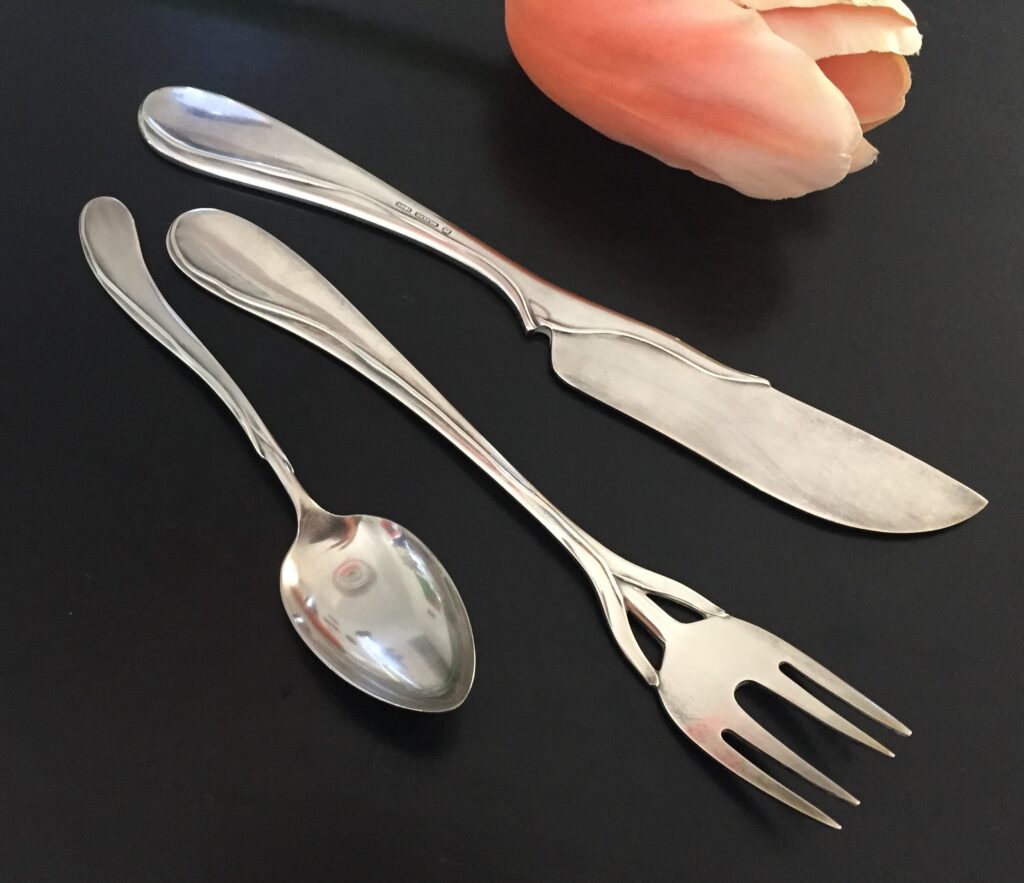
1899 | Tulipan
Heinrich Vogeler, designer (German, 1872-1942)
Tulipan/Tulip, designed 1898-1899
Commissioned by Alfred Walter Heymel
sterling silver
IMoDD 2025.145 Gift of Jerryll Habegger
Photo credit: Joseph Osman and Jerryll Habegger
The earliest is a German set designed in 1898-1899, Tulipan/Tulip, considered the designer’s most iconic pattern in Art Nouveau design, created by Heinrich Vogeler (1872-1942), a silversmith from Bremen. He was the prominent designer of flatware for Wilkens & Söhne at the turn of the century. The Tulipan pattern was commissioned by Alfred Walter Heymel of Munich. Tulip leaves were sensually wrapped around the handle, integrating the shoulder into the layered form. Fluid linear details unified the knife, fork and spoon. Each function had an innate elemental significance, each relating to a coherent organic growth. The sterling silver was manufactured by Wilkens & Söhne.
1900 | Suomi
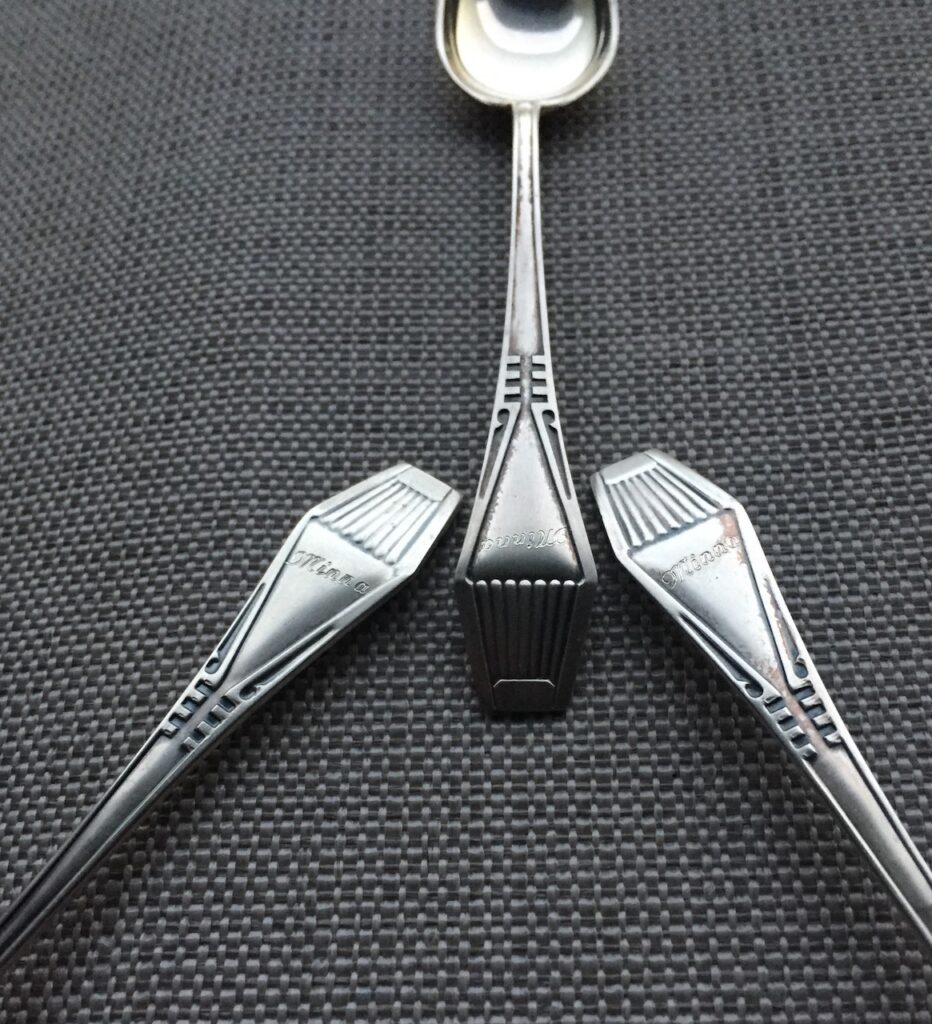
Akseli Gallen-Kallela, designer (Finland 1865-1931)
SUOMI, designed 1900
sterling silver, stainless steel, or steel
IMoDD 2025.145 Gift of Jerryll Habegger
Photo credit: Joseph Osman and Jerryll Habegger
Akseli Gallen Kallela’s SUOMI flatware from 1900 represented the beginning of progressive geometric structure suggestive of constructive principles. The ornament of the handle defined a rhythmic modularity which became standard in 20th century design. The stem spread wide with implied square grid. The canted terminal integrated a distinct spread wing-like pattern. Gallen Kallela painted this symbolic detail in the interior of the Finnish Pavillion at the 1900 World’s Fair in Paris.
1913 | Lily of the Valley
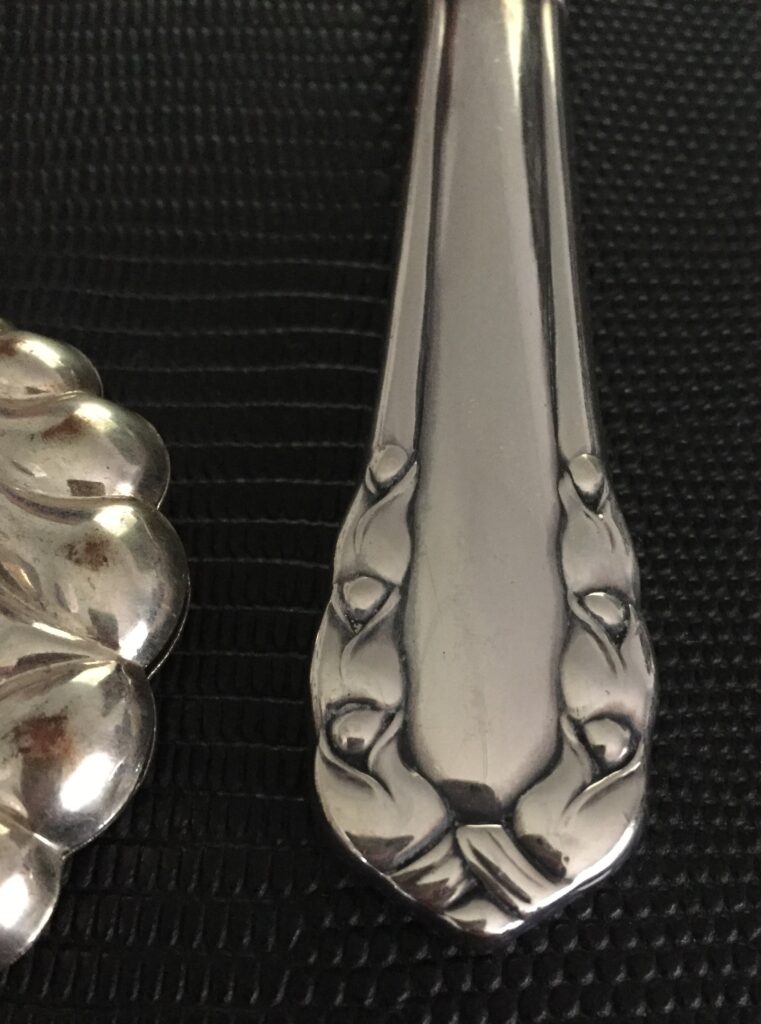
Georg Jensen, designer (Danish, 1866-1935)
Lily of the Valley, designed 1913
sterling silver
IMoDD 2025.145 Gift of Jerryll Habegger
Photo credit: Joseph Osman and Jerryll Habegger
Lily of the Valley from 1913 epitomizes the recognizable and dimensionally rich presence of Georg Jensen’s flatware. Its visual weight was firmly tied to broad proportions. Its appeal was based on an ordered balance between a coherent formal structure and a sensual spontaneity. The material surface and ornament were in a balanced relationship to the form. Recognizable elements were combined with regional craft traditions.
1924 | Biarritz/Chantco
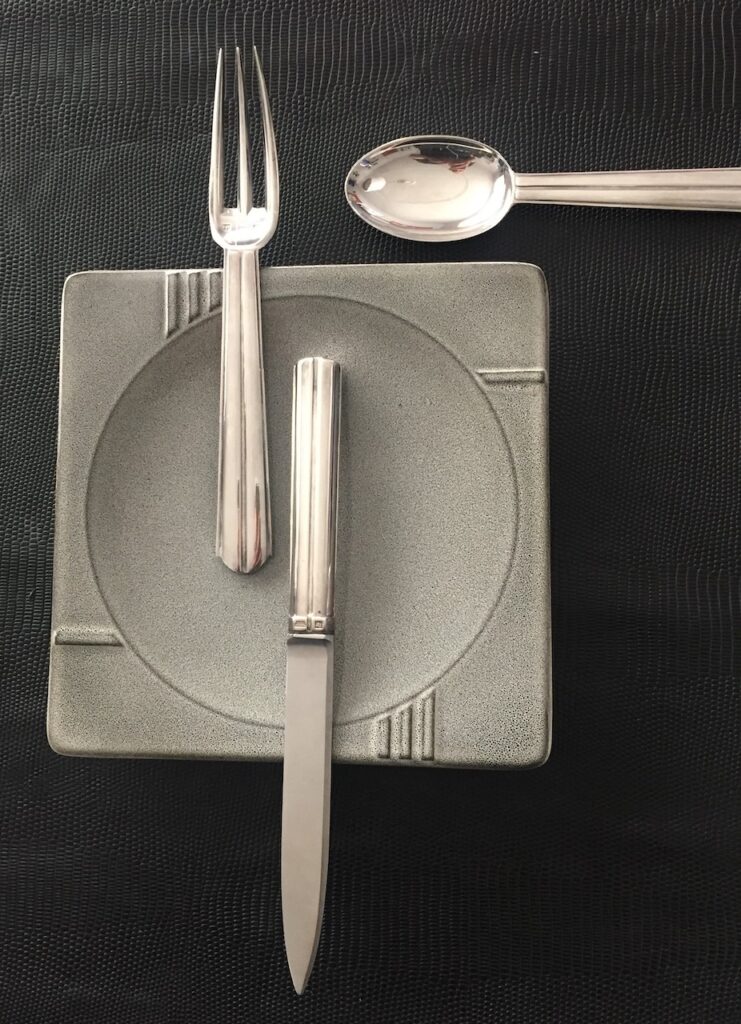
Jean Elysée Puiforcat, designer (French, 1897-1945)
Biarritz, designed 1924
sterling silver
IMoDD 2025.145 Gift of Jerryll Habegger
Photo credit: Joseph Osman and Jerryll Habegger
For 15 years Jean Emile Puiforcat designed silver flatware. The patterns were precise geometric compositions with exact proportional relationships between elements. The 1924 Biarritz set in place the characteristics for Puiforcat’s designs through the 1920s. The length of the knife handle equaled the blade length. The knife handle was straight and symmetrical. The three long fork tines curved inward with squared openings between the tines. The handle flared at the terminal. The spoon bowl was a symmetrical oval – not an egg shape. The handle flared at the terminal reinforcing the pattern’s centralized material mass.
1934 | Series II Salad Servers
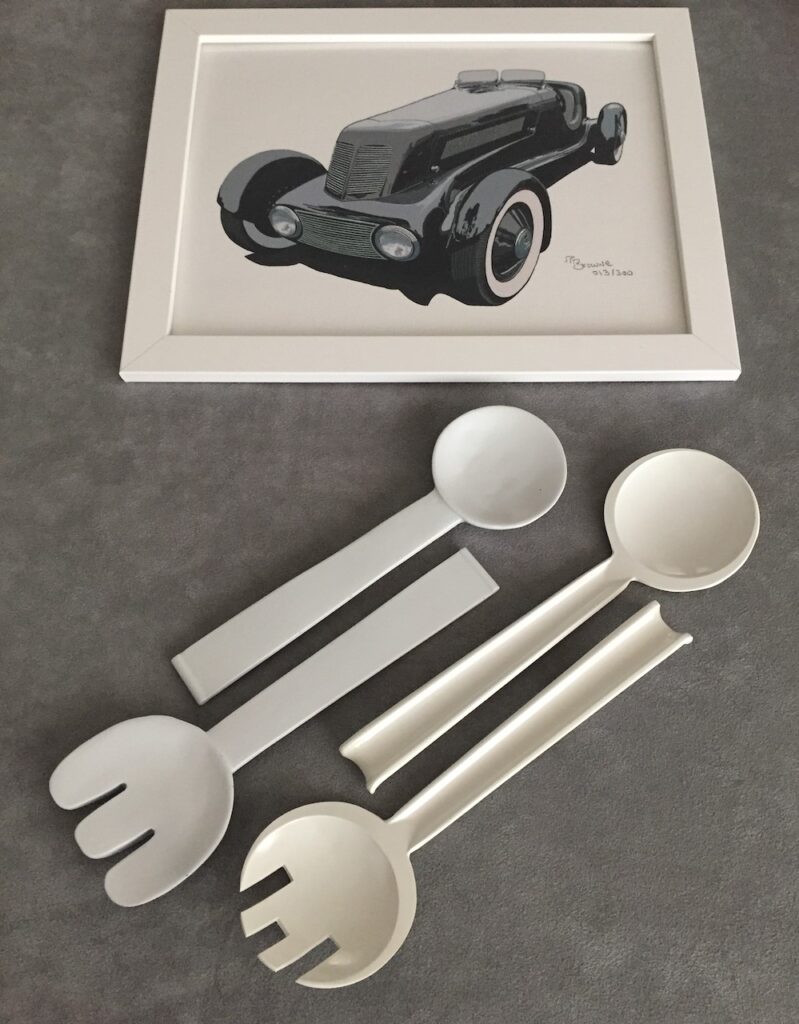
Friedrich Adler, designer (German, 1878-1942)
salad servers, designed 1934
synthetic polymer
IMoDD 2025.145 Gift of Jerryll Habegger
Photo credit: Joseph Osman and Jerryll Habegger
Friedrich Adler, the German designer of silverware and holloware, was renowned for his pewter ware for the manufacturers Orion, Walter Sherf (Osiris), Urania of Maastricht, Netherlands, Berndorf, Art Krupp, Wilkens, and Bruckman. From 1932-1934 Adler realized the production of one-piece utensils made of a synthetic polymer. He designed two sets of salad servers. The first set was of limited production but had a very powerful profile. The second set established a technical approach of compression-molded synthetic-based utensils. The material was wide in section and concave to gain strength. The termination of the handle also turned downward to elevate the handle off the table surface. The original production materials for the salad servers was Pollopas/Ultrapas (urea formaldehyde) thermoset polymer with good chemical scratch and stain resistance. Acidic vinegar and salad dressing stained silver not washed immediately after use. Synthetic polymers overcame this problem. The same concave structure was applied to stainless steel flatware after World War II. The forms reflected technical advances and differentiated themselves in the competitive marketplace.
1947 | Korsmoplett
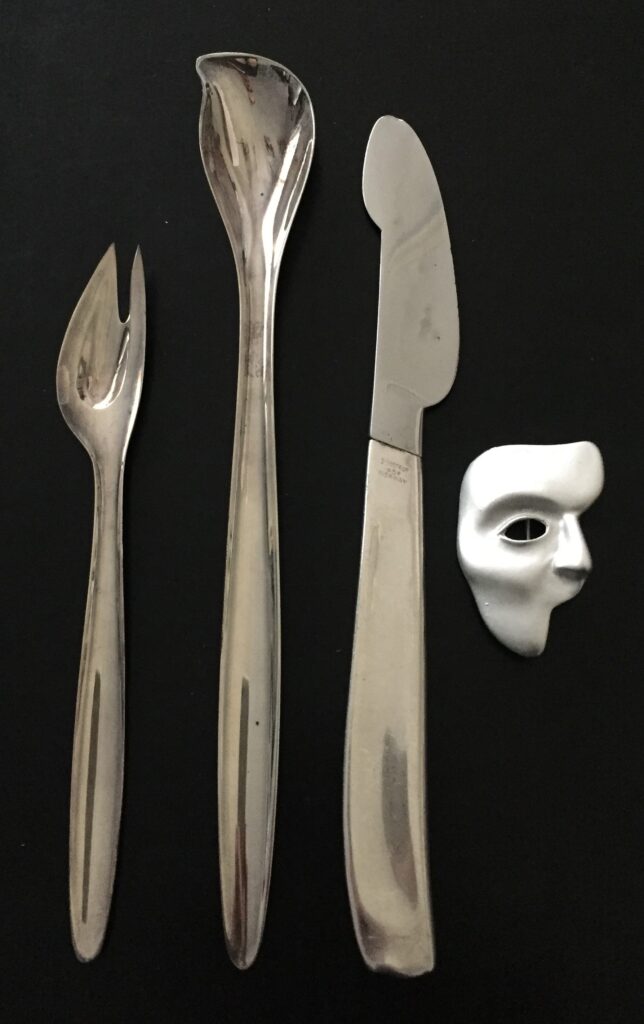
Arne Korsmo, designer (Norway, 1900-1929)
Korsmoplett, designed 1947
silver plated metal
IMoDD 2025.145 Gift of Jerryll Habegger
Photo credit: Joseph Osman and Jerryll Habegger
In the post war period, a logical use of material and manufacturing process evolved as a form of expression. With the exception of the KORSMOPLETTE knife, the flatware pieces of this pattern were pressed from sheet metal of the same thickness and bowed in section to gain strength. Curvatures in the materials were necessary to provide resistance against deformation. This solution also enabled the stacking of flatware for storage. The natural flow of the individual pieces provided decisive gestures in a variety of ways. The form of the knife made a gradual transition from its gentle handle to the blade as the material decreased in thickness. The blade curved slowly, providing a good cutting edge. The small reverse curve could be used for cutting or spreading. The asymmetrical cold meat fork placed emphasis on its one exaggerated tine. And the biomorphic cocktail spoon had seamless curves with a spout at one end. The unified design won a gold medal at the Milan Triennale in 1954.
1955 | Piruett
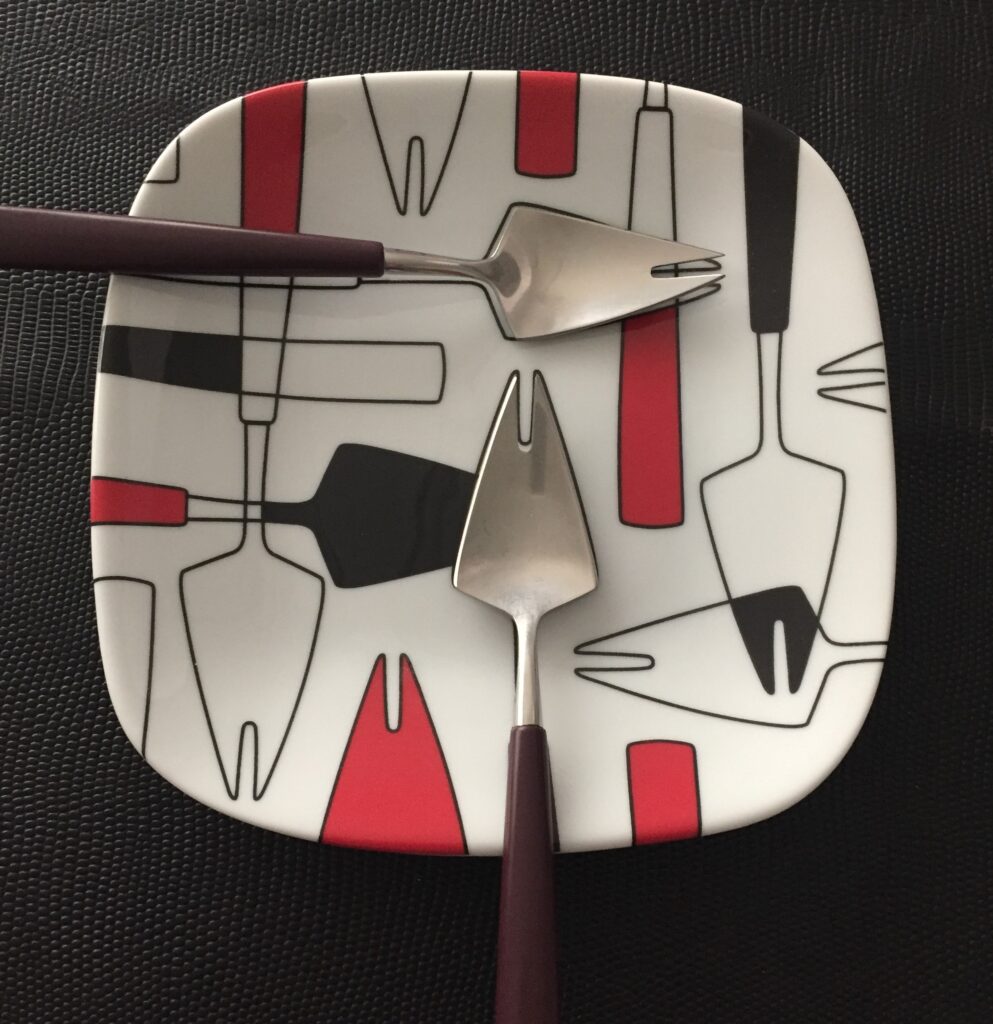
Pierre Forssell, designer (Sweden, 1925-2004)
Piruett, designed 1955
stainless steel & plastic handles
IMoDD 2025.145 Gift of Jerryll Habegger
Photo credit: Joseph Osman and Jerryll Habegger
Attempts have been made to integrate all three flatware functions into one utensil. A fine example of this was the Piruett Spoforken. Designed in 1955 by Pierre Forssell for Gense. The tines or prongs of the fork were an integral part of the spoon bowl, which was sharpened on the edge for cutting. It was utilized if more than one utensil complicated matters such as open buffet use. Typically, this abundant food service was set with hot and cold dishes from appetizers to desserts. All food was presented on a table for diner selection using a fork, spoon, tong, cheese plane, and cake server. The PIRUETT SPOFORKN accommodated the majority of the diner’s needs.
1960 | Vision
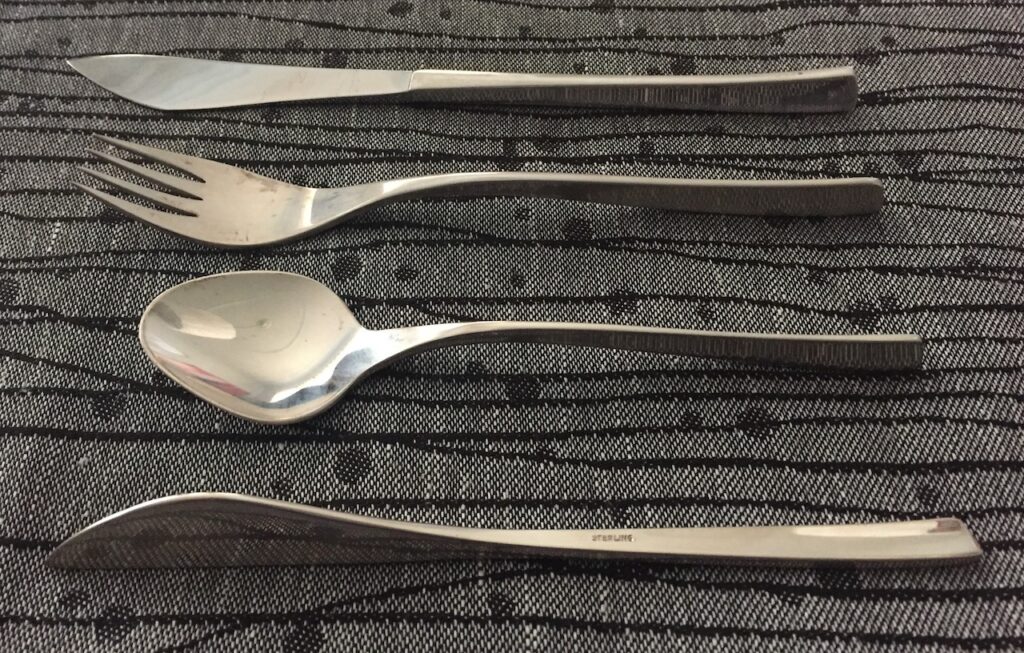
Ronald Hayes Pearson, designer (American, 1924-1996)
Vision, designed 1960
sterling silver
IMoDD 2025.145 Gift of Jerryll Habegger
Photo credit: Joseph Osman and Jerryll Habegger
“Designed for Silver” was a competition in 1959 sponsored by the International Silver Company of Meridan, Connecticut, commemorating their 60th anniversary. The competition’s jury, which included the industrial designer Walter Dorwin Teague and the architect Eduard Durelle Stone, selected 22 finalists from America, Europe, and the Middle East for mock-ups in sterling silver. Jury awards were given to Alnar Axelsson, Berman Manahem, Sven Arne Gillgreen, David Gumbel, and Tapio Wirkkala. All sterling silver mockups were documented in the 1960 “Designed for Silver” Catalogue. The jury had recognized sculptural potential of sterling silver, and the importance of form, clarity found in basic structure.
The only pattern that went into production was VISION by Ronald Hayes Pearson. Its graceful flared profiles were the result of the genuine weight and strength of solid silver and consummate craftsmanship. The knife could lay with the blade flat on the tabletop or the blade could sit perpendicular to the table surface. The pattern had a continuity of tapered details, with emphasis on the top edge. The simple forms had a strong sensual content.
The flatware creations of Ronald Pearson (1960-1976) were a summation of post-World War II American Silver: THICK AND THIN by John Prip – LARK 1949, soft fluid structure by John van Koert – CONTOUR 1949, and flared profile – DIMENSION 1959.
1970 | Romance
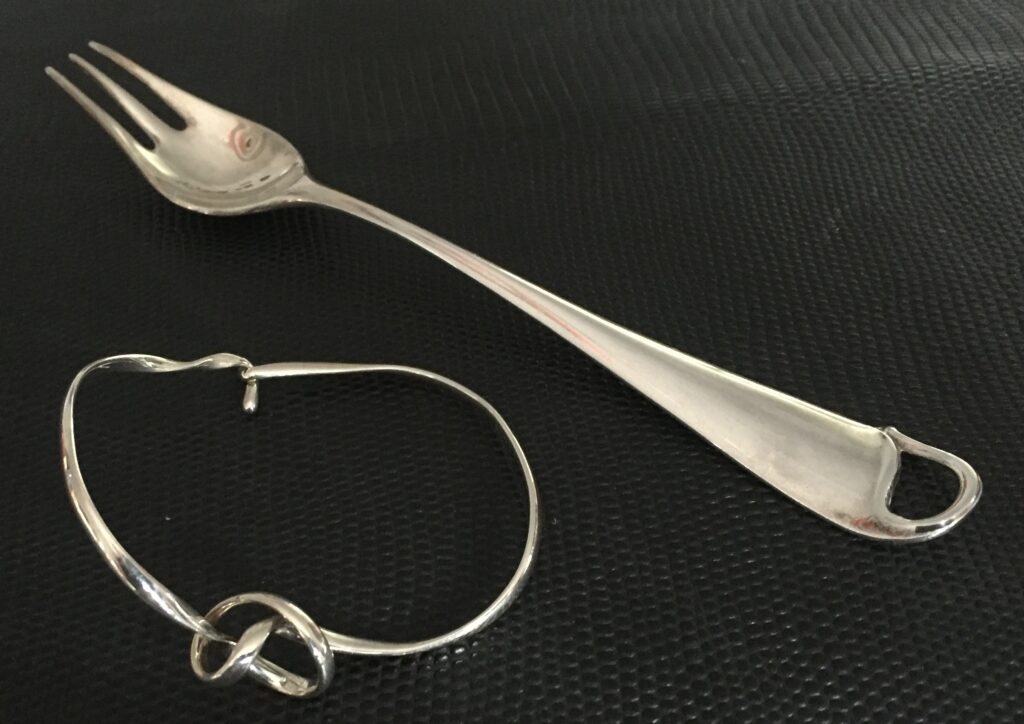
Vivianna Torun Bulow-Hübe, designer (Sweden, 1927-2004)
Romance, designed 1970
stainless steel
IMoDD 2025.145 Gift of Jerryll Habegger
Photo credit: Joseph Osman and Jerryll Habegger
The ROMANCE pattern designed in 1970 clearly expressed Swedish Vivianna Torun Bulow-Hübe’s enduring philosophy: Shaping material, the basis of a feeling for form. (Conversation with Viviana on May 20, 1998, George Jenson Store, Chicago). Consistent in her jewelry and flatware designs was a balanced fluidity. She brought to life maximum expression from stainless steel, a rigid material. This pattern’s value was measured by the approach to perfection of form. The manufacturer also produced silverplate.
1982 | Yanagi
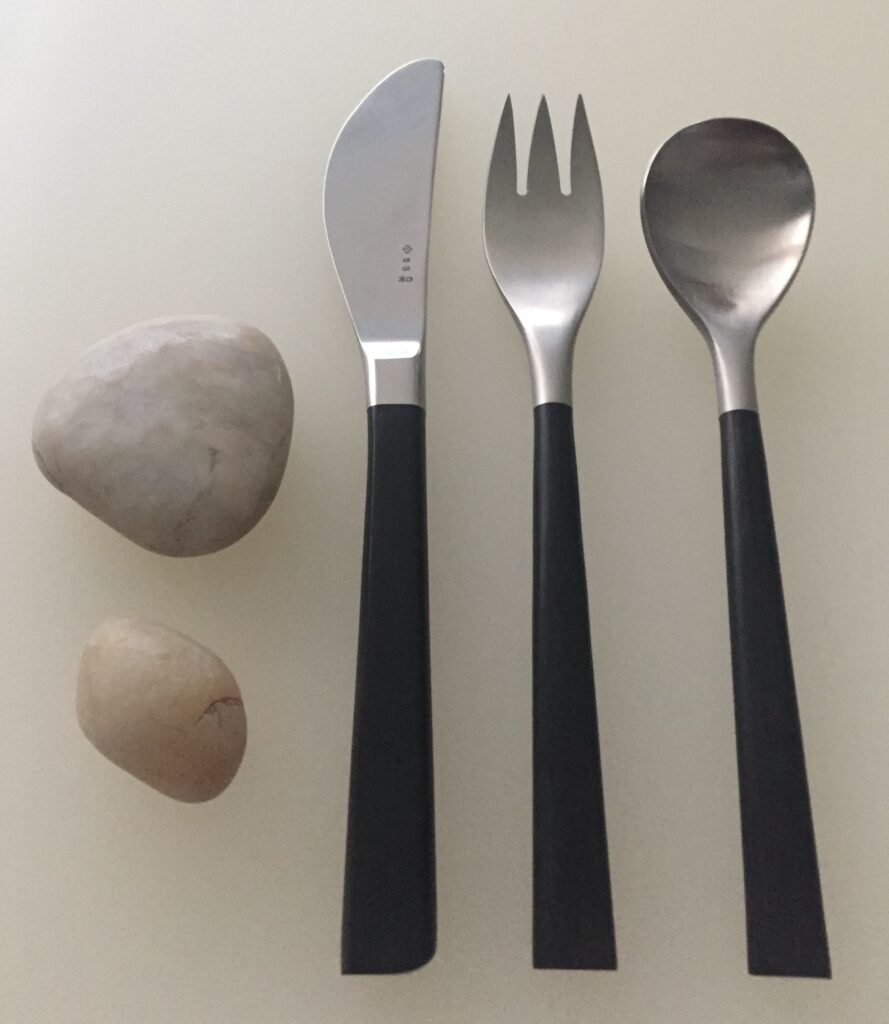
Sōri Yanagi, designer (Japanese, 1915-2011)
Commissioned by Sato Shoji Corporation, Ltd.
Model 2250, Black Pattern Series Cutlery, designed 1982
stainless steel, handle impregnated hippo wood
IMoDD 2025.145 Gift of Jerryll Habegger
Photo credit: Joseph Osman and Jerryll Habegger
YANAGI 1982 The handles of Sori Yanagi’s utensils were an advanced composite made up of a modified epoxy resin (7 parts) infused with Betula Wood (3 parts) using a high pressure oven. This combination of natural material and synthetic produced additional strength from the coherence between the gentle wood handles and fluid growth of the stainless steel shapes. Harmony among the materials’ natural textures, structural clarity, and an organic sensuality defined the form.
1991 | Zueg
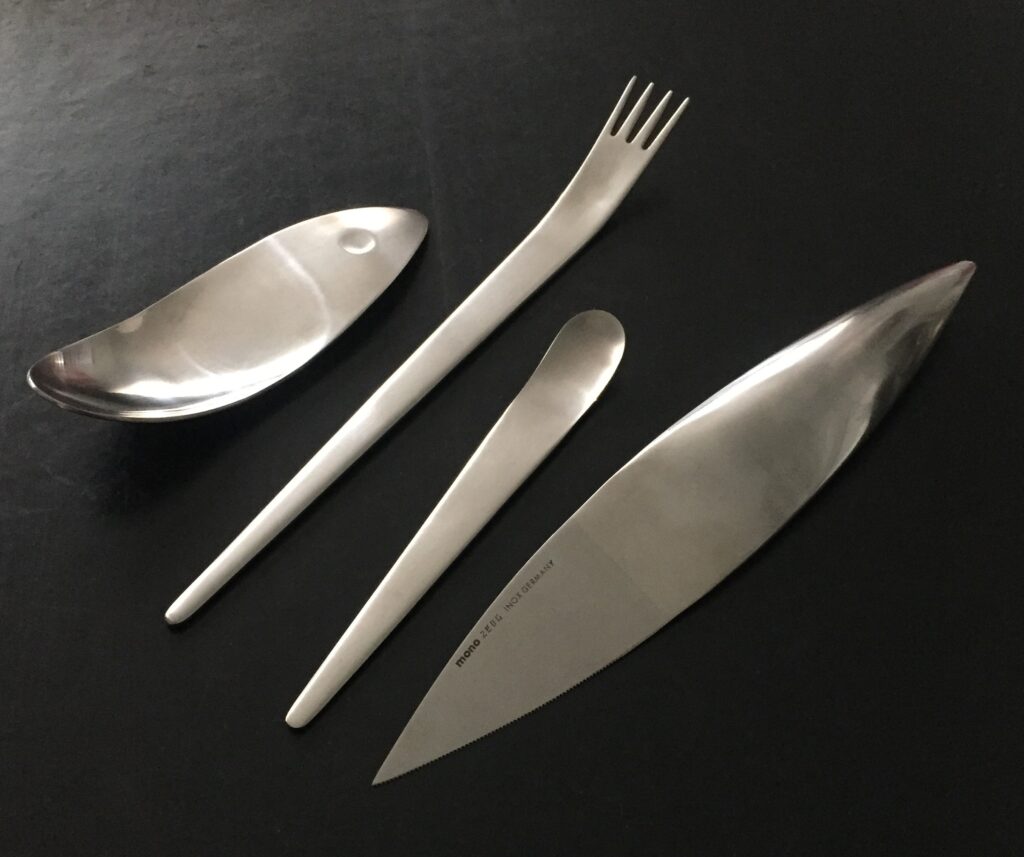
Michael Schneider, designer (German, b.1962)
Mono Zeug, designed 1991
matte-brushed stainless steel
IMoDD 2025.145 Gift of Jerryll Habegger
Photo credit: Joseph Osman and Jerryll Habegger
1991 Zeug. In the fall of 1991, The Deutsches Klingenmuseum of Solingen and 15 German flatware manufacturers held a competition for eating utensils that were to be practical and have the capability of being produced by a manufacturer. Out of the ten finalists, the Michael Schneider design ZEUG was realized into production by Mono of Mettmann, Germany. The spare simplicity of the pieces returned to the basic primitive functions of stone flints, bone skewers, and cupped hands, as a beginning of sensible forms which respond comfortably in the hand. The collecting of food for eating was accomplished with a seashell-shaped spoon bowl which had an extension to be used as a full surface for grasping. The form with four tynes was elongated for easy skewering of food. The knife has full handle volume, and this thickening established a pronounced plasticity. This contributed to a restructuring of design language, with light becoming the determinate of heightened form.
2004 | WMF Style
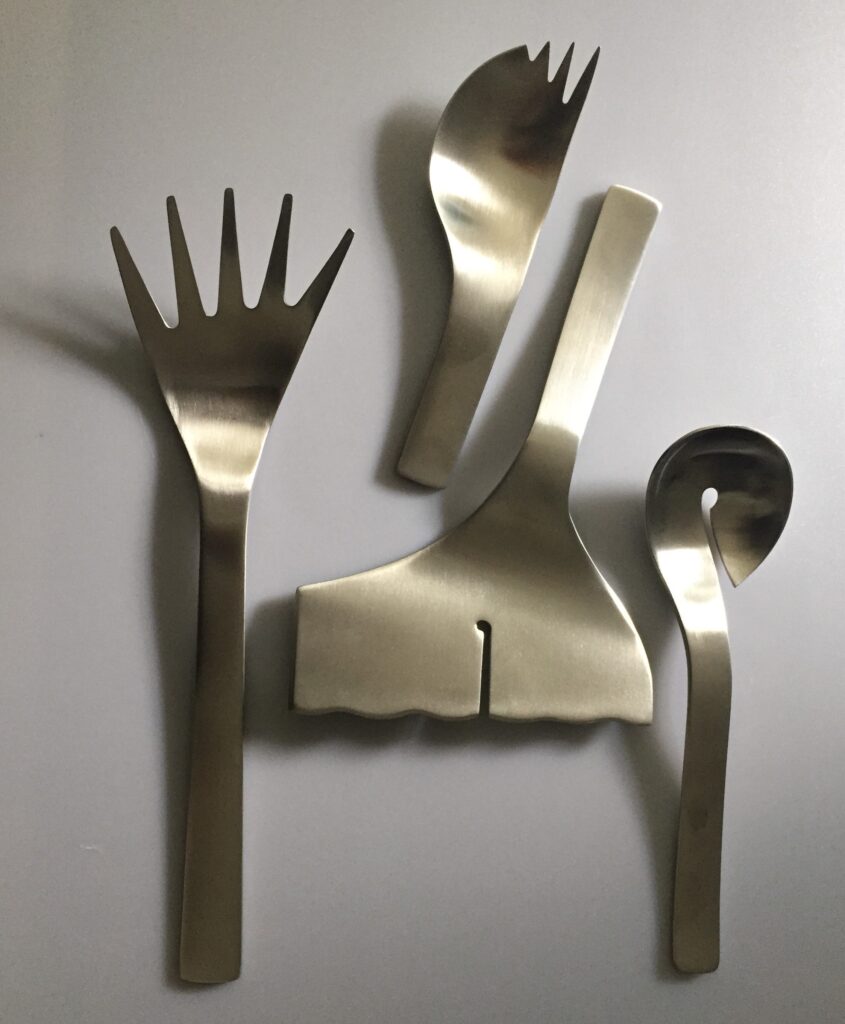
Daniel Eltner, designer (German, b. 1978)
WMF Style, pasta, fish soup, and asparagus servers with olive spoon
Designed 2004
patented Cromargan Protect Ò stainless steel alloy
IMoDD 2025.145 Gift of Jerryll Habegger
Photo credit: Joseph Osman and Jerryll Habegger
2024 WMF Style. The creative concept of these serving pieces initiated a new phase of development for specific food types: Pasta salad, sushi, fish soup and dumplings. Broad specialty functions had not been addressed for over 100 years. Bold, self-sufficient forms were the result of this effort by Daniel Eltner. His modeling of stainless steel embodied a rhythm of natural pulses, which projected art into life. The designs were inspired by the observation of dining cultures and aesthetic expressions. This resulted in a display of strong profiles, which stimulated the users’ sensual experience.
2010 | Zermatt
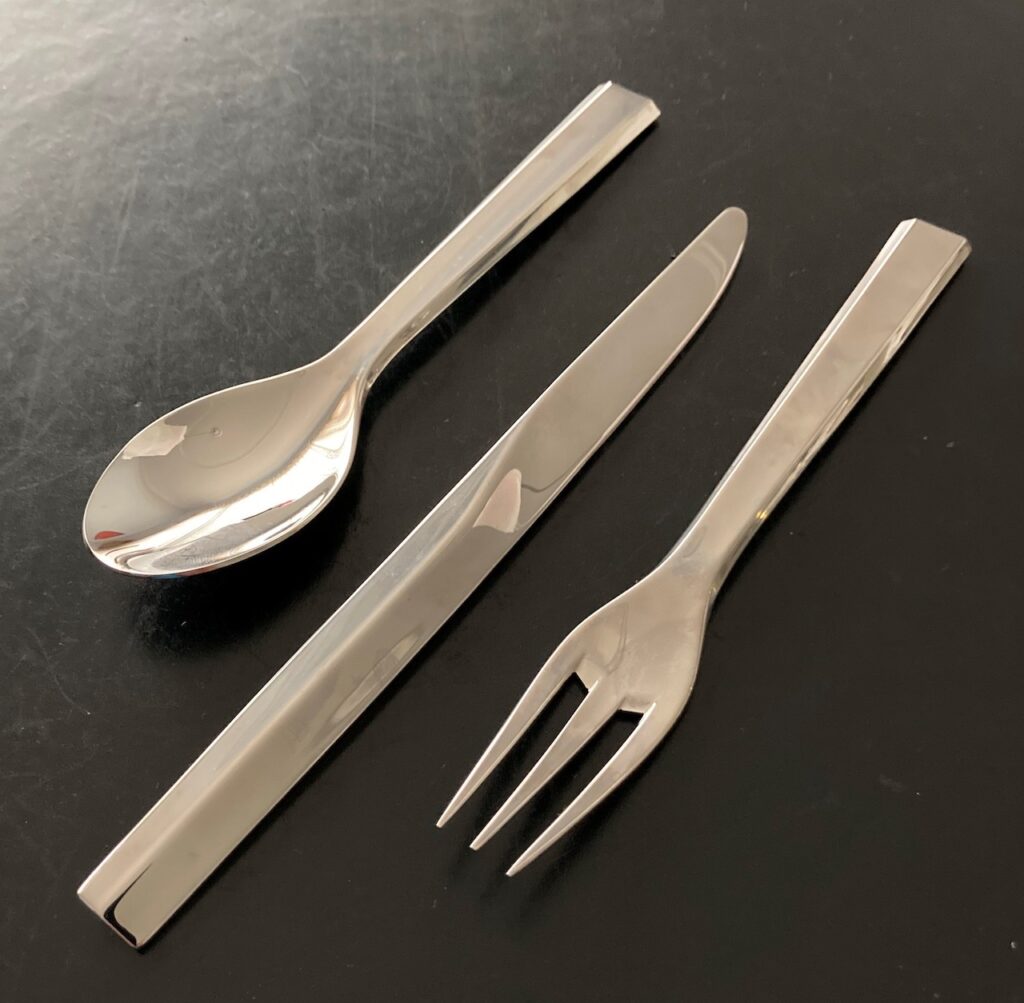
Patrick Jouin, designer (French, b. 1967)
Zermatt, designed 2010
stainless steel
IMoDD 2025.145 Gift of Jerryll Habegger
Photo credit: Joseph Osman and Jerryll Habegger
The framework of Patrick Jouin’s ZERMATT pattern for Puiforcat evolved with an inherent order. In section the utensils were a wide, symmetrical pentagon. The flat side was to lay on the table surface. the knife handle effortlessly extended to the blade. The rib of the fork crested at the center prong. The fluid spine of the spoon resulted in modulated and severe form. As in music intervals, alternating sequences reoccurred in relationships to a visual rhythm.
Paper Napkins
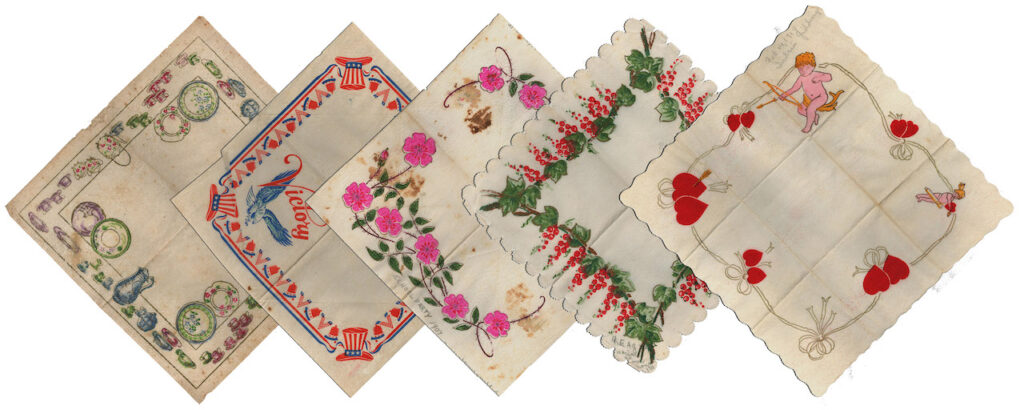
A single donated or purchased artwork can tell a story. Just think of the stories connected to the donation of a collection of 93 vintage early 20th century paper napkins, many of which have handwritten notes telling the dates, the year of the party and where the napkins was originally used. Sometimes there are food stains surrounding the name of the person whose party it was. A selection of this collection is included in the exhibition that was generously donated by Roxanne Cross in Memory of her mother Winifred Louise Cross. Her gift included photographs of the family members, including Maude L. Leonard and Maude Streeter (Beadle), the grandmother and great grandmother of the donor, who collected the napkins and saved them in a cardboard box for literally more than 100 years. A family history is recorded in these fragile exquisite dining objects. The collection was donated in 2026 and is still undergoing cataloguing and preservation care.
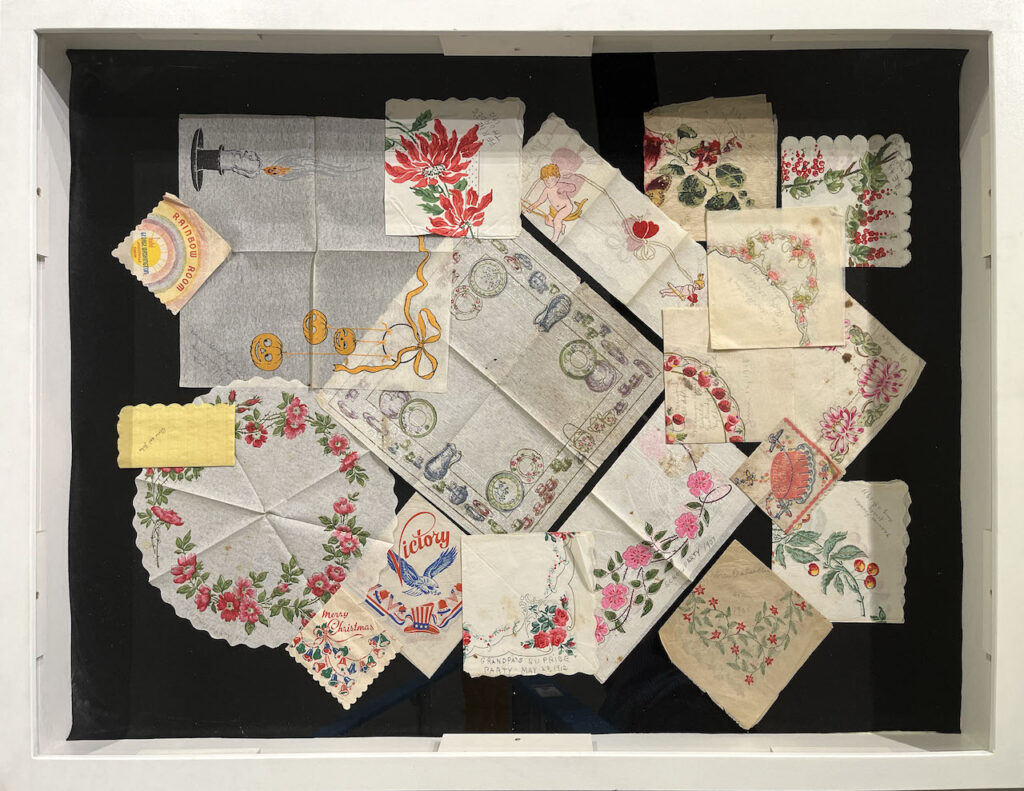
collected by Maude L. Leonard and Maude Streeter (Beadle)
marked in pencil with the name and date of the party where they were used
IMoDD 2026.51 Gift of Rosanne Cross in memory of Winifred Louise Cross
While paper napkins have apparently been around since the 2nd century B.C. in China, their popularity today can largely be credited to the American etiquette authority Emily Post in 1948 when she publicly endorsed paper napkins. She proclaimed it was “far better form to use paper napkins than linen napkins that were used at breakfast.” When asked by a major New York department store whether it was better to reuse a lightly used cloth napkin or opt for a paper one, she decisively chose paper. She firmly stated that “freshness is of the first importance.” Before her endorsement, paper napkins were widely viewed as a faux pas in polite, formal society. Paper napkins were considered more hygienic, which made them acceptable to use even when entertaining.
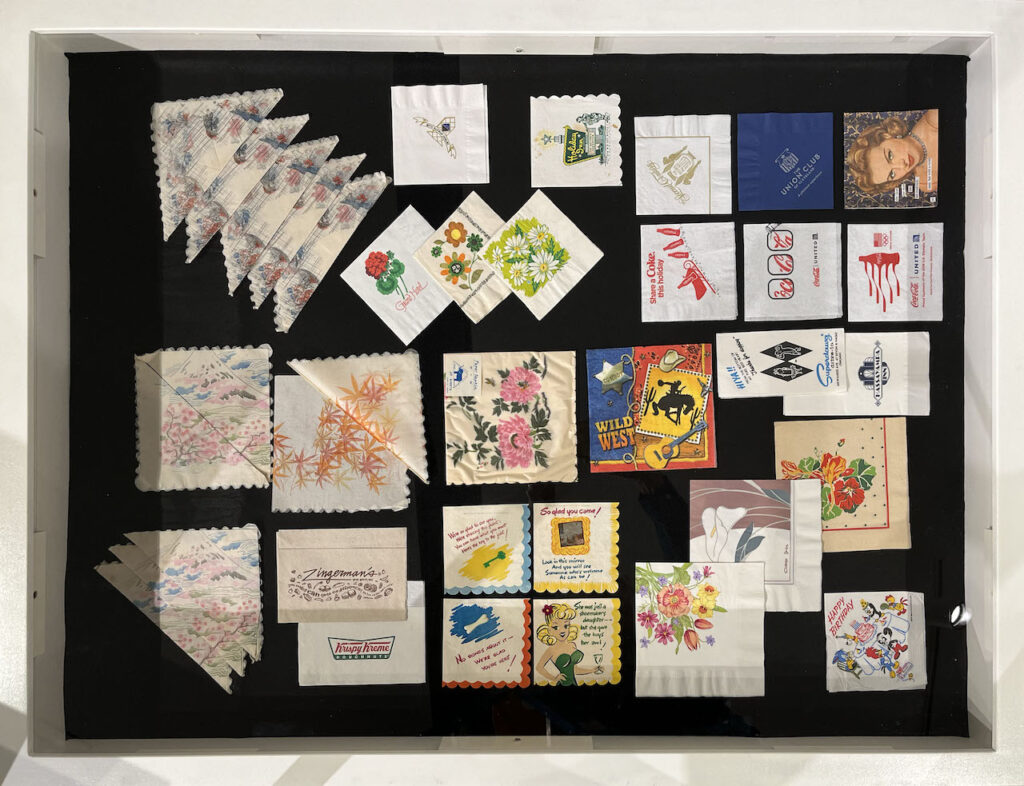
primarily 20th century
IMoDD 2024.42 Gift of Jane C. Busch
Why I Collected Disposable Dinnerware
June 26. 2026
Many years ago, I wrote my doctoral dissertation on the throwaway ethic in America. The dissertation included a chapter on disposable paper products, examining how paper developed from a relatively scarce, valuable commodity in the eighteenth century to the material of billions of disposable paper products consumed in America every year. Armed with my knowledge of the history of paper napkins, plates, and cups, I began to look for them when I went to thrift shops. At antique shops, I splurged on rare items, such as a package of Adam style Dixie cups from the 1920s. There were found items, like the Serv-a dish paper plates long forgotten in a snack shop closet. One of my favorite finds was a Holiday Inn cocktail napkin that my father had saved in a bag of travel brochures from a trip my parents took in the 1960s. On the back of the napkin, my father wrote the name and address of a fellow traveler.
When I moved into an apartment two years ago, I had to downsize. It was relatively easy to give away or donate books and dishes. But vintage paper napkins, plates, and cups? I was thrilled to discover that the International Museum of Dinnerware Design would provide a home for my collection and use it to further the museum’s educational mission.
Jane C. Busch, historic preservation consultant
Chagrin Falls, Ohio
The Arthur J. Williams Collection
Sometimes the story of how collections arrive is wonderfully circuitous. A ceramics collector known to this museum’s curator became friends in the early 1990s, and later, when Arthur J. Williams, Jr. passed away in Florida, his friend and executor, Richard W. Gold, chose to generously donate a selection of relevant dining-adjacent objects from his collection to IMoDD. There are more than 100 objects in this collection, including manufactured and one-of-a-kind objects. These range from contemporary dinnerware, to Rockwood vases, to sculpture. Along with these objects came financial support, which greatly assisted IMoDD in its relocation to Kingston. It’s a small world after all, full of happy coincidences, as the collector Arthur Williams, his friend and estate executor, and many mutual friends, all resided in Kingston and/or Stone Ridge at one time. Life is indeed full circle.
Arthur J. Williams (1936 – 2021) lived a life in the arts, surrounded by exquisite art which he had lovingly and judiciously acquired during some sixty-five years of collecting. In his 20s, when he (and his mother) realized that acting did not provide a steady income, he began work in the mailroom at CBS and climbed the ladder to making cue cards for “Captain Kangaroo.” He then worked in production and editing TV advertisements. All the while, his interest in the arts was growing. Learning the ins and outs of the film editing business from his mentor, Edna Paul, he took a job with an editing company that eventually fell on hard times. He and his assistant were paid in equipment and in 1970, they opened Editing Concepts. Arthur became Chair of the Board as Editing Concepts expanded to five divisions of post-production film and video. He was a founding member of the Association of Independent Creative Editors and its former president.
His successes in the media world gave him the freedom to follow his passionate interest in the arts, especially ceramics. Arthur became a respected member of the International Academy of Ceramics. He served on the Advisory Board and was Vice-President of the Watershed Center in Newcastle, Maine. He said in a 2000 interview with Wendy Dubin (published in Ceramics: Art and Perception), “Educating oneself is the most exciting thing if not the most important aspect of collection. Without knowledge, you can’t grow…” His vast collection features superb examples of American artists’ pottery and traditional glazes as well as Pennsylvania Red Ware and Chinese Export Ware. Arthur’s vast knowledge of the ceramic arts led him to conceptualize the Museum of Ceramic Art—New York, a brilliant idea which, had it been built, would have greatly enhanced New York’s arts landscape. He leaves it to our imaginations to look with a keen eye and appreciation of the hand-made object. When he looked around his home, he said to Ms. Dubin, “I like to be surrounded by art… stuff. It is a great source of comfort. But the greater joy is seeking it out.”
Rose and Ernie Cabat
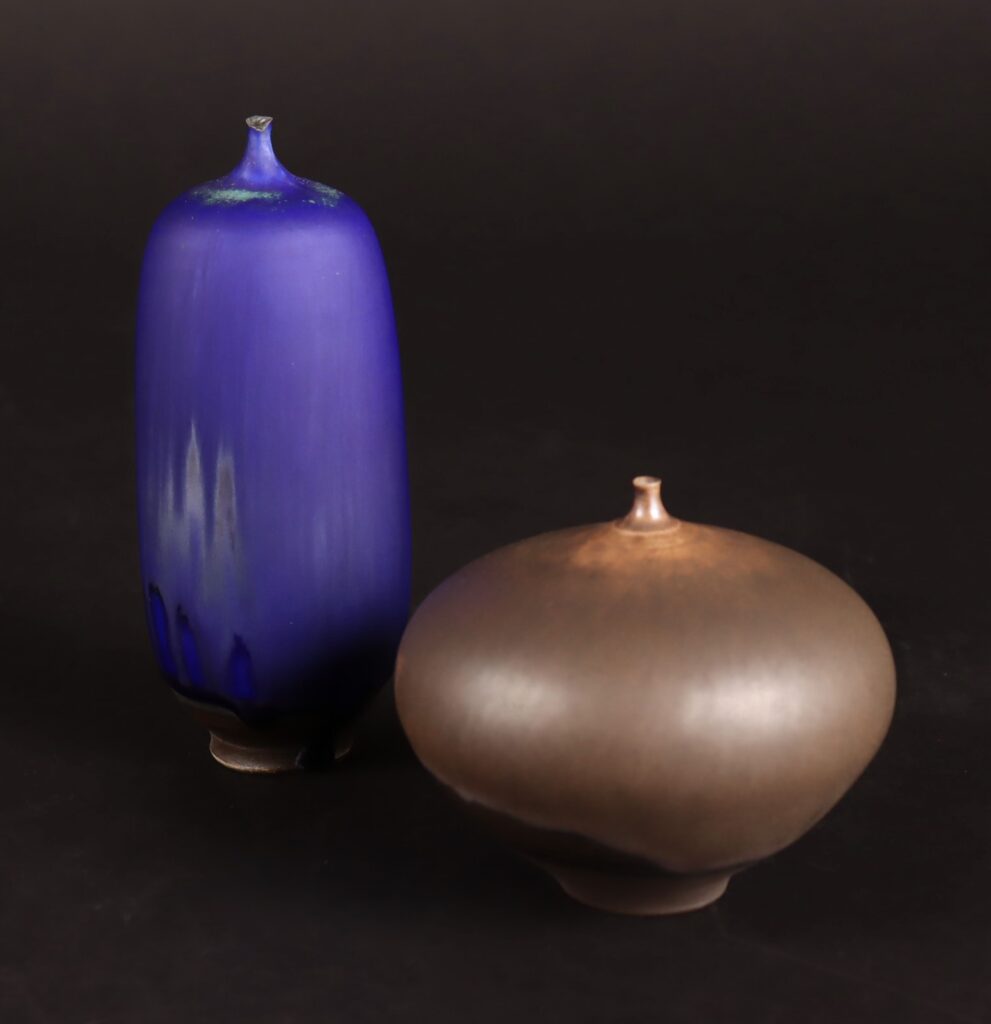
Rose (American, 1914-2015) and Ernie Cabat (American, 1914-1994)
purplish cobalt Porcelain Feelie, n.d.
brown Porcelain Feelie, n.d.
IMoDD 2024.140 and 2024.141 Gifts of Richard W. Gold from the Arthur J. Williams Collection
Toshiko Takaezu
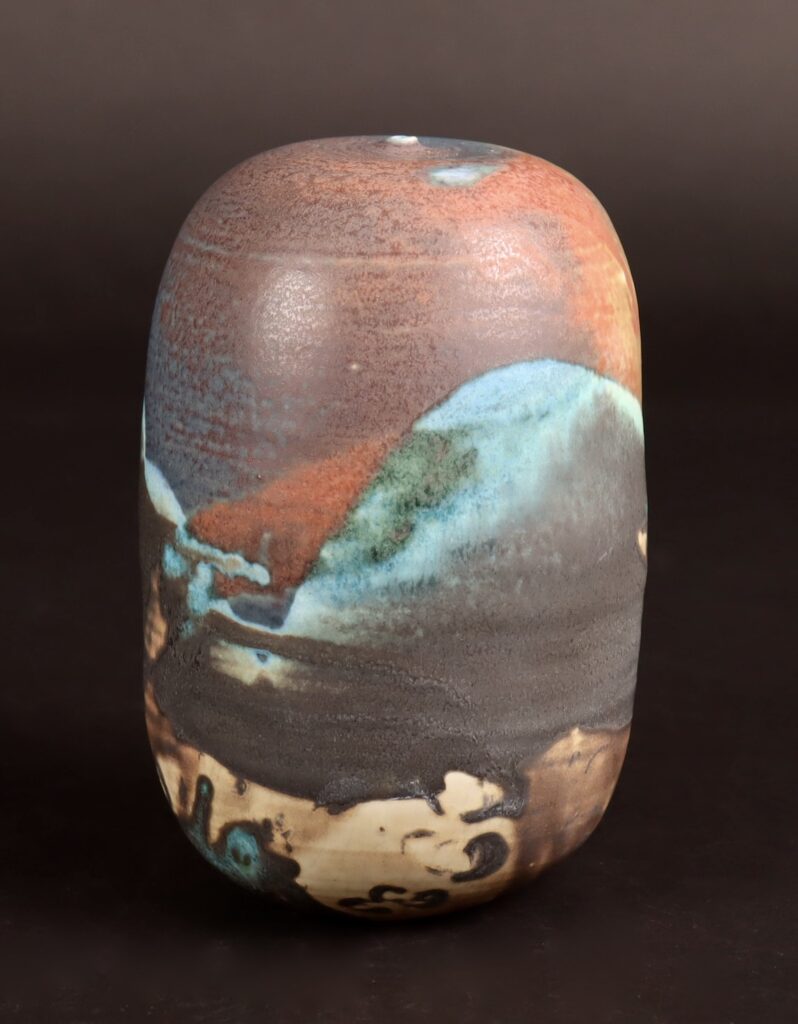
Toshiko Takaezu (American, 1922-2011)
closed form porcelain vessel, circa 1995
IMoDD 2024.65 Gift of Richard W. Gold from the Arthur J. Williams Collection
Waylande de Santis Gregory
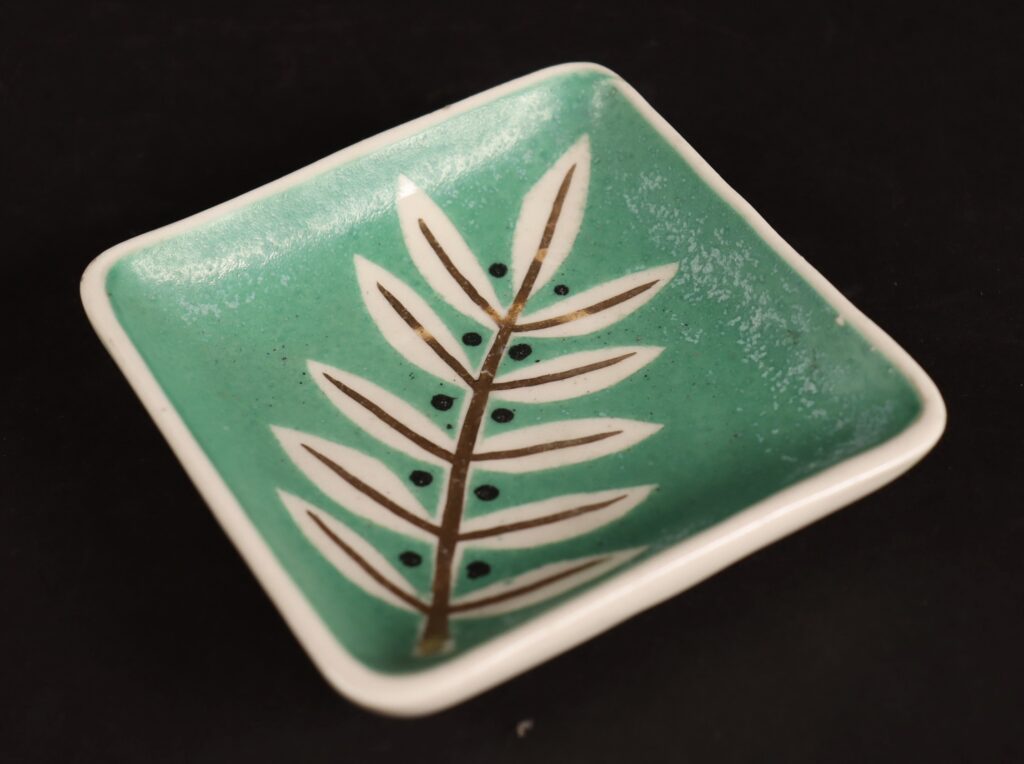
Waylande de Santis Gregory (American, 1905-1971)
small square white ceramic dish with painted decorations, n.d.
ceramic, glazed and hand-painted
IMoDD 2024.119 Gift of Richard W. Gold from the Collection of Arthur J. Williams
Irv Tepper
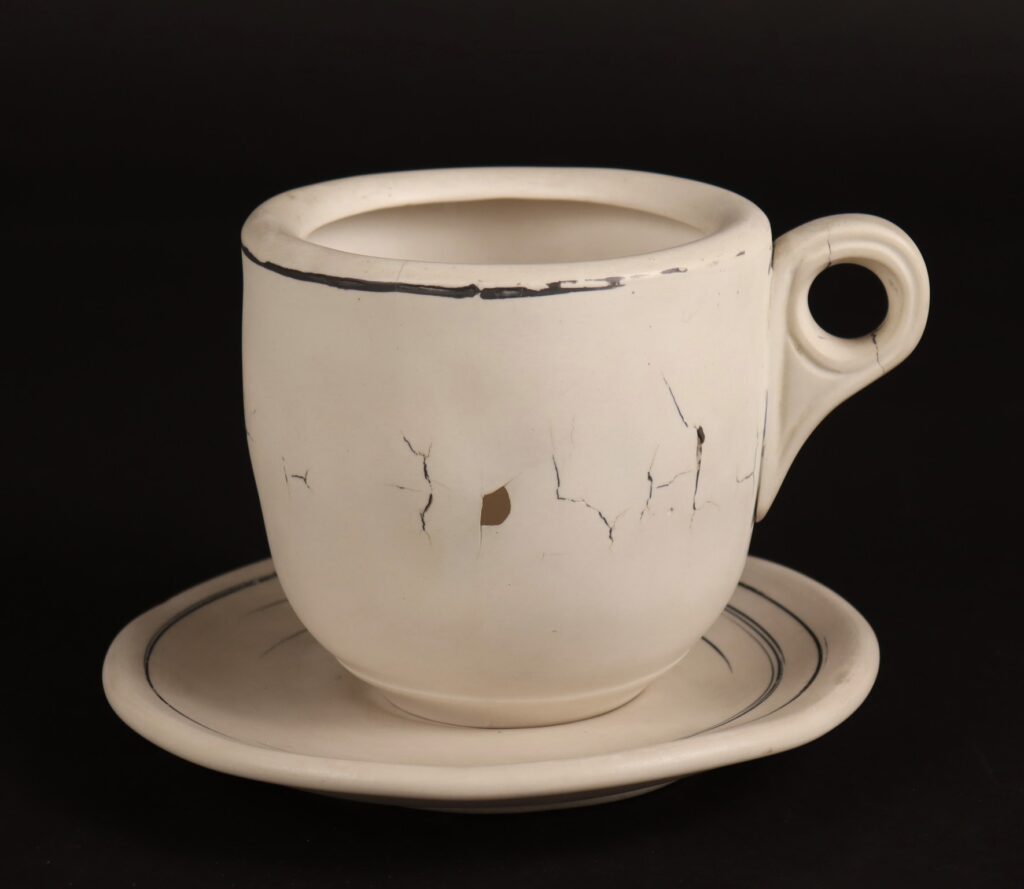
Irv Tepper (American, b. 1947)
oversized porcelain cup and saucer with cup with thin walls and intentional cracks and holes and heavy slipcast saucer, ca. 1982
IMoDD 2024.68 Gift of Richard W. Gold from the Arthur J. Williams Collection
Robert Mapplethorpe
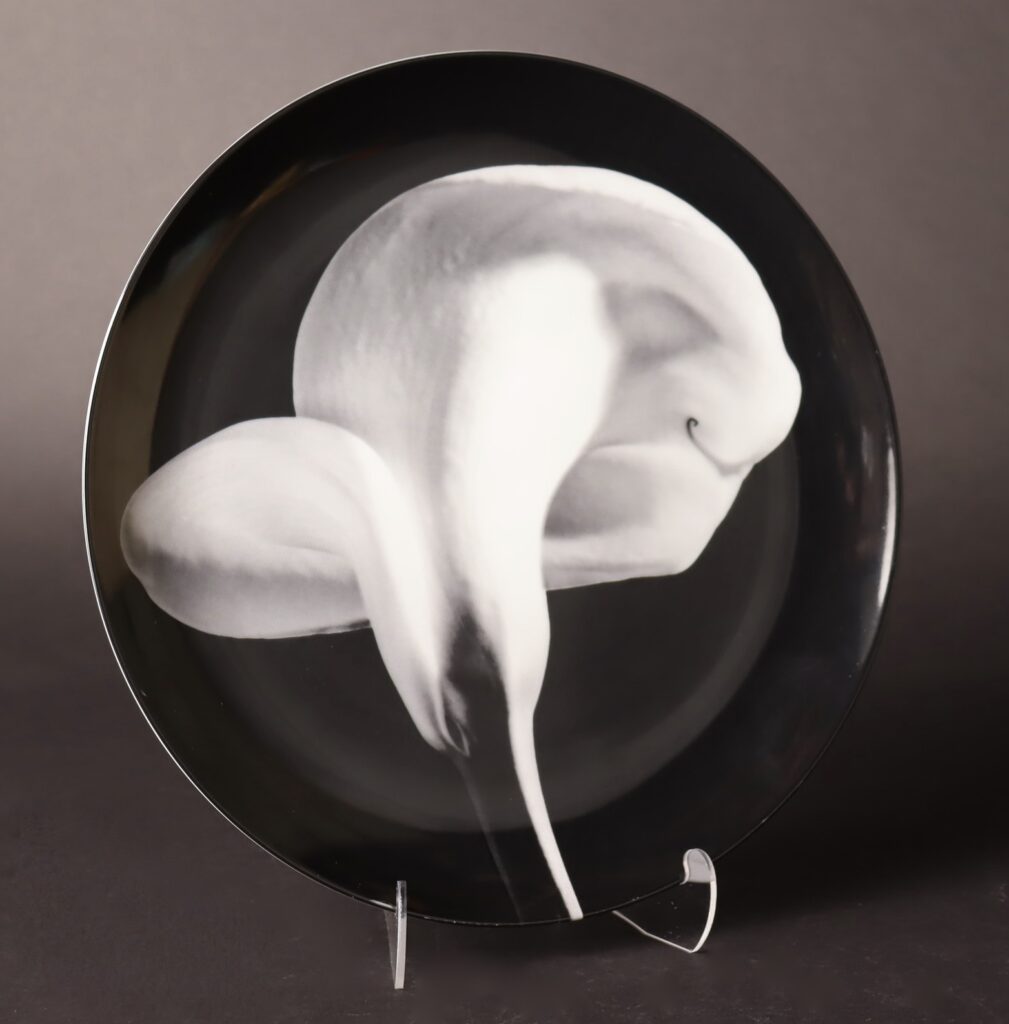
Swid Powell, New York City (1982-2001), manufacturer
Robert Mapplethorpe (1946-1989)
Calla Lily photographic image on porcelain service plate, 1984
porcelain, glazed, with overglaze transfer printed photographic image
IMoDD 2024.103 Gift of Richard W. Gold from the Arthur J. Williams Collection
Bruce Winn
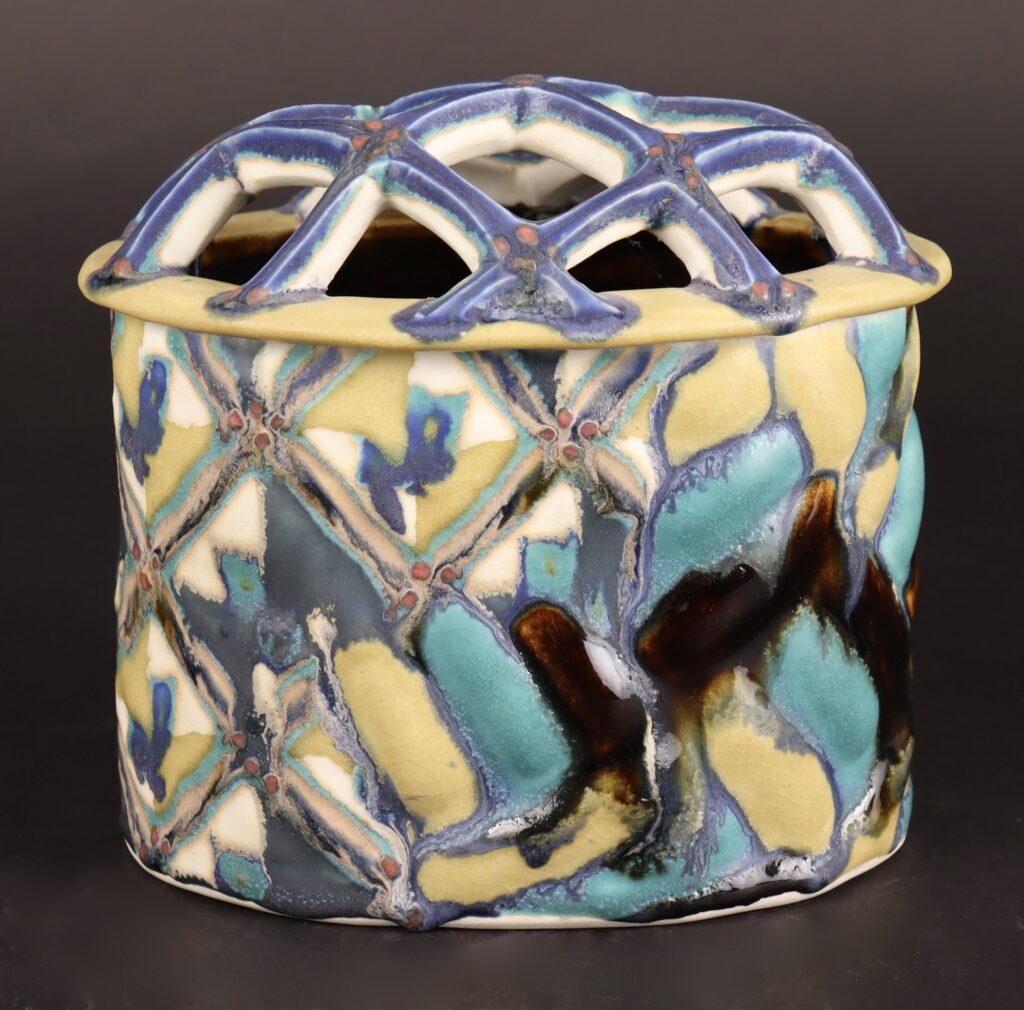
Bruce Winn (American, 1959-2012)
2-part porcelain flower holder with Persian-looking cobalt and turquoise glazes and a perforated top to assist in arranging the flowers, dated 1990
IMoDD 2024.122 Gift of Richard W. Gold from the Arthur J. Williams Collection
Ron Meyers
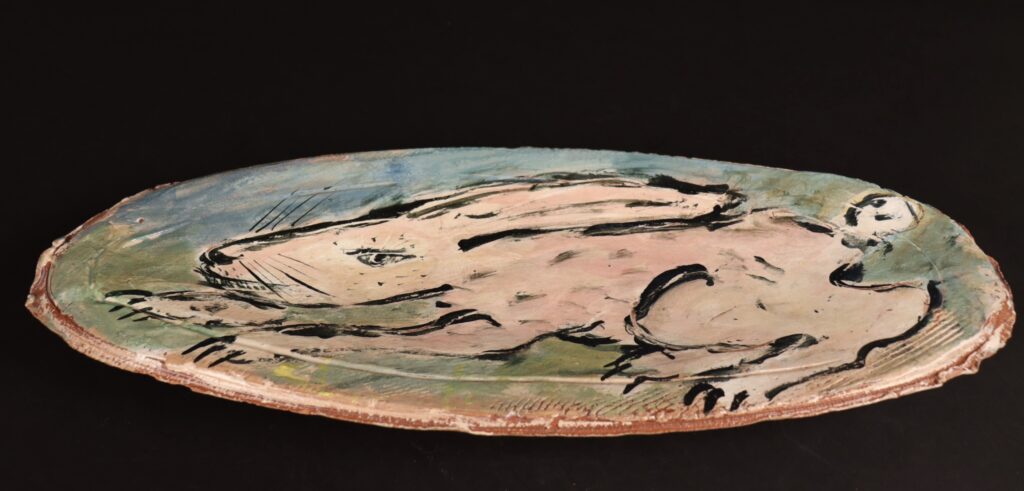
Ron Meyers (American, b. 1934)
earthenware fish platter, 1990s
earthenware, hand-painted with slips, glazed
IMoDD 2024.71 Gift of Richard W. Gold from the Arthur J. Williams Collection
KPM and PMR
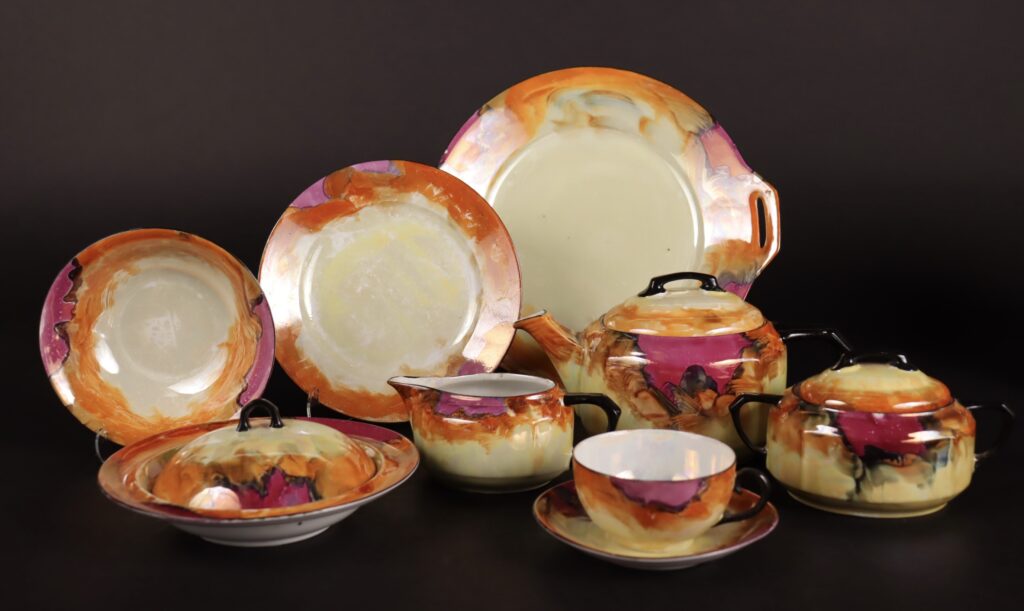
KPM and PMR Manufacturers, among others, Germany
hand-painted porcelain luncheon set with teapot, ca.1920s
IMoDD 2024.98 Gift of Richard W. Gold from the Arthur J. Williams Collection
René Lalique
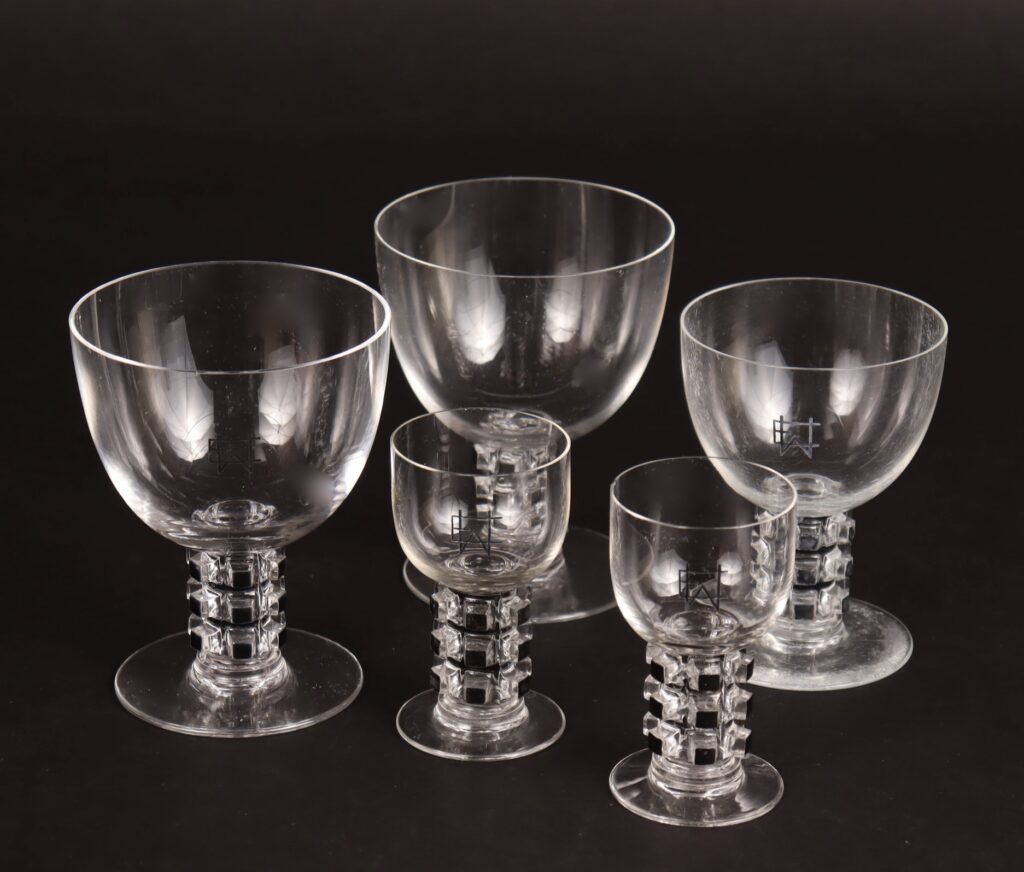
René Lalique for Lalique Glassworks (Verrerie d’Alsace)
René Lalique (French, 1860-1945)
Unawihr pattern Lalique stemware glasses, colorless glass, mold-blown
bowl and foot, mold-pressed and enamelled stem, monogrammed “EW”, signed, designed 1926 and in catalogues 1928-37
IMoDD 2024.23 Gift of Richard W. Gold from the Arthur J. Williams Collection
Glass Straw Dispenser
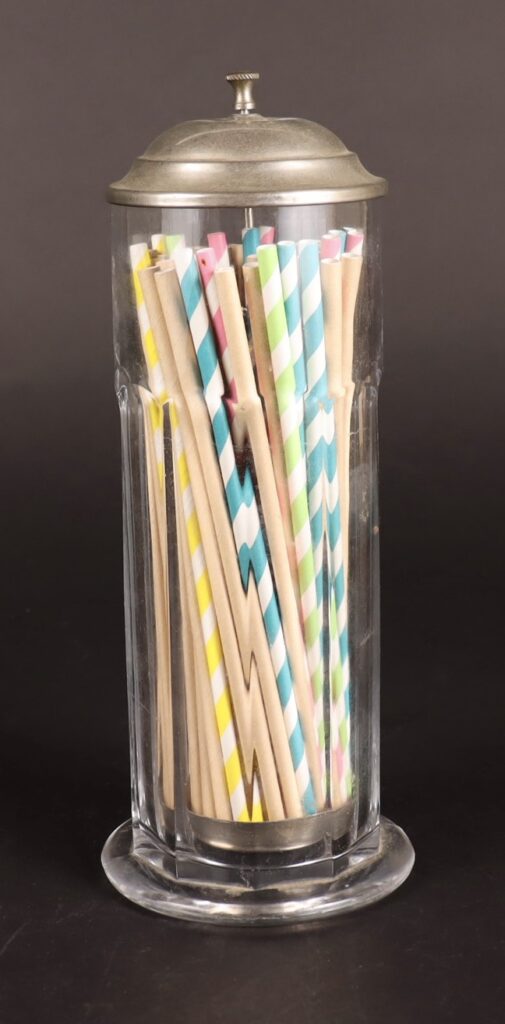
glass straw dispenser with metal lid that allows the dispensing of straws when the lid is raised, 20thcentury
IMoDD 2024.86 Gift of Richard W. Gold from the Arthur J. Williams Collection
Rockwell Kent
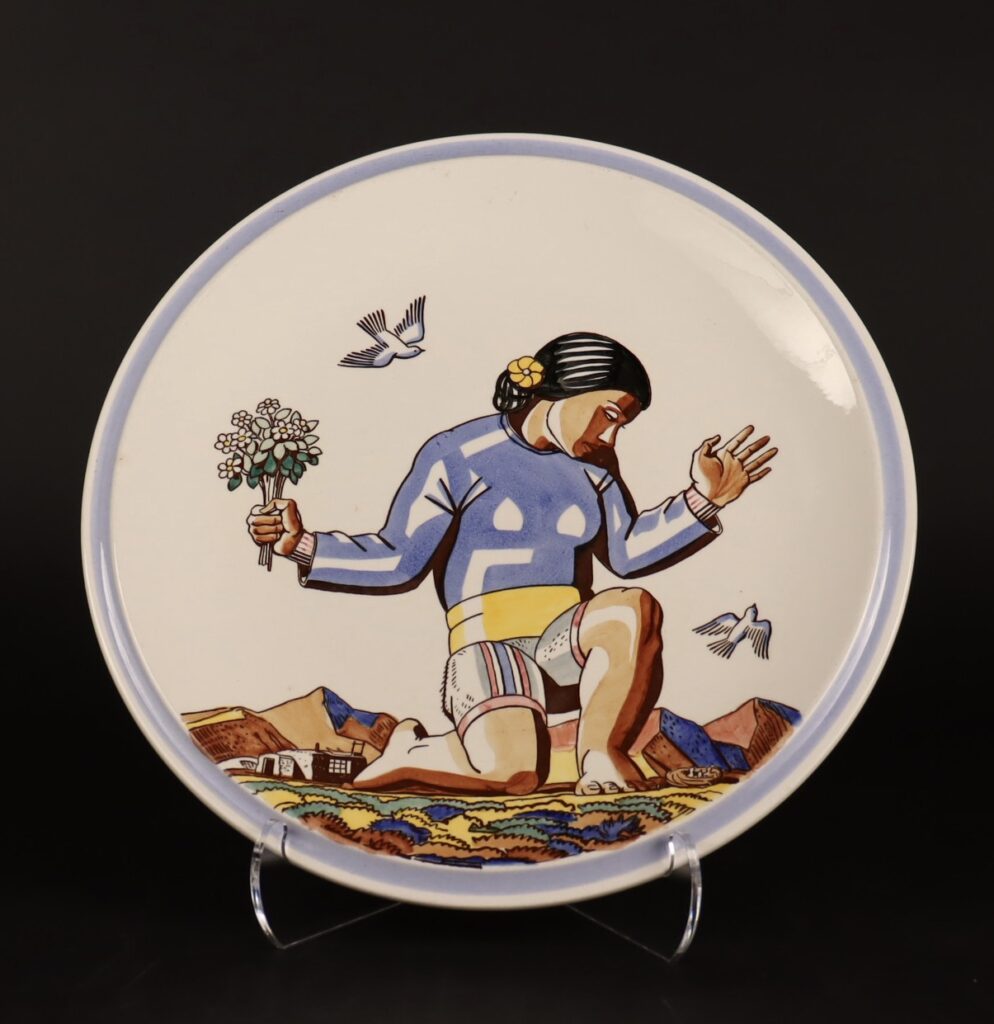
Vernon Kilns, Vernon, California (1931-1958)
Rockwell Kent (American, 1882-1971)
Vernon Kilns large 13.75” circular ceramic charger
designed by Rockwell Kent with the Salamina pattern
earthenware, decorated and glazed
IMoDD 2024.181 Gift of Richard W. Gold from the Arthur J. Williams Collection
Chinese Rose Medallion
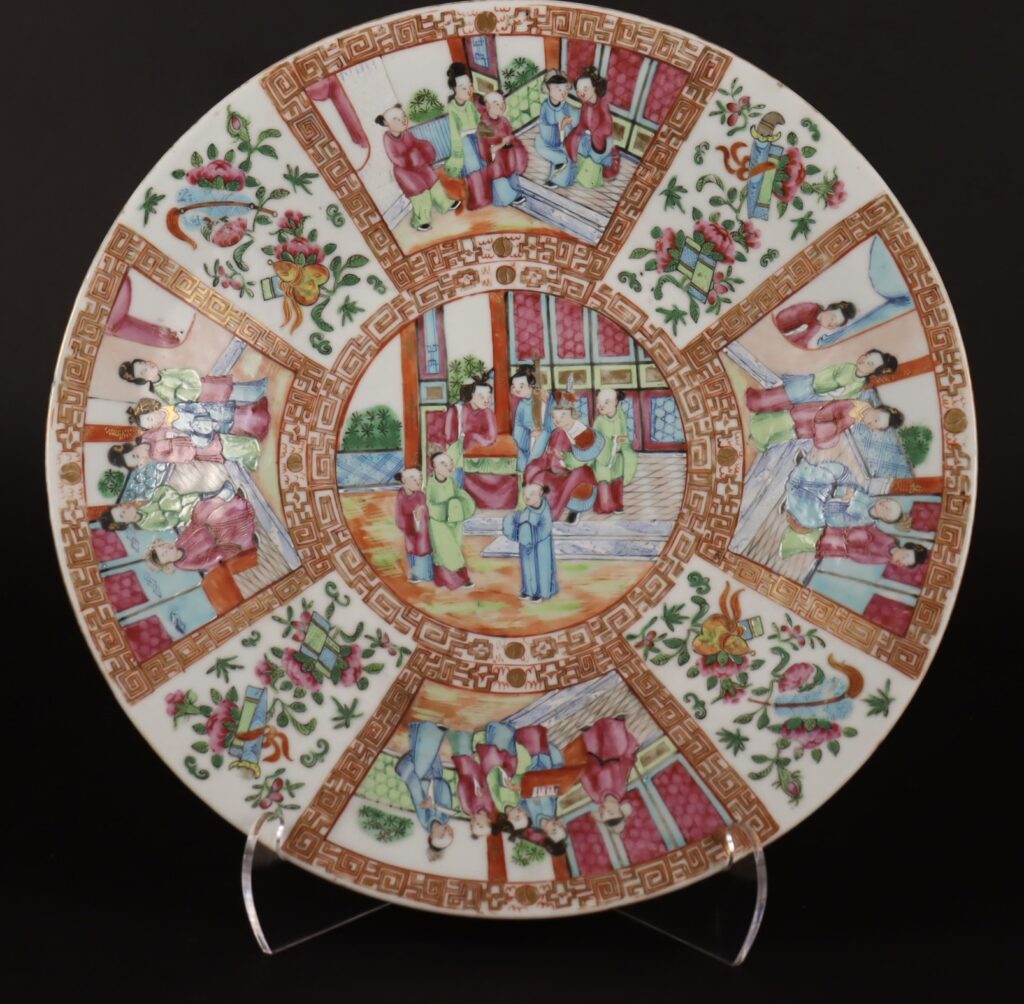
China
exportware charger with Rose Medallion motif, late 19th century
porcelain, overglaze enamels
IMoDD 2024.73 Gifts of Richard W. Gold from the Arthur J. Williams Collection
Henry Varnum Poor
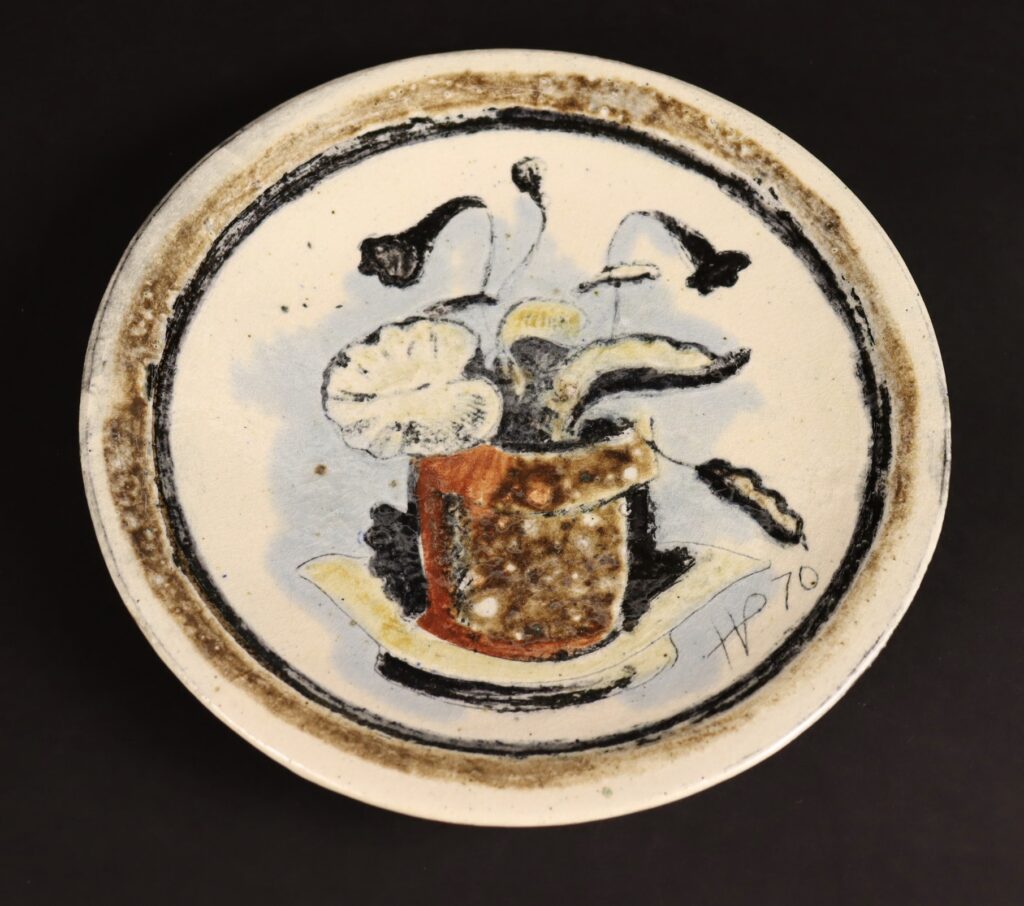
Henry Varnum Poor (American, 1887-1970)
earthenware plate with potted plant motif, signed “HVP 70”, 1970
IMoDD 2024.66 Gift of Richard W. Gold from the Arthur J. Williams Collection
Jim Makins
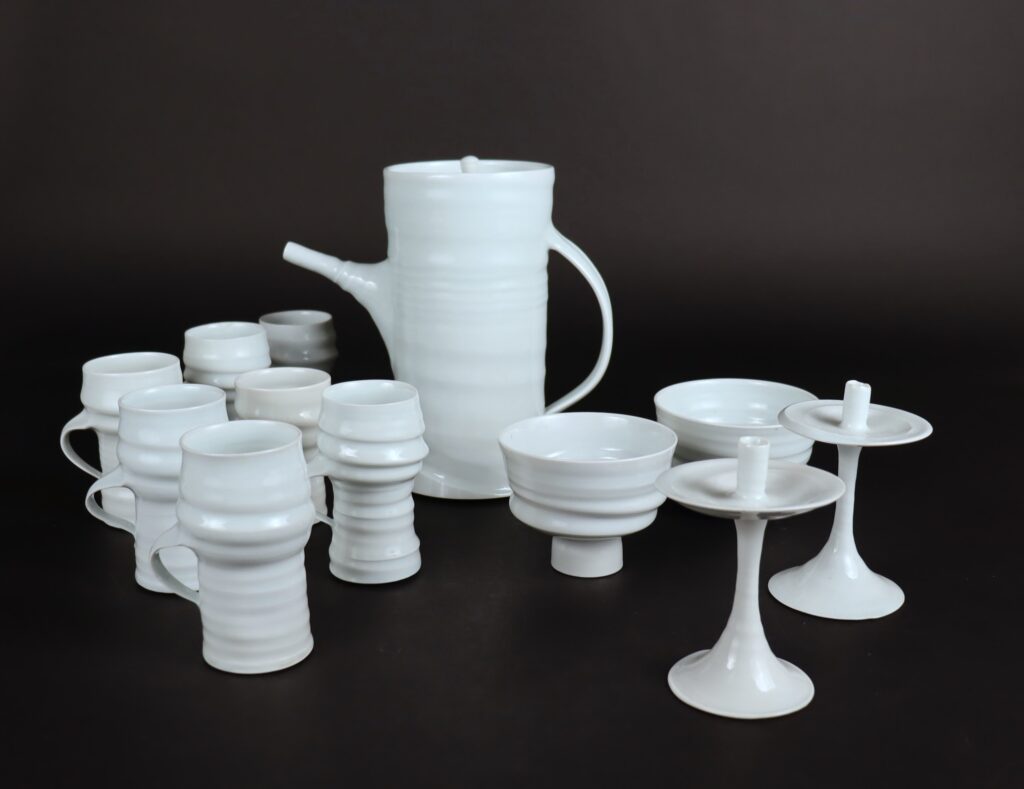
Jim Makins (American, b. 1946)
porcelain pitcher with lid with pale celadon glaze and 7 matching cups with handles, 1990s
IMoDD 2025.56 Gift of Richard W. Gold from the Arthur J. Williams Collection
Clewell Pottery
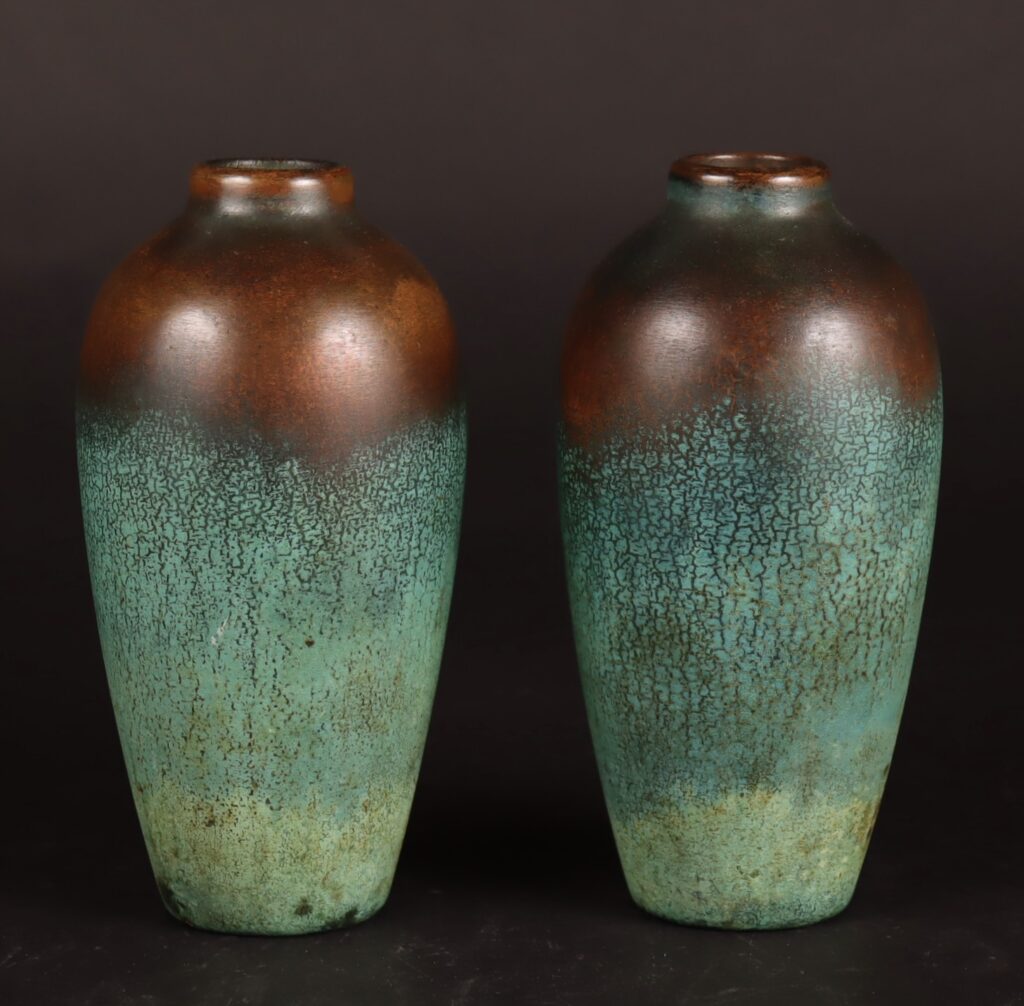
Clewell Pottery, Canton, Ohio (1906-1965)
Charles Walter Clewell (American, 1876-1965)
pair of Clewell copper clad ceramic vase with copper to green color palette
ceramic, copper
IMoDD 2024.177 and 2024.178 Gift of Richard W. Gold from the Arthur J. Williams Collection
Haviland
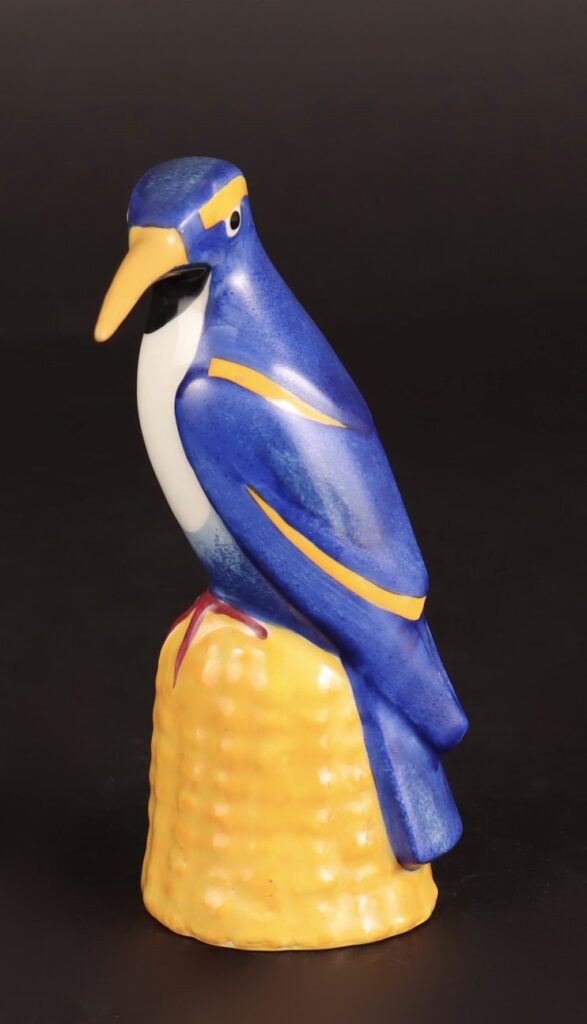
Haviland Limoges, France (1881-1971)
Edouard-Marcel Sandoz, designer (Swiss, 1881-1971)
Haviland Sandoz earthenware, painted and glazed bird sculpture, 1915-1925
IMoDD 2024.148 Gift of Richard W. Gold from the Arthur J. Williams Collection
Warren MacKenzie
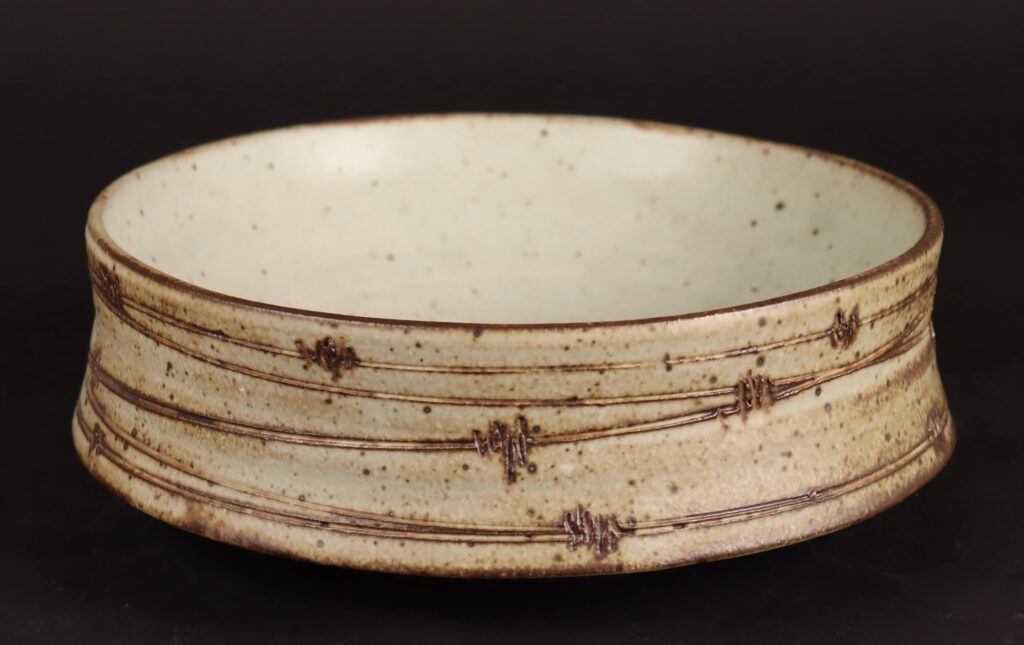
Warren MacKenzie (American, 1924-2018)
reduction-fired stoneware fold over bowl with earthy glazes and red iron rubbed into grooves, 1990s
IMoDD 2024.123 Gift of Richard W. Gold from the Arthur J. Williams Collection
Ruskin Pottery
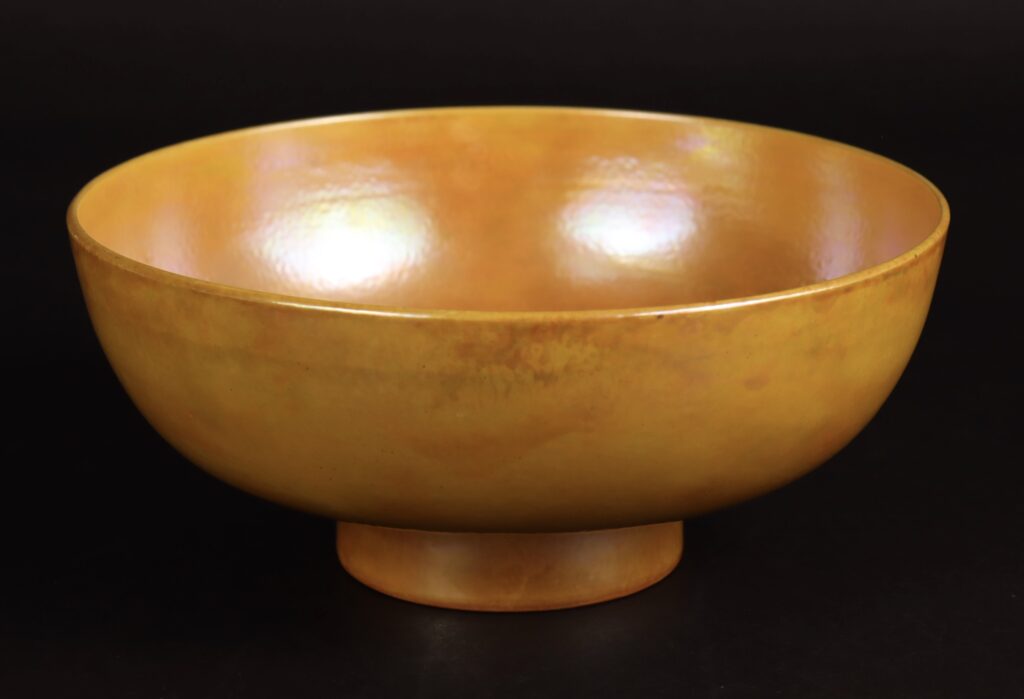
Ruskin Pottery, Smethwick, England (1898-1935)
iridescent gold luster glazed Ruskin Pottery bowl, after 1907
ceramic, glazed
IMoDD 2024.58 Gift of Richard W. Gold from the Arthur J. Williams Collection
Chinese Export Ware
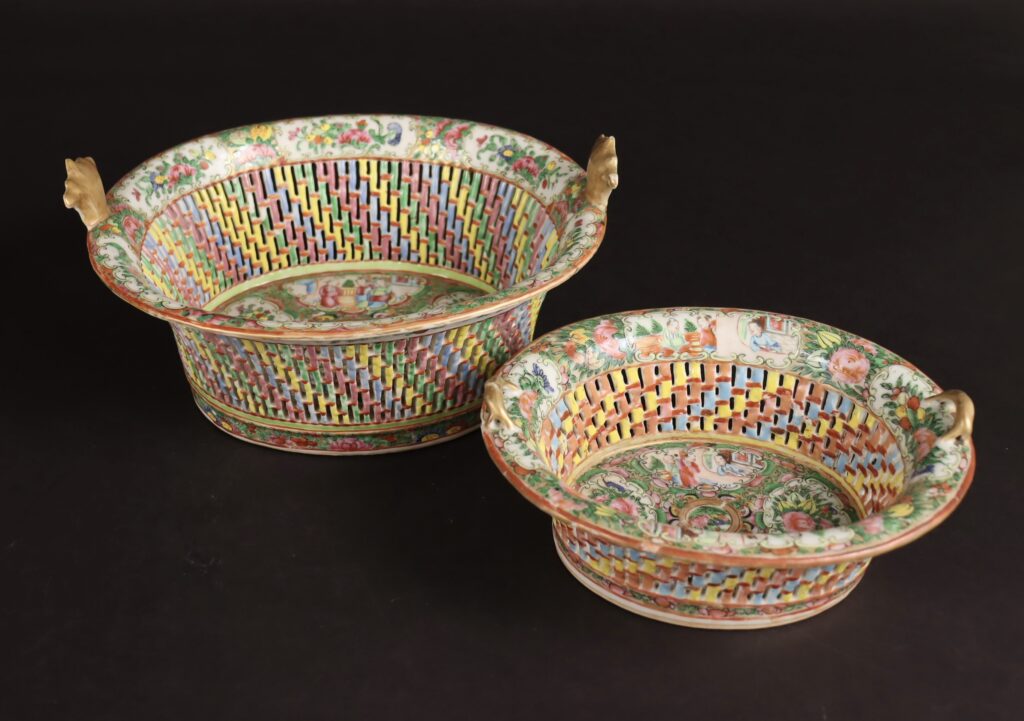
China
2 Chinese exportware porcelain baskets, reticulated, with Rose Medallion motif, handles and no lids, and scenes of figures and flowers and birds and insects in overglaze enamel decoration, late 19thcentury
porcelain, overglaze enamels
IMoDD 2024.73 Gifts of Richard W. Gold from the Arthur J. Williams Collection
American Redware
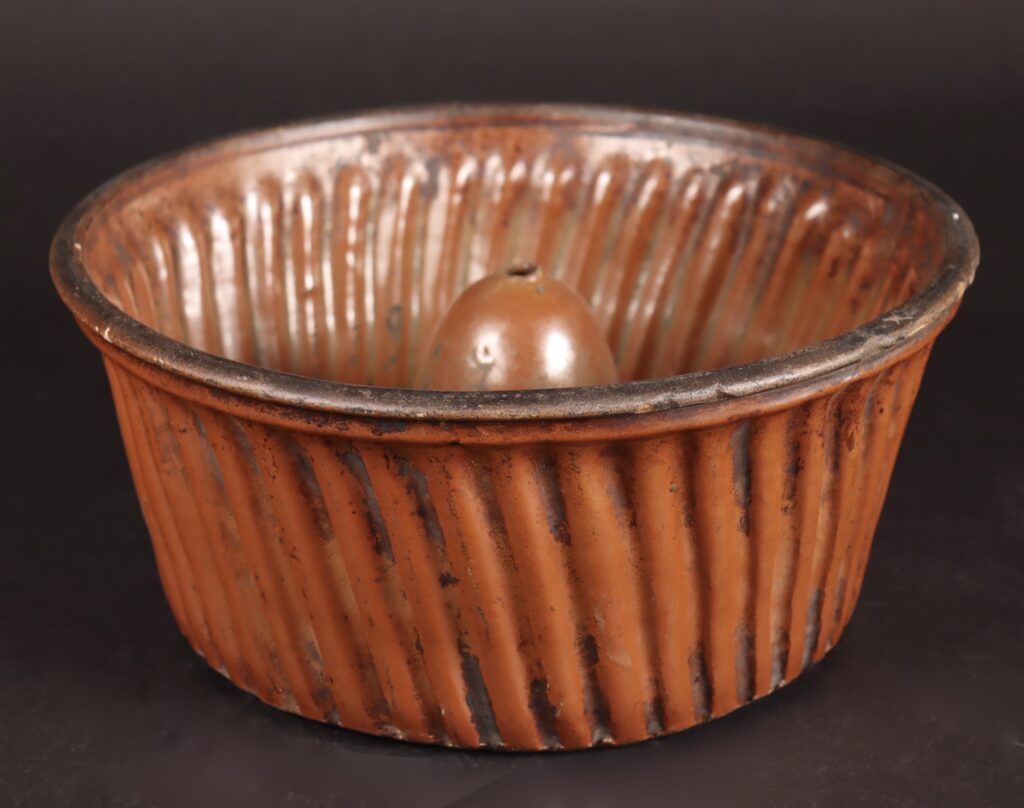
USA
early American redware cake pan with fluted sides, 19th century
earthenware, glazed
IMoDD 2024.166 Gift of Richard W. Gold from the Arthur J. Williams Collection
David Furman
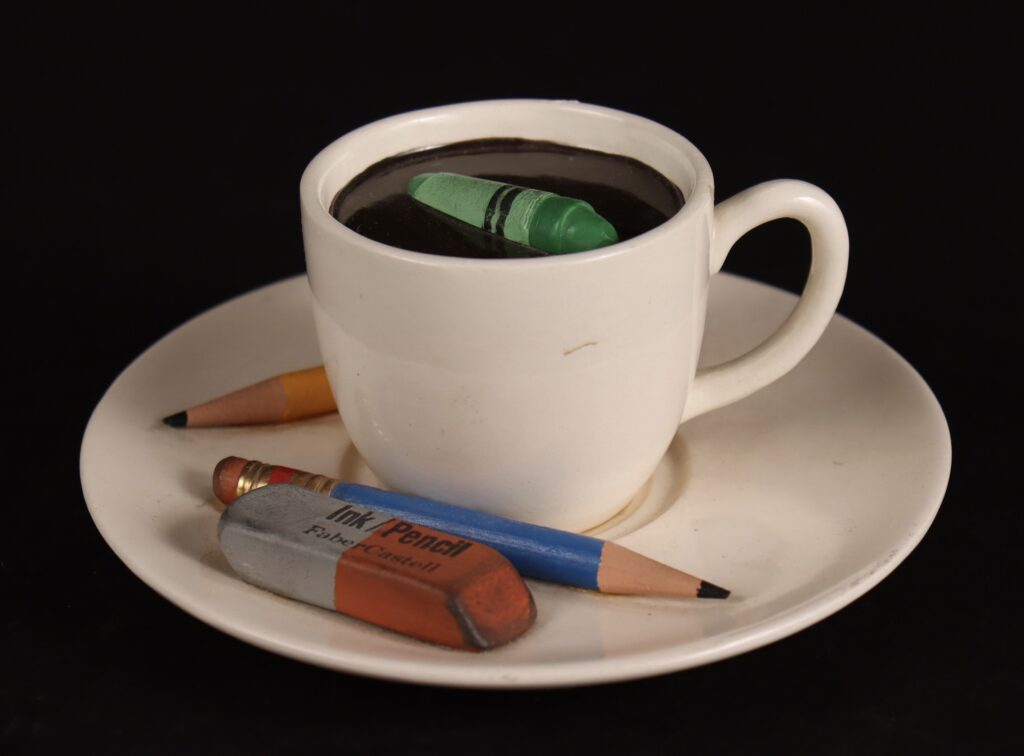
David Furman (American, b. 1945)
Trompe-l’oeil still life of cup and saucer showing coffee with crayon immersed, pencil and eraser resting on saucer, all ceramic (not found objects), dated 1990
IMoDD 2024.139 Gift of Richard W. Gold from the Collection of Arthur J. Williams
Brad Keeler Lobster ware
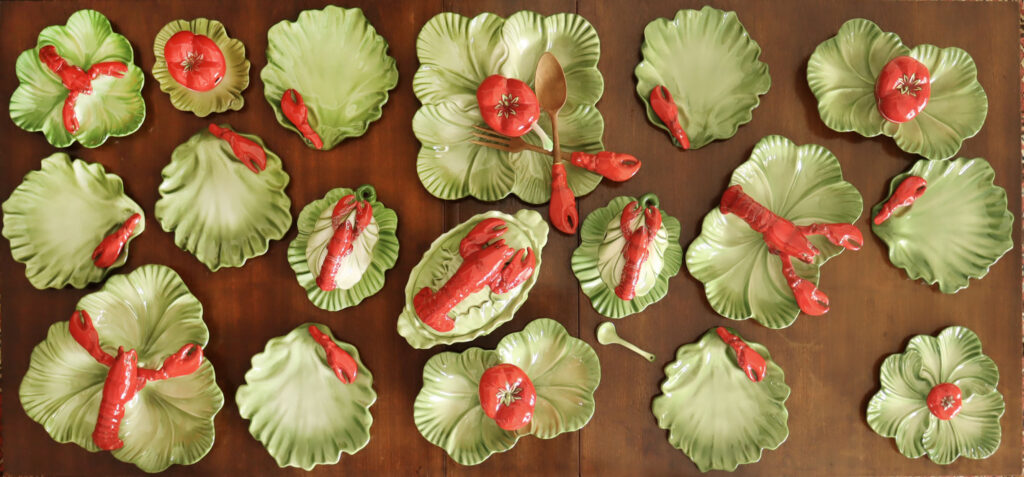
Brad Keeler (American, 1913-1952)
19-piece Lobsterware service consisting of green and ivory glazed earthenware lettuce leaf dishes with bright red lobster motifs, casseroles, serving platters, and individual plates with a single lobster claw at the edge, 1940s-1950s
earthenware, glazed
IMoDD 2025.80 Gift of Rina Weisman
Sometimes collections focus on the designs of one individual and even one motif. An example featured in this exhibition would be the collection of work by the California designer, Brad Keeler (1913-1952), which was donated to IMoDD in 2025 by Rina Weisman. Nineteen examples of the colorful ceramic Lobsterware buffet service beckon to the diner in a playful table set complete with shiny red lobsters posed with lettuce and tomatoes in the form of casseroles, serving trays, salad sets, and dishes of all sorts.
The company, Brad Keeler Artwares, was in operation in Los Angeles and San Juan Capistrano from 1939-1952. According to one website owned by his granddaughter, Catherine Porter, his ”most notable contribution to the ceramics community was the formulation of a ‘true red’ glaze, which he named ‘Ming Dragon Blood,’ and which can be seen utilized on his lobsterware buffet service series.” (https://www.bradkeelerartwares.com/about/)
Many gifts take years to be finalized for one reason or another. The museum curator was in conversation with this donor about the potential gift beginning in 2022, and the conversation kept going until it was packed and shipped and received in 2025. Definitely worth waiting for.
Grainware
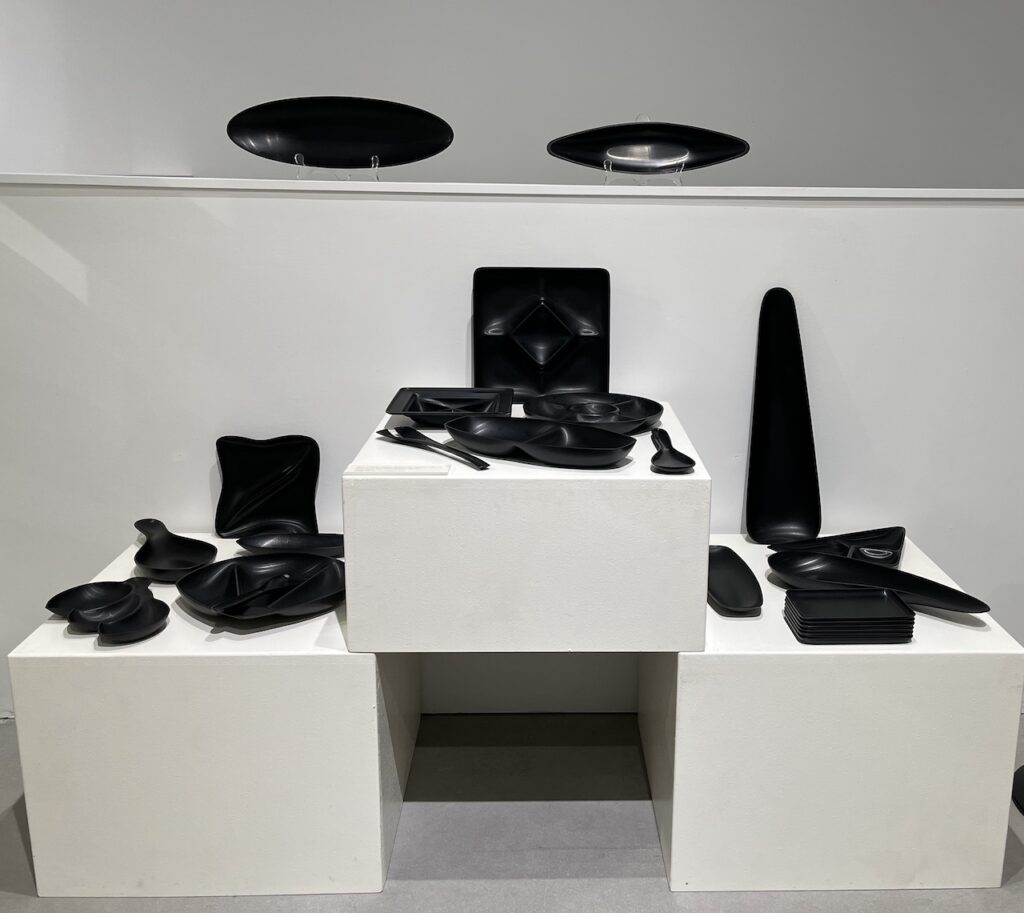
Plastic Productions Company, Redwood City, California (1948-1971)
Charles H. McCrea, designer (American, 1909-1971)
24 examples of Black Acrylic Grainware, mid-century modern serving pieces and barware designed by Charles H. McCrea, including trays, bowls, platters and serving utensils in elongated, geometric, and abstract forms, 1950-55
acrylic, molded
Gift of Margaret Bach
Grainware is a brand name, known for its mid-century modern serving pieces and barware, often made from acrylic and featuring hand-loomed fibers such as abaca. Abaca ware, on the other hand, refers to items, particularly serving pieces, made using abaca fibers. Grainware frequently incorporated abaca fibers, particularly in Mid-Century Modern designs, by weaving the abaca and then encasing it in clear acrylic for durability and a unique aesthetic. Abaca is a strong, natural fiber derived from the leaves of the abaca plant, which is a type of banana plant native to the Philippines.
Acrylic was invented in 1902 by Otto Röhm, a German chemist, but it was not commercialized on a large scale until 1933, when Röhm and Haas GmbH began to market it under the name PlexiglassÒ. Acrylic has unparalleled transparency among polymers and is also known as Lucite. It is non-toxic, free of BPA, and doesn’t leach harmful chemicals. It is a food-grade material commonly used for outdoor serve ware.
Soon after Plexiglas became available, Plastic Productions Company of Redwood City, California began to manufacture housewares using acrylic sheets. These products were primarily black in color, although they also carried a gray tone created by the graining process during production. As a result, the products were initially marketed under the Gray ‘n Ware brand, later changed to Grainware. Charles McCrea, who owned the company, was the chief product designer. In June of 1951, the Museum of Modern Art in New York (MoMA) acquired a number of Grainware pieces, where they remain as part of the collection.
Grainware bowls and other pieces were displayed at the Museum of Modern Art’s Good Design exhibitions in 1951, 1952 and 1953 as well as the exhibition 20th Century Design from the Museum Collection, December 17, 1958 – February 23, 1959.
Good Design was a series of exhibitions of home furnishings, organized by the Museum of Modern Art, New York, for the Merchandise Mart, Chicago. Originating in January 1950, its purpose was to present the best new examples in modern design home furnishings.
Sources: https://vineyardsgifts.myshoplocal.com/about.cfm/Grainware
Barbie’s Dream Kitchen
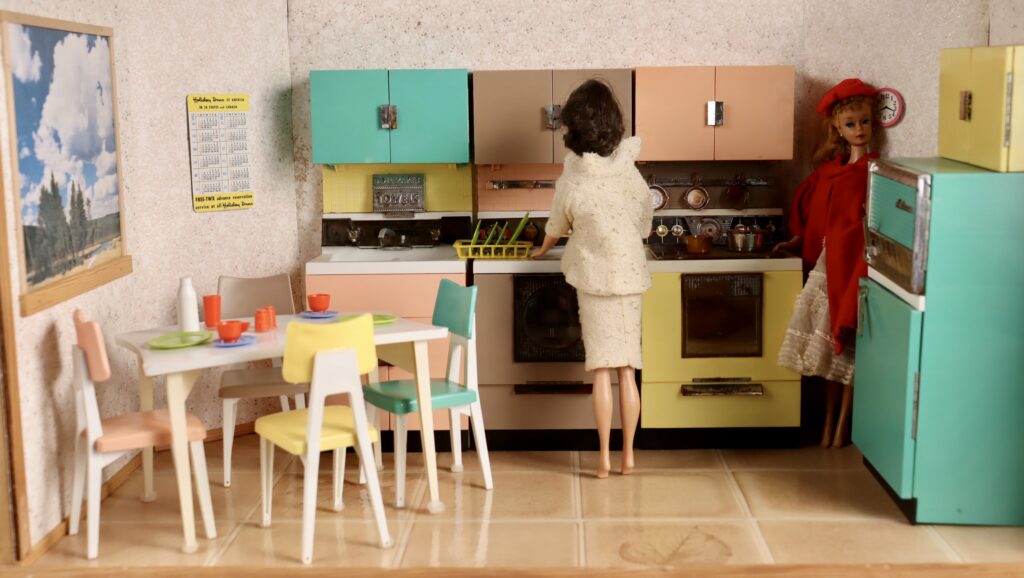
Deluxe Reading Corporation, Elizabeth, NJ (est. 1951-1973)
Barbie’s kitchen furniture and appliances in display box and three Barbie dolls with accessories, ca. early 1960s
plastic, textiles, wood, acrylic
IMoDD 2024.91 Gift of Lucy and Jerry McMahon
The 1960s Barbie Deluxe Reading Dream Kitchen was manufactured by the Deluxe Reading Corporation. It was not an official licensed Mattel accessory but was compatible with Barbie dolls. It is considered by many to be a cult classic, with battery operated features like working sinks, lights and rotisseries. These features were considered more advanced than what Mattel produced at the time. It was sold through the Montgomery Ward catalogue. It has been said that Mattel did not originally give Barbie much time in the kitchen because she was destined to be a career woman or college student.
Now, in the donor, Lucy McMahon’s own words:
Everyone loved Aunt Jean and wanted her for their mother. That’s because she was full of love, compassion, and always had a dollar in her pocket to buy something to make you happy. Our own mothers were more concerned with raising us right rather than our happiness. In May 1961, my sister Dorothy & I were prepared for First Holy Communion. I was the oldest (8) and tallest in the class and very self-conscious about this. This unhappiness evaporated the moment I opened my present from Aunt Jean – BARBIE! – in all her blonde glory. We got missals from my mother. Barbie hit the market at the most perfect time-the Baby Boom girls were an ideal market for a role model adult doll.
I admired Barbie because:
She had her own convertible sports car
She had plenty of nice clothes
She must have had a job to afford these things
She had a boyfriend
She had her own room
She made her own decisions
She was pretty and had enough blonde hair to wear a ponytail
Anyway, later that year on the way to visit Aunt Jean my mother stopped to buy a stove part at the only appliance store in the area. Looking around my eyes were drawn upwards to the colorful Kitchen Set put on top of a real refrigerator. Transfixed, I showed my mother who asked the proprietor the price. He said it was only a prop with a smile and directed us to the nearby local toy store which we went to immediately. $11.00!!! Too much!!
I couldn’t wait to tell Aunt Jean about the discovery. The pastel colors made housework look fun. A dishwasher instead of a gray, greasy dish rag floating in a dishpan! A rotisseried turkey inside the oven instead of fried fish in a pan on the burner. A spacious freezer instead of a frost filled compartment inside the refrigerator that always needed defrosting. Each appliance color had a matching chair!
It probably wasn’t a coincidence that the Kitchen Set hit the market before Christmas. Back then, television commercials targeted our generation with toys we didn’t know we wanted.
Mattel had created a submarket- OEM (ORIGINAL EQUIPMENT MANUFACTURER) brands were more expensive than knockoffs usually made overseas. Barbie outfits would fit perfectly if made by the OEM (Mattel), but it was probably best to crochet or knit your own rather than waste money on the imported clothes.
The Kitchen Set was sized perfectly to Barbie’s dimensions & showed creative design. Mattel Barbie furniture was usually cardboard which was assembled by the user. The Kitchen Set was made of durable, colorful plastic and advertised running water in the sink & dishwasher. However, the plastic tubing hardened and never really brought the water out of the tanks. A C-sized battery did make the rotisserie revolve & light up the burners but didn’t last long.
The shelves held packages of cleaning supplies and dry goods. Plastic dinnerware filled the dishwasher racks. Table was set with thin plastic food like a roast turkey, layer cake, gelatin mold. Miniature milk bottles, ice trays fit on the refrigerator shelves. There was a set of saucepans that were supposed to snap into brackets over the stove. Not easily, as I recall. Tiny flatware & cooking utensils tarnished easily but helped us get our table setting & stirring moves down. Despite its weak points, the Kitchen Set provided years of fun for my sisters, cousins, and my Barbies.
While remodeling our own kitchen in the 80s my husband made the display box which later made an appearance at a 50th Birthday Party for 2 of the original Barbie owners.
Thank you, Aunt Jean- from all of us.
Salesman’s Sample Kitchen Display
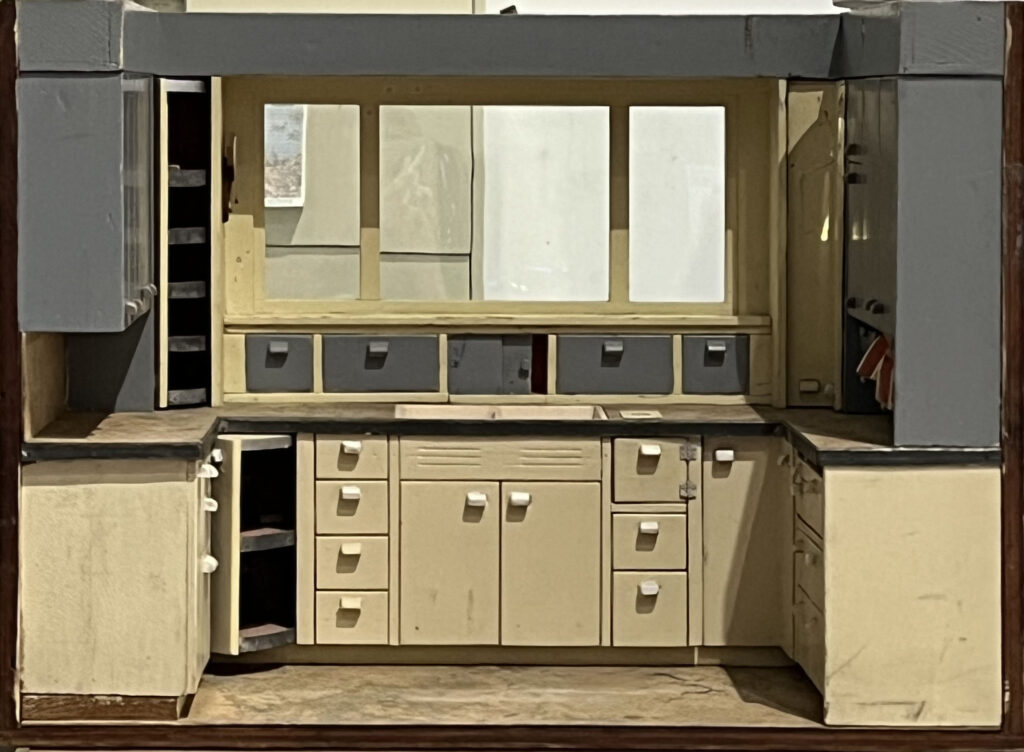
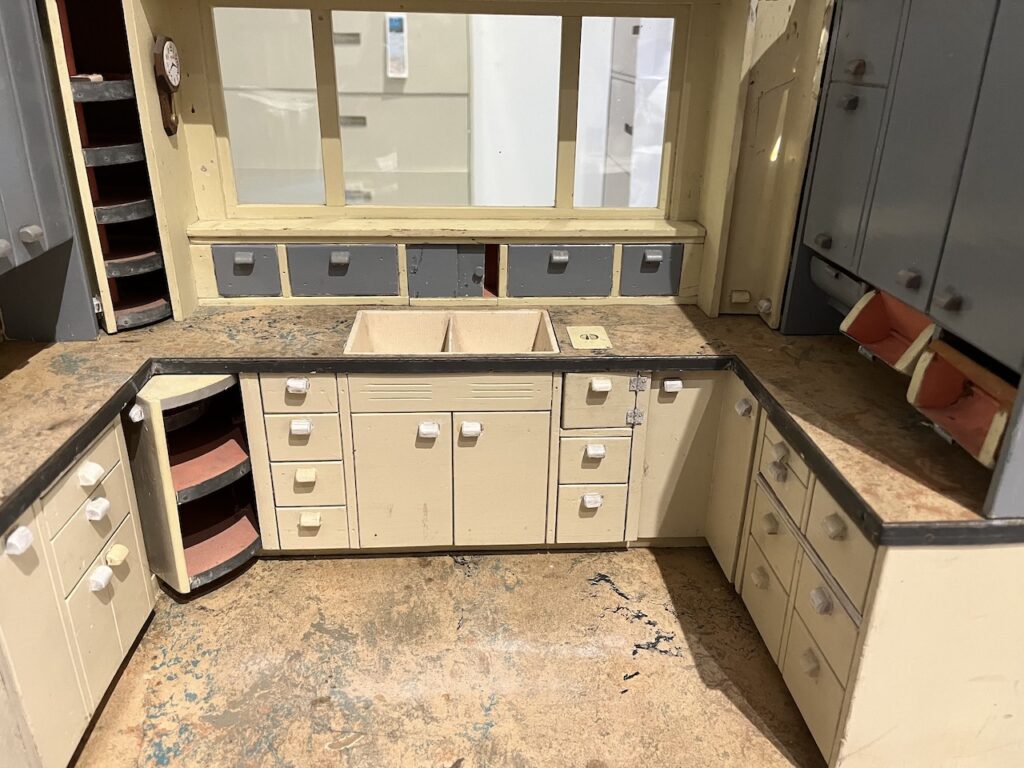
saleman’s kitchen sampler, n.d
Thank you to the dozens of other donors who gifted work to the museum during the past two years, a selection of which is included in this exhibition.
William Underhill
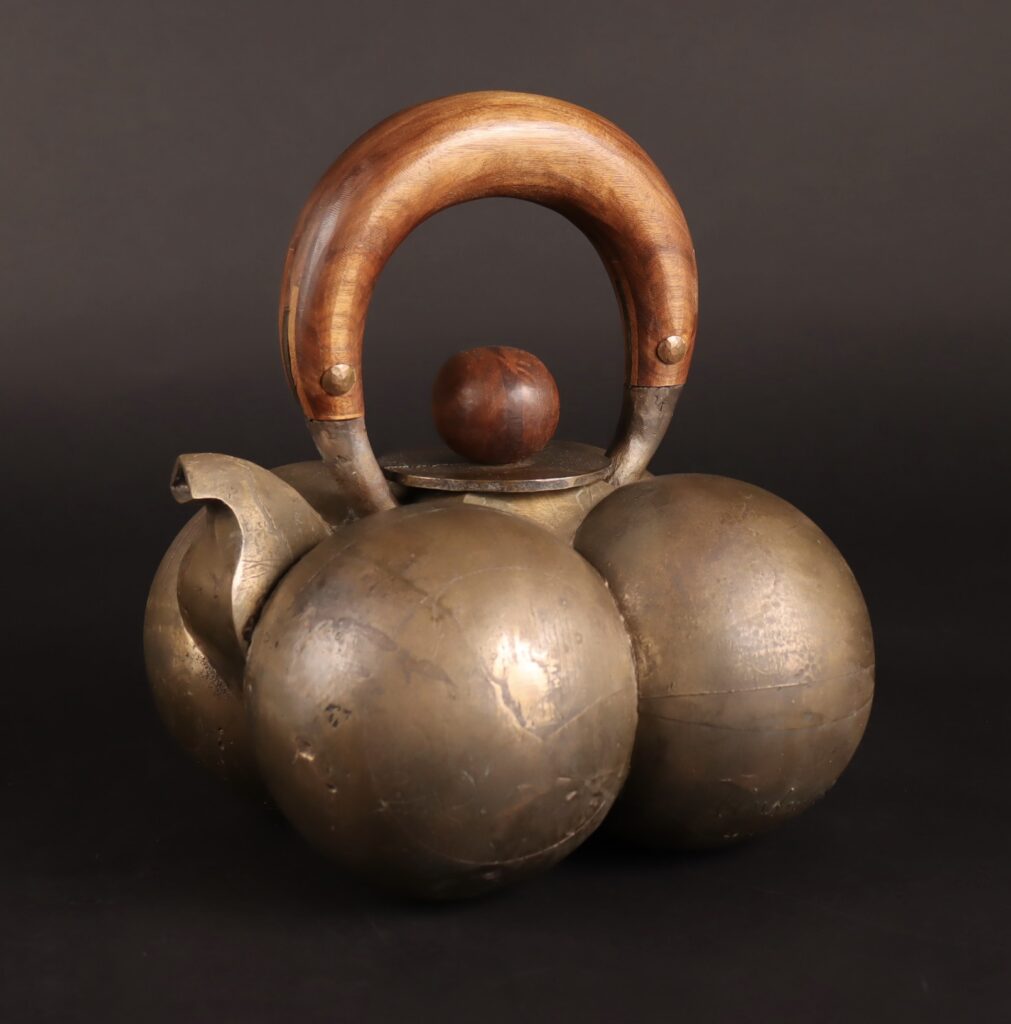
William Underhill, American 1933-2022
Bronze Teapot, 1976-2000
bronze tea kettle, 4-lobed form, with unfinished bronze and oiled
wood handle created with the lost-wax technique, and carved wood
IMoDD 2024.77 Gift of Sarah, Kate and Joe Underhill
Glidden Pottery
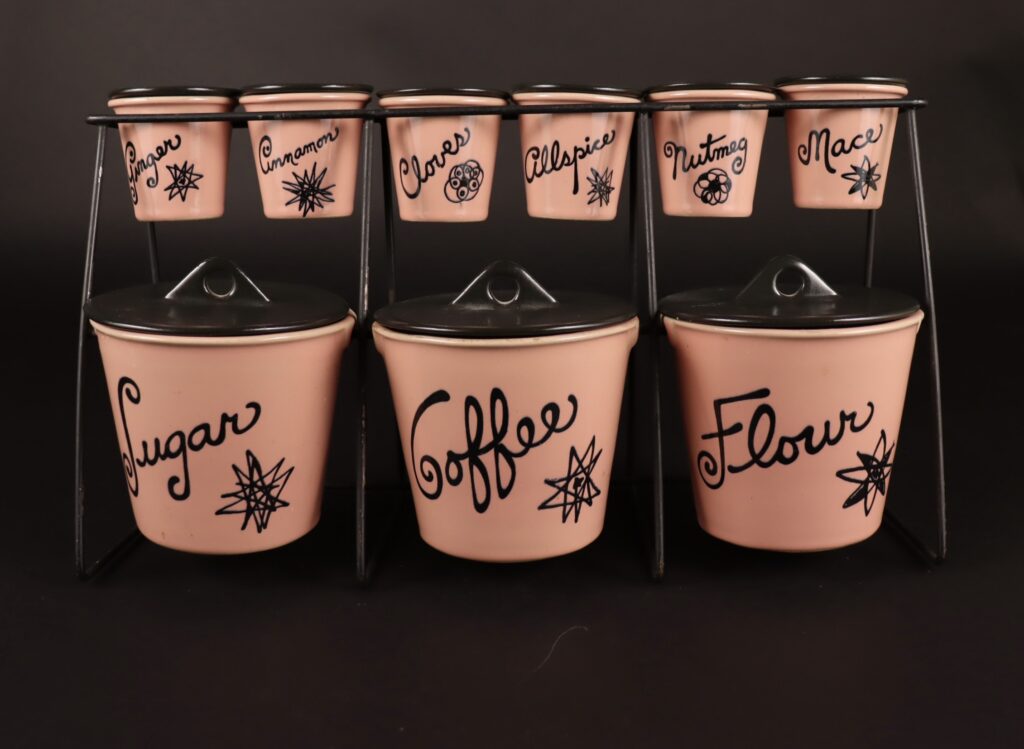
Glidden Pottery, Alfred, New York (1940-1958)
Glidden Pottery stoneware New Equations cannister set with spice jars with lids on wire rack, circa 1953
IMoDD 2026.34 Museum Purchase and Gift of Terry and Gail Scanlin
Glidden Pottery
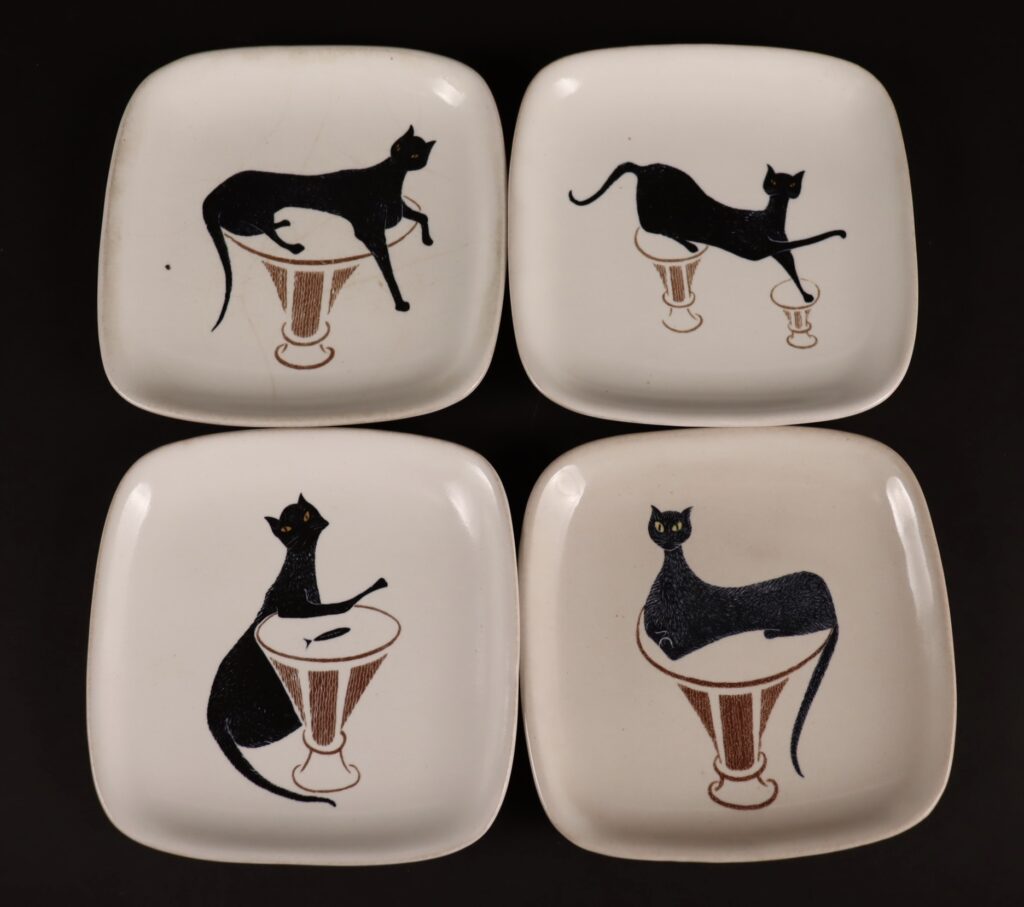
Glidden Pottery, Alfred, New York (1940-1958)
Glidden Pottery set of 4 Sophisticats or Amiable Cats no. 35 canape plates with 4 black cats, hand-painted, posing in various luxurious positions on a table, with names Highstepper, Gourmet, Sphinx, and Odalisque, introduced in 1954
stoneware, glazed with hand painted cat designs
IMoDD 2026.43 Museum Purchase
Judy Instructo puzzle
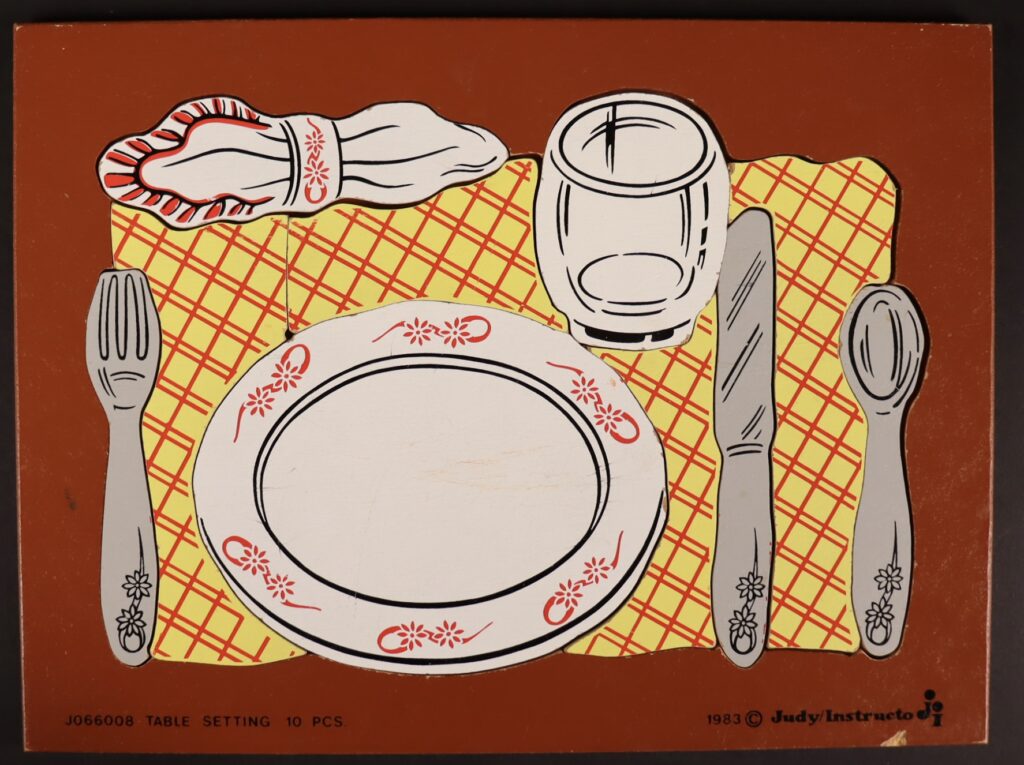
Judy Instructo, Minneapolis, Minnesota (1930s-1990s)
10-piece painted wood jigsaw puzzle of table place setting on a Masonite board, dated 1983
IMoDD 2026.30 Gift of Emily McAdoo
Cambridge Glass
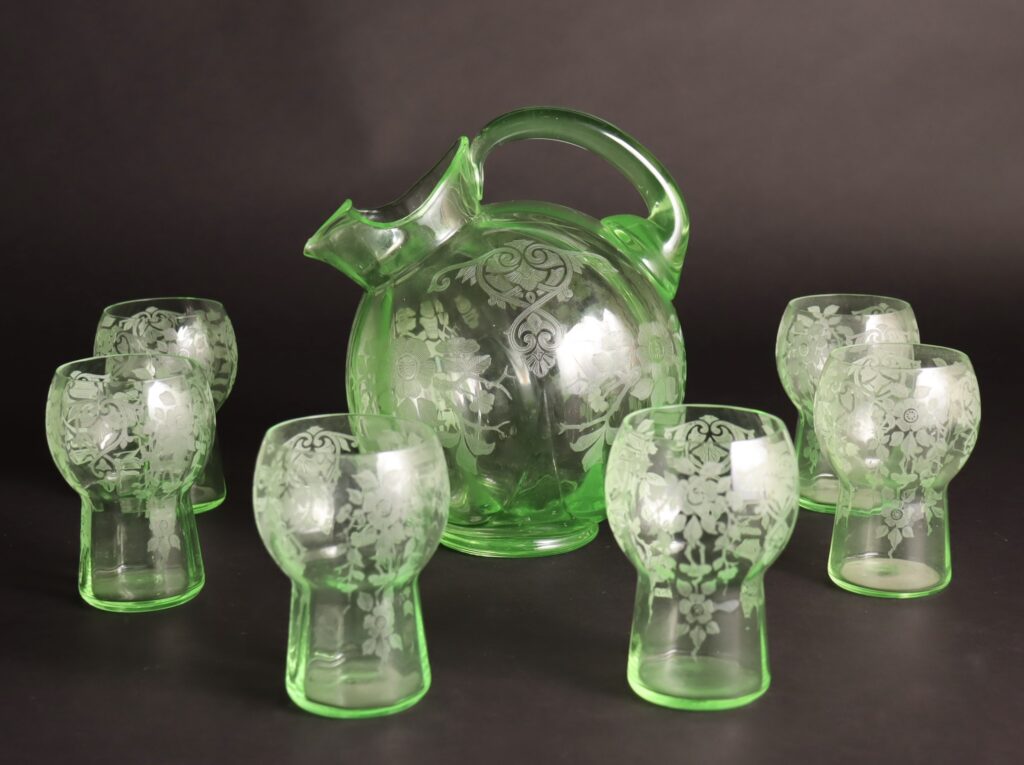
Cambridge Glass Co., Cambridge, Ohio (1901-1958)
7-piece Cambridge Glass green uranium glass globe pitcher and 6 tumblers all etched with the Wildflower pattern, ca. 1940s-1950s
2026.24 Gift of Victoria Matranga
Fiesta Ware
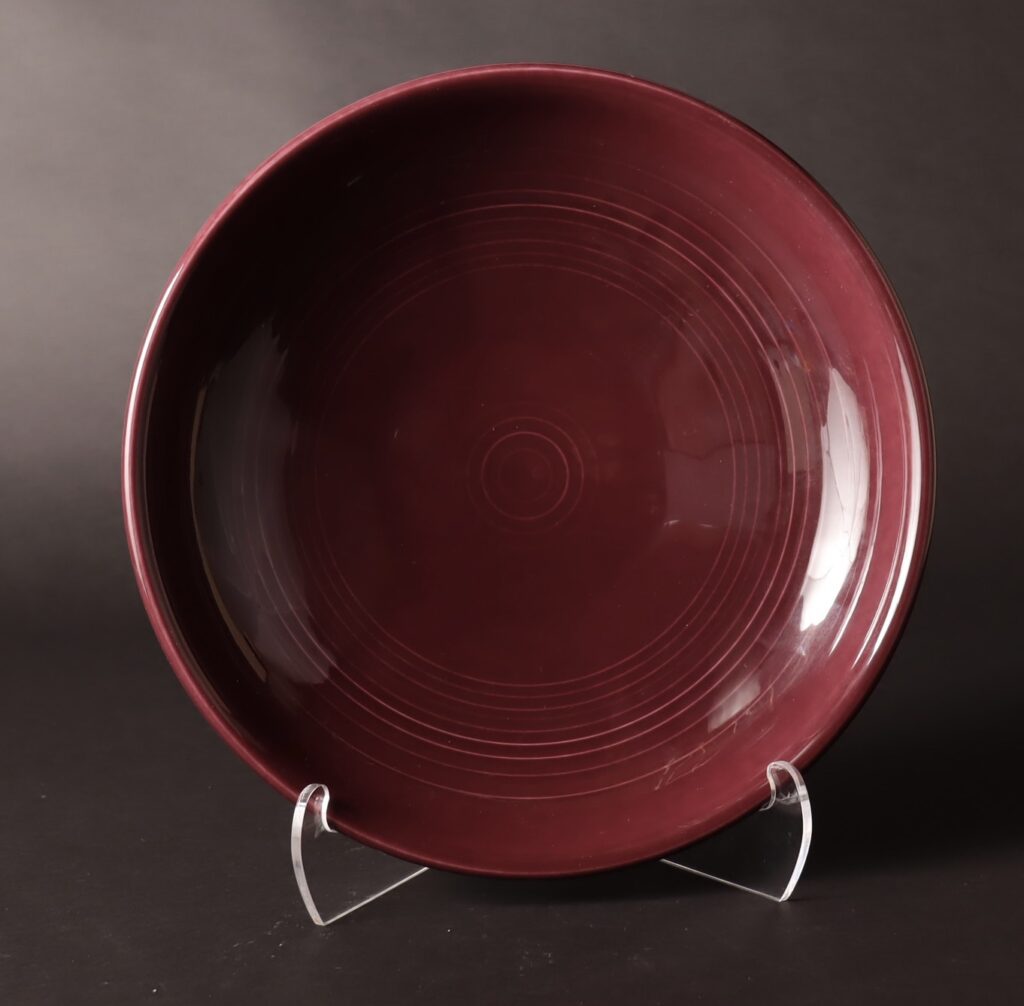
Homer Laughlin China Company, Newell, West Virginia (1877-present)|Joe Geisse, designer, under the direction of Jonathan Parry
rare Raspberry Presentation Bowl created in 1997 to celebrate production of the 500 millionth piece of Fiesta (1936-1997) with this example being #43 of 500, with a glaze that will not appear again in the future, 1997
vitrified clay, glazed
2025.146 Gift of Margo Rosenfeld
Heather Rios
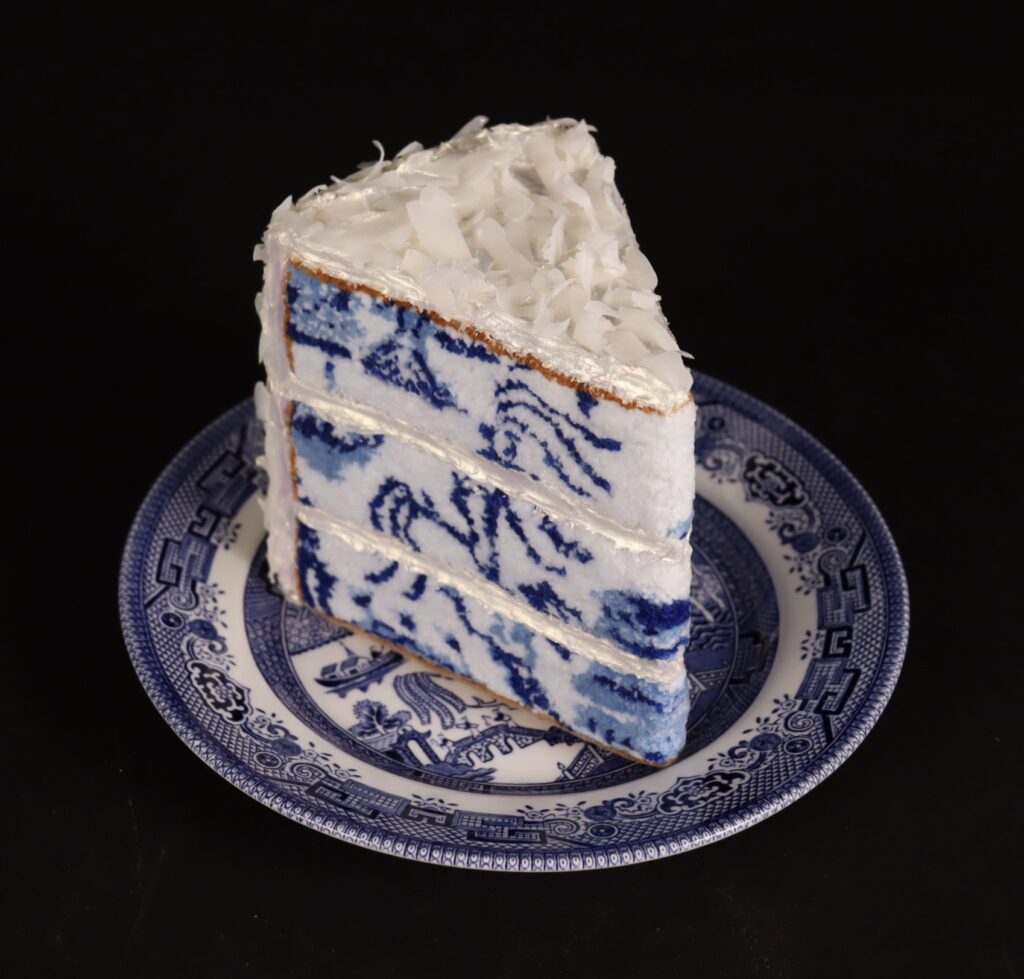
Heather Rios (b. 1979)
trompe l’oeil Blue Willow Coconut embroidered cake sculpture on contemporary manufactured English Blue Willow ceramic plate, 2025
cotton embroidery on cotton fabric, polymer clay, and craft foam
made of recycled plastic bottles, earthenware
IMoDD 2025.51 Museum Purchase
Anne Currier
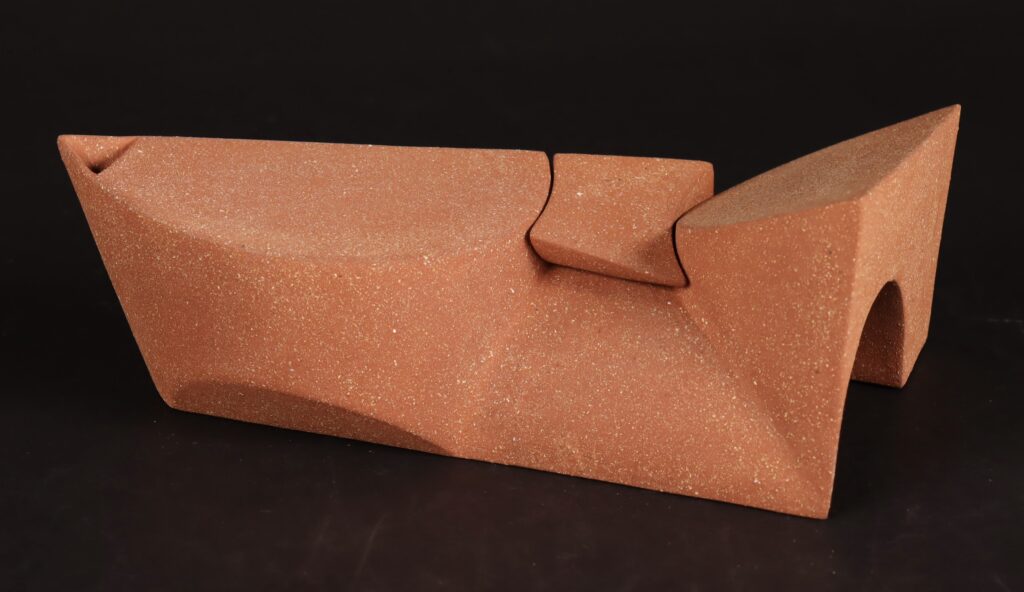
Anne Currier (American, b. 1949)
Teapot #20, with lid, 1991
unglazed terracotta
IMoDD 2025.35 Museum Purchase
Salt and Pepper Shakers
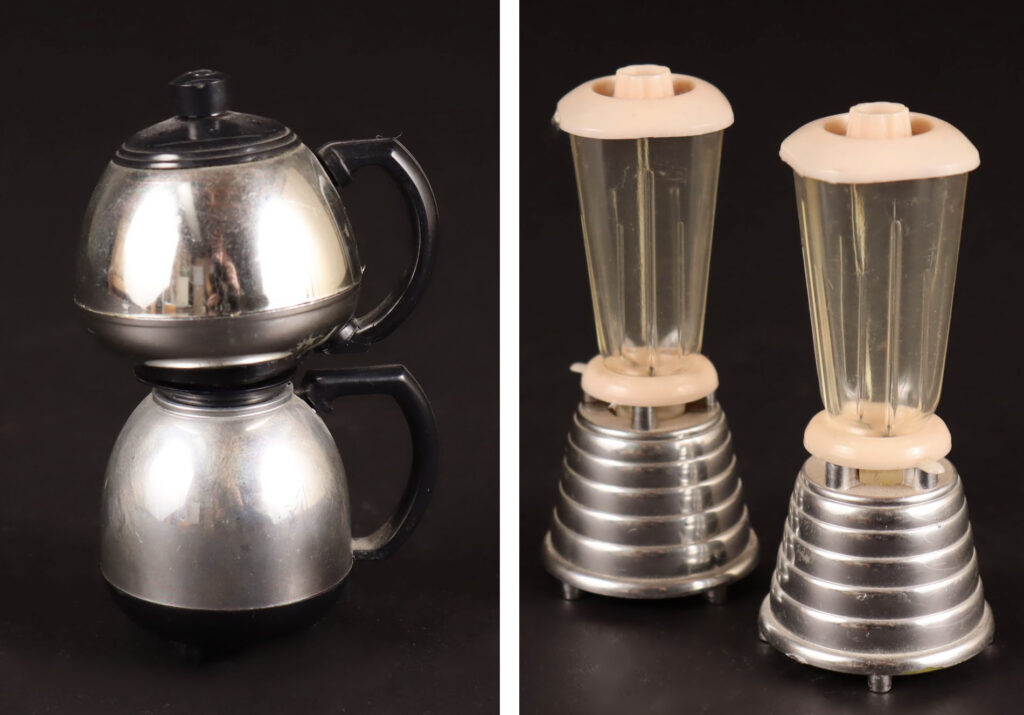
set of plastic black and chrome-look Sunbeam Coffeemaster salt & pepper shakers in the form of stacking Sunbeam drip coffee makers, 1950s
IMoDD 2026.63 Gift of Victoria Matranga
pair plastic blenders salt & pepper shakers imitating
Waring Beehive or Oster Osterizer, 1950s
2026.81 Gift of Victoria Matranga
Perc-O-Toaster
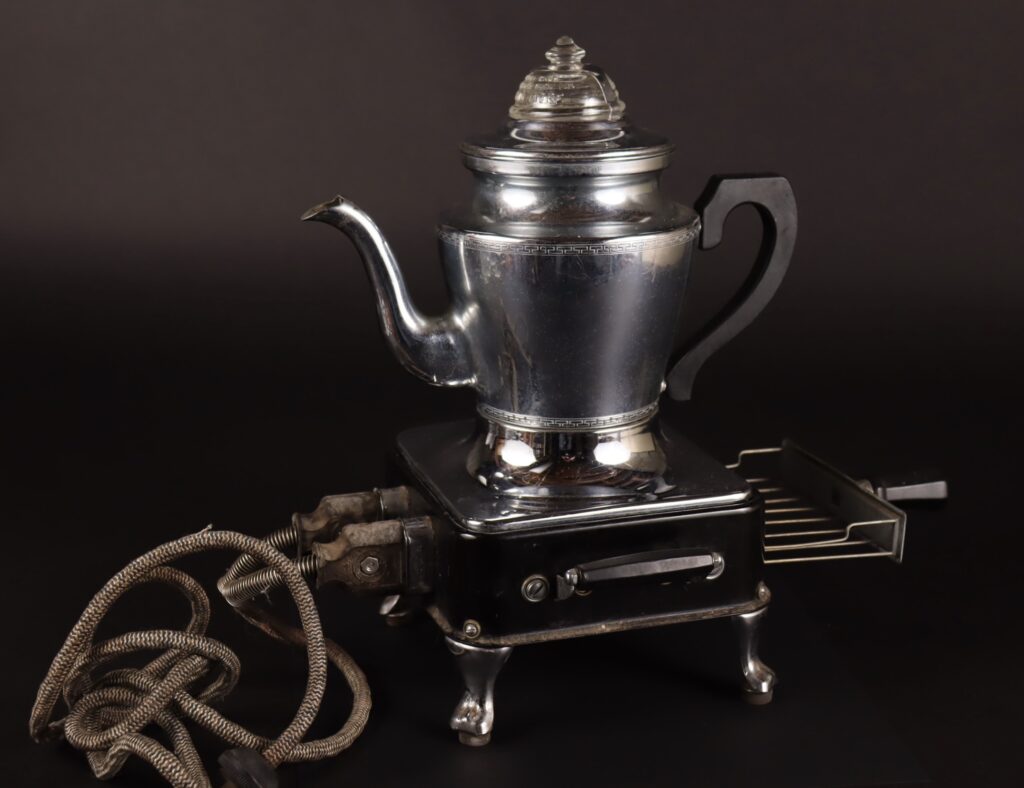
Armstrong Products Corp., Columbus, Ohio and Huntington, West Virginia (1899-mid-20th century)
Armstrong Perc-O-Toaster, a combo of a chrome percolater, with built in toaster, with small hot plate for cooking sausage and bacon or warming cereal, all on one stand, with cord to plug it in for use on the dining tabletop, 1920s
chrome, glass, electric cord
IMoDD 2026.66 Gift of Mary Ann Mays
Aluminum Cooking Untensil Company
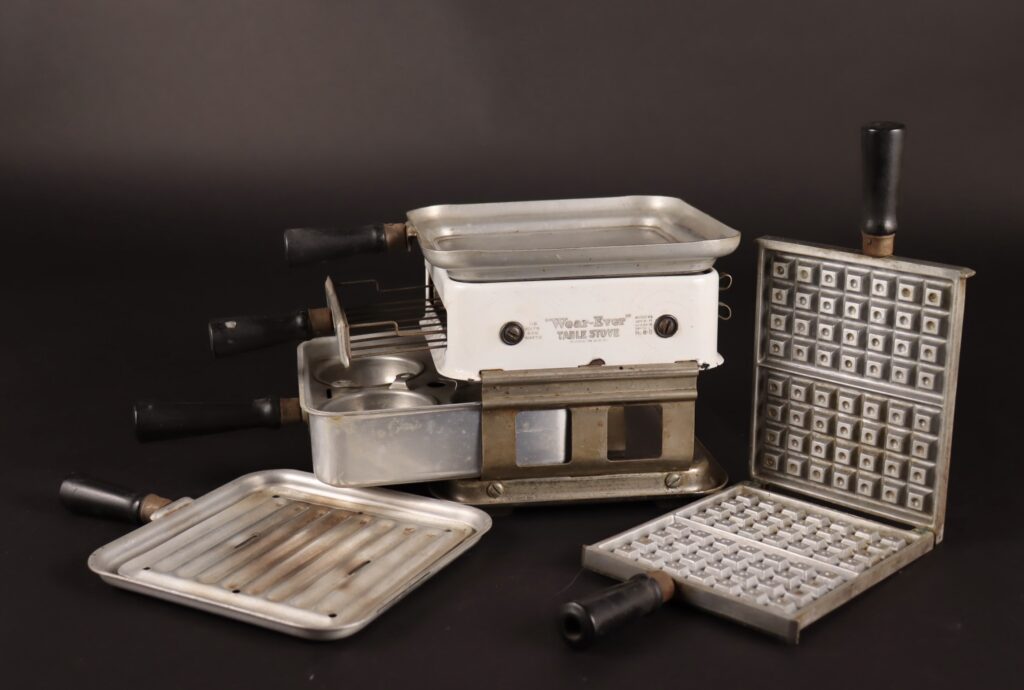
Aluminum Cooking Utensil Company (a subsidiary of ALCOA),
New Kensington, Pennsylvania 1903-, later Wear-Ever Aluminum, Inc.
Wear-Ever aluminum and enamel 1920s tabletop cooking stove with oven, egg poacher, waffle iron, bacon fryer, toaster, and cooking pan all-in-one appliance
IMoDD 2026.85 Museum Purchase
Cake Breakers
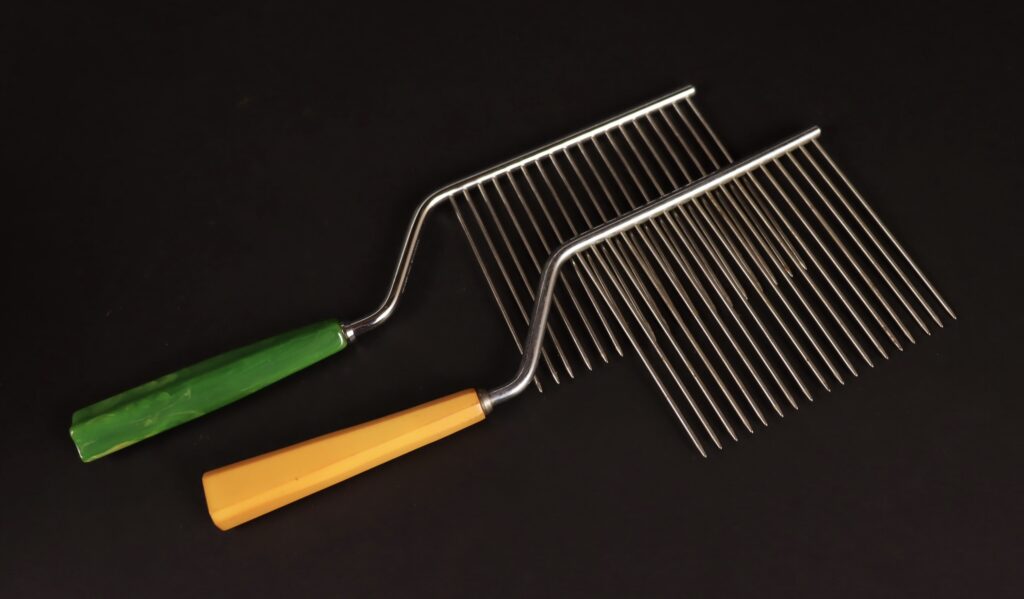
C.J. Schneider MFG. Co., Toledo, Ohio
2 Catalin/Bakelite handled cake breakers
chrome, plastic
IMoDD 2026.78, 2026.79 Gifts of Victoria Matranga
Edwin M. Knowles China Company
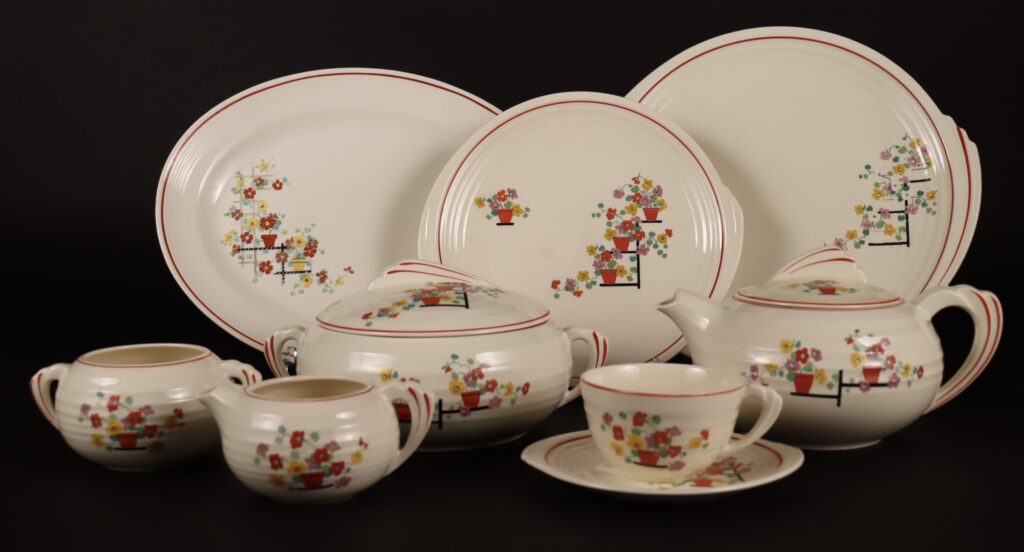
The Edwin M. Knowles China Co., Chester and Newell, West Virginia (1900-1962)
Yorktown shape Penthouse pattern earthenware dinnerware, 1930-1940
IMoDD 2026.50 Gift of Alan and Barbara Eisenberg
Rudolph Staffel
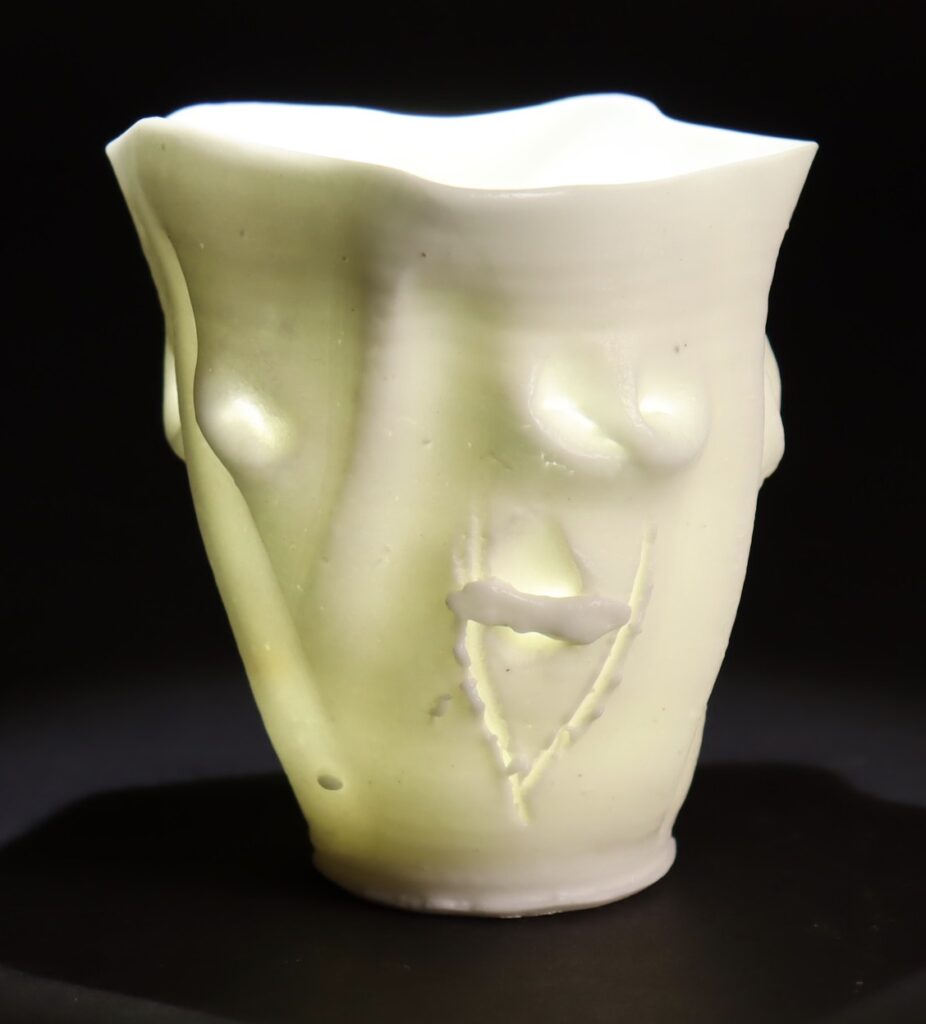
Rudolph Staffel (American, 1911-2002)
translucent porcelain Light Gatherer cup, 20th century
IMoDD 2026.52 Museum Purchase
Hopalong Cassidy lunchbox
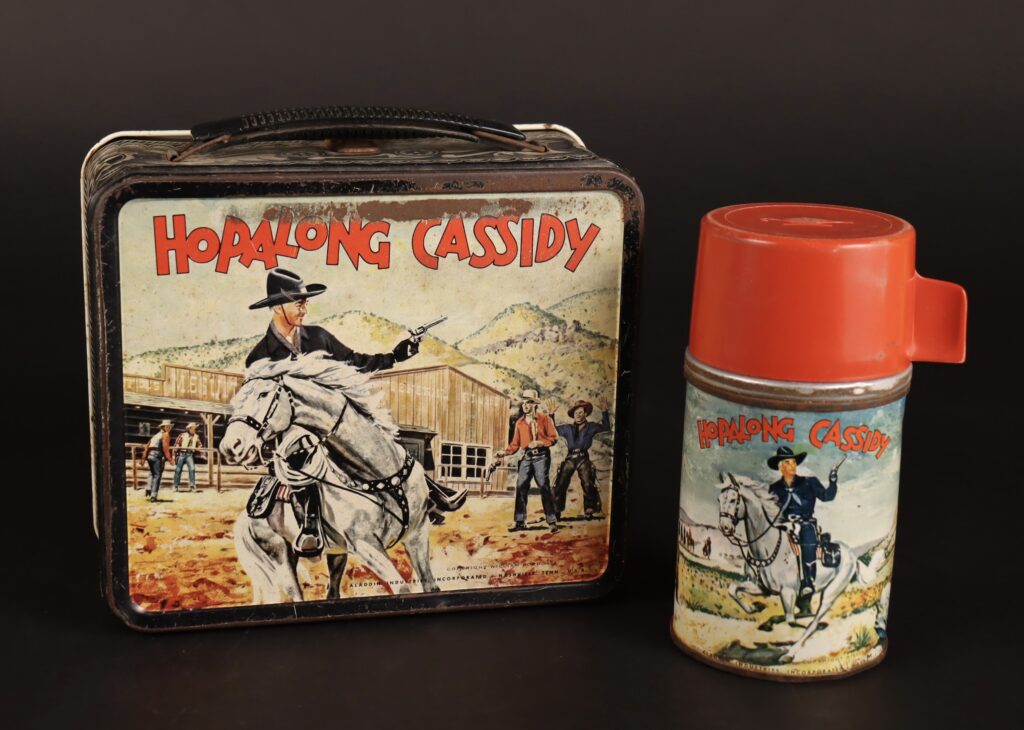
Aladdin Industries Incorporated (established Chicago, 1908)
Hopalong Cassidy theme metal lunch box and thermos, 1954
tin, with lithography, with red plastic lid on thermos
note: this is the first “character” lunch box issued by Aladdin Industries
IMoDD 2024.55 Museum Purchase
Tupperware
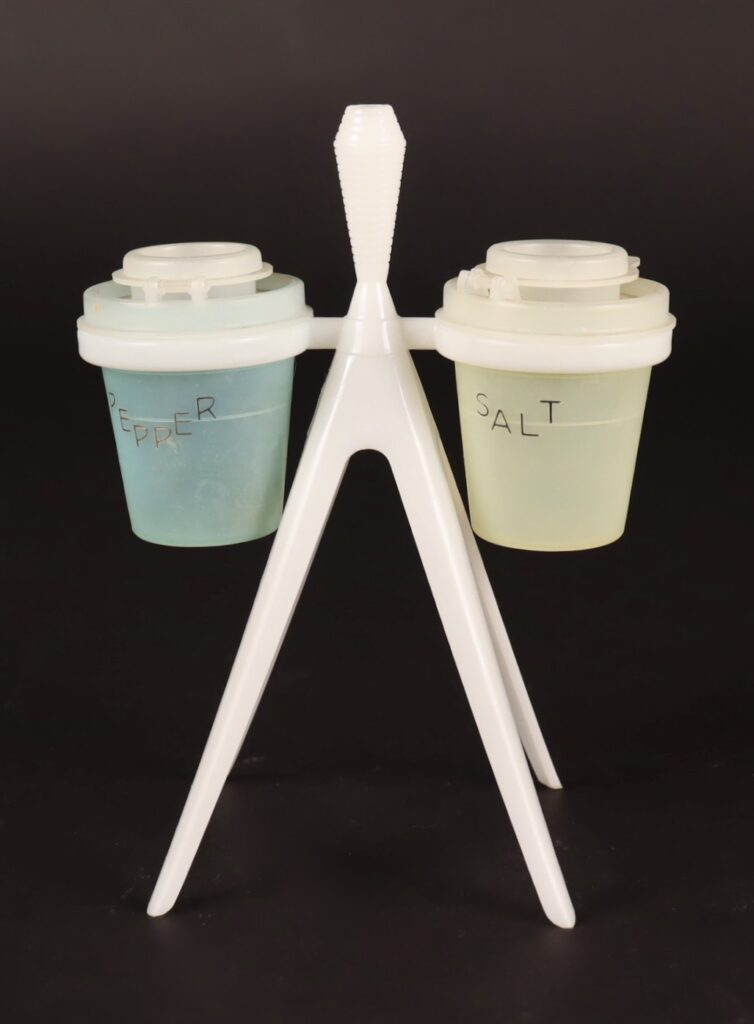
Tupperware, Leominster, Massachusetts (1946-1924)
Tupperware “Mini Millionaire” atomic-style salt & pepper shaker set on white plastic 4-legged stand, containers with “Salt” and “Pepper” marked on the exterior and built in toothpick holder, late 1940s-1950s
IMoDD 2026.59 Gift of Victoria Matranga
Goebel
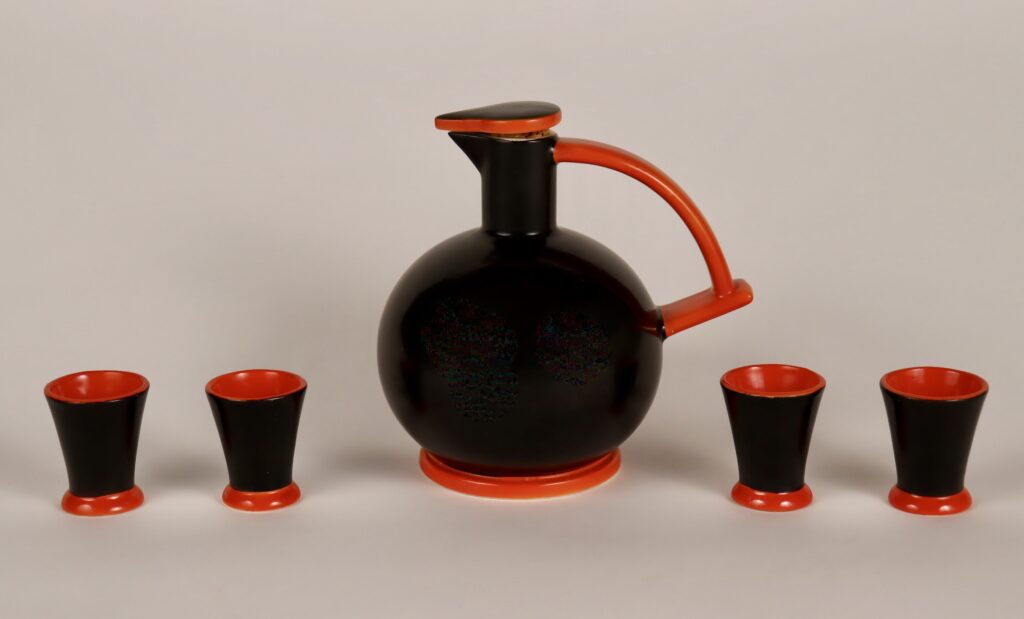
Goebel, Germany
Art Deco glazed black with orange accents earthenware carafe/decanter with 4 small cups, 1930s
IMoDD 2024.81 Museum Purchase
Larabee’s Lunchbox Blook
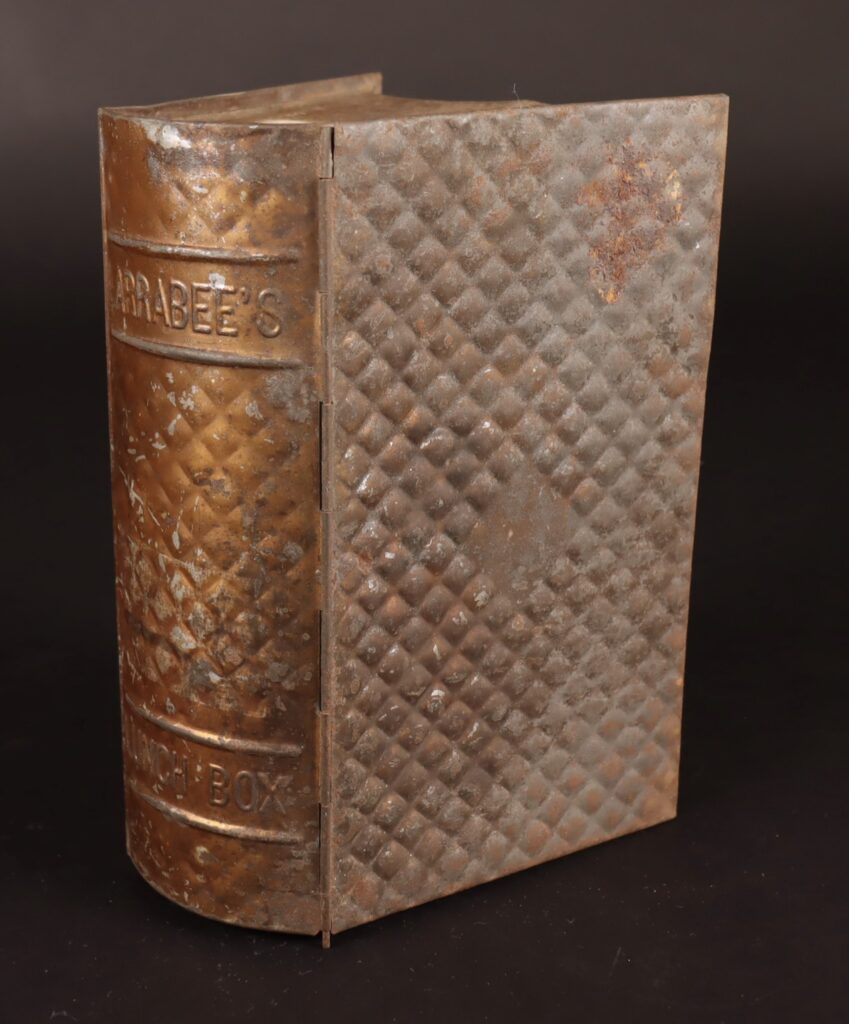
Larrabee’s
Larrabee’s Lunch Box made of tin and shaped like a book, also referred to as a blook, 1890s
IMoDD 2026.33 Museum Purchase
Georg Jensen
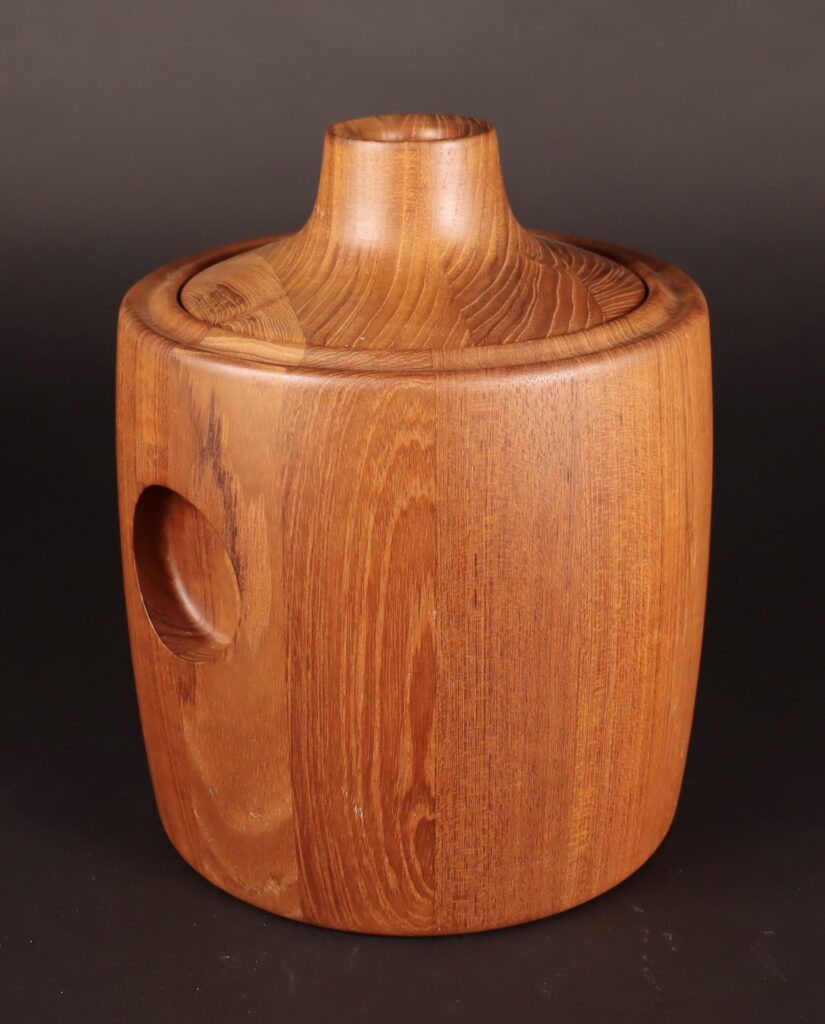
Georg Jensen, Inc., Denmark, established 1904
Henning Koppel (Denmark, 1918-1981)
2-piece Mid Century Modern teak wood ice bucket with lid, 1960s
IMoDD 2025.118 Gift of Heide and Jim Klein
Clarice Cliff
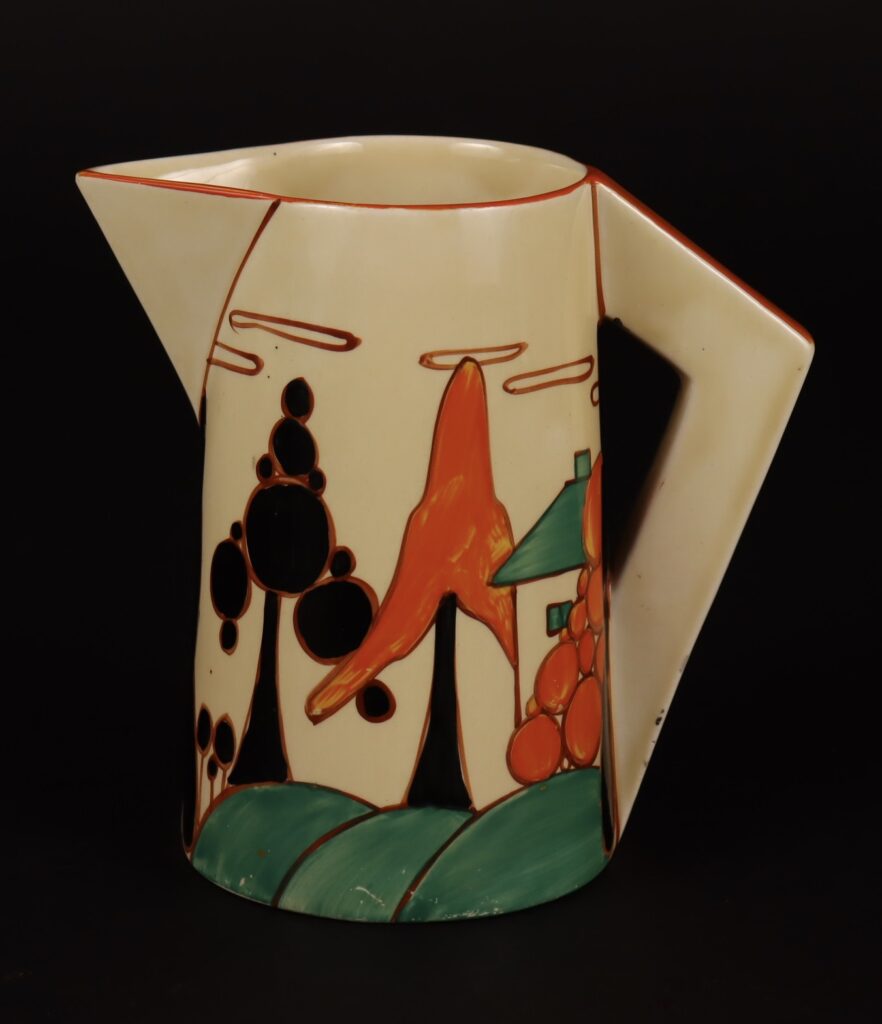
Clarice Cliff, Newport Pottery
Fantasque Bizarre line conical jug in the Orange Trees & House pattern, ca. 1930-1931
earthenware, hand-painted and glazed
IMoDD 2026.88 Gift of Kenneth J. Rosa
Hamburger Coaster
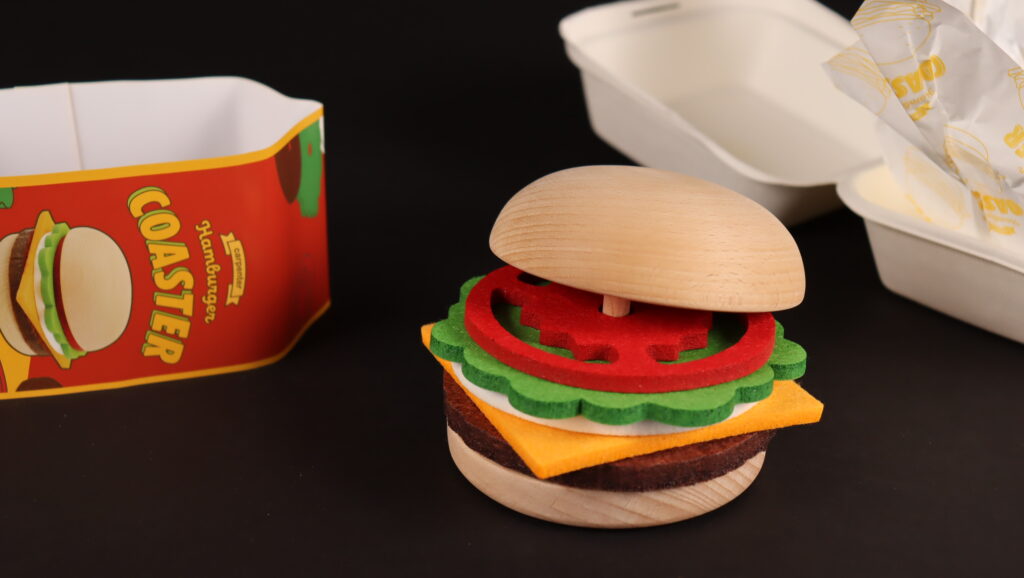
Taiwan
Carpenter Brother & Sister Technology
Hamburger Coaster set comprised of beechwood bun, 5 wool felt coasters (meat, cheese, lettuce, onion, tomato), all in Styrofoam takeout box, 2025
cardboard, beechwood, wool felt
IMoDD 2025.95 Museum Purchase
Trader Vic’s hibachi set
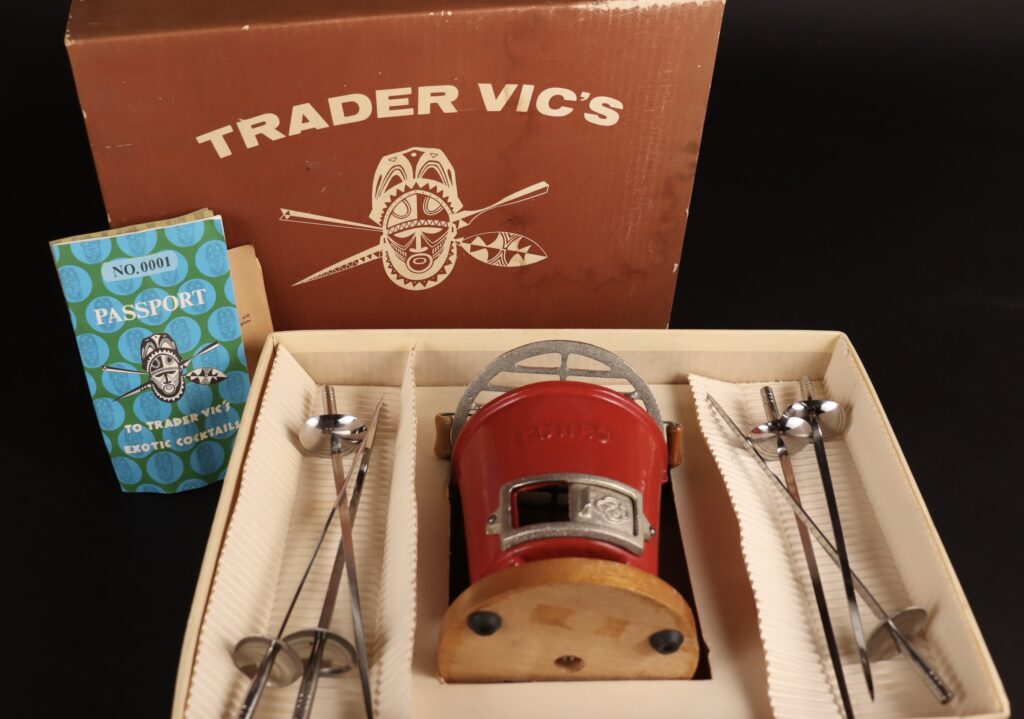
Japan
Trader Vic’s Tiki Bar tabletop hibachi set in original box including cast iron grill, 6 saber-shaped and sharp stainless steel skewers, brochure with cocktail recipes, brochure with exotic Trader Vic’s food, and page with Chinese recipes, circa 1960s-1970s
cast iron, stainless steel, paper
IMoDD 2024.30 Gift of Jane C. Busch
Sara Lee ashtray
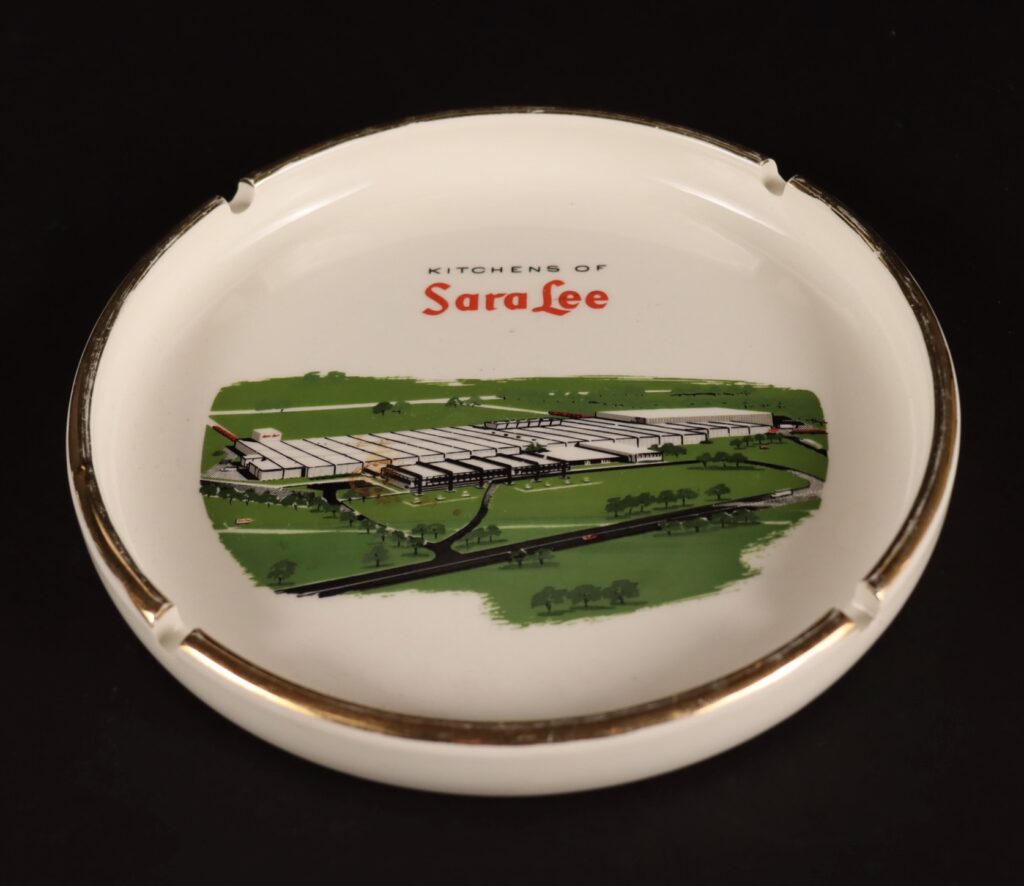
KAN-DER, Chicago, mid-20th century
shallow round ceramic ashtray with the image of the “Kitchens of Sara Lee” as topmark, and a gold rim with four slots for cigarettes to rest, mid-20th century
IMoDD 2026.86 Gift of Fran Morris Rossman
Tiki tumblers
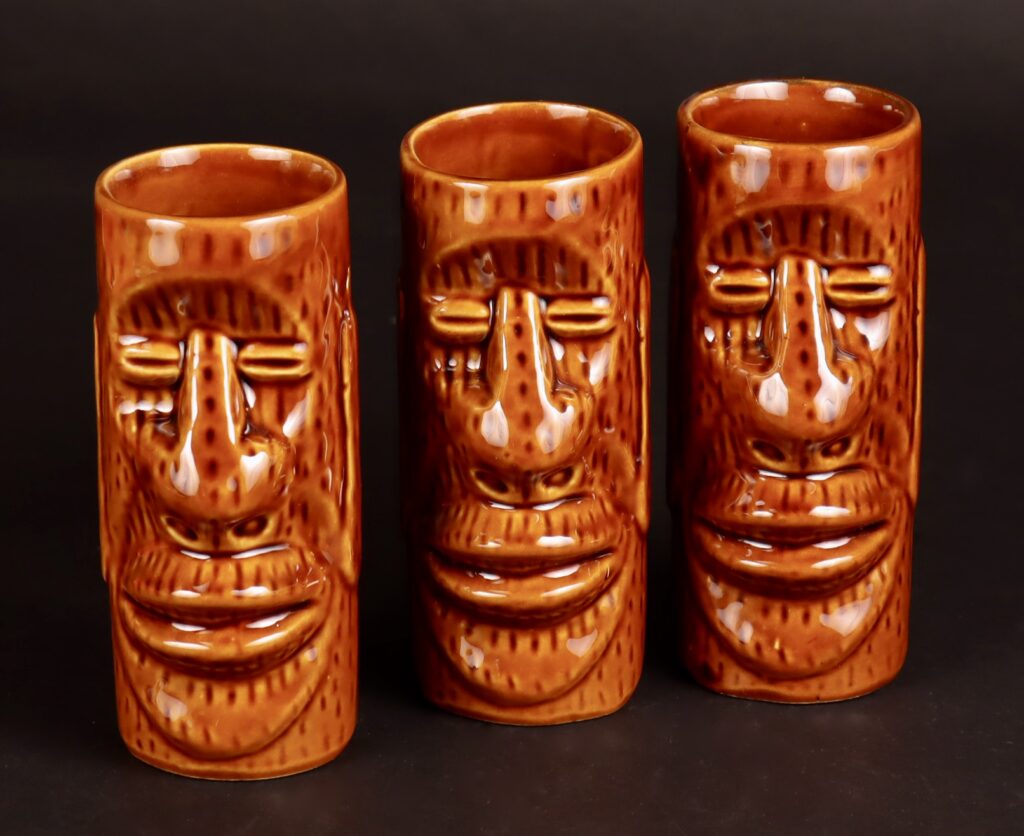
3 Tiki Moai head brown-glazed, earthenware, mold-made tumblers from the Kahiki Supper Club in Columbus, Ohio, which was built in 1961, listed on the National Register in 1997, closed, and was demolished in 2000.
ceramic
IMoDD 2024.38 Gift of Jane C. Busch
West Bend Thermo-Serv
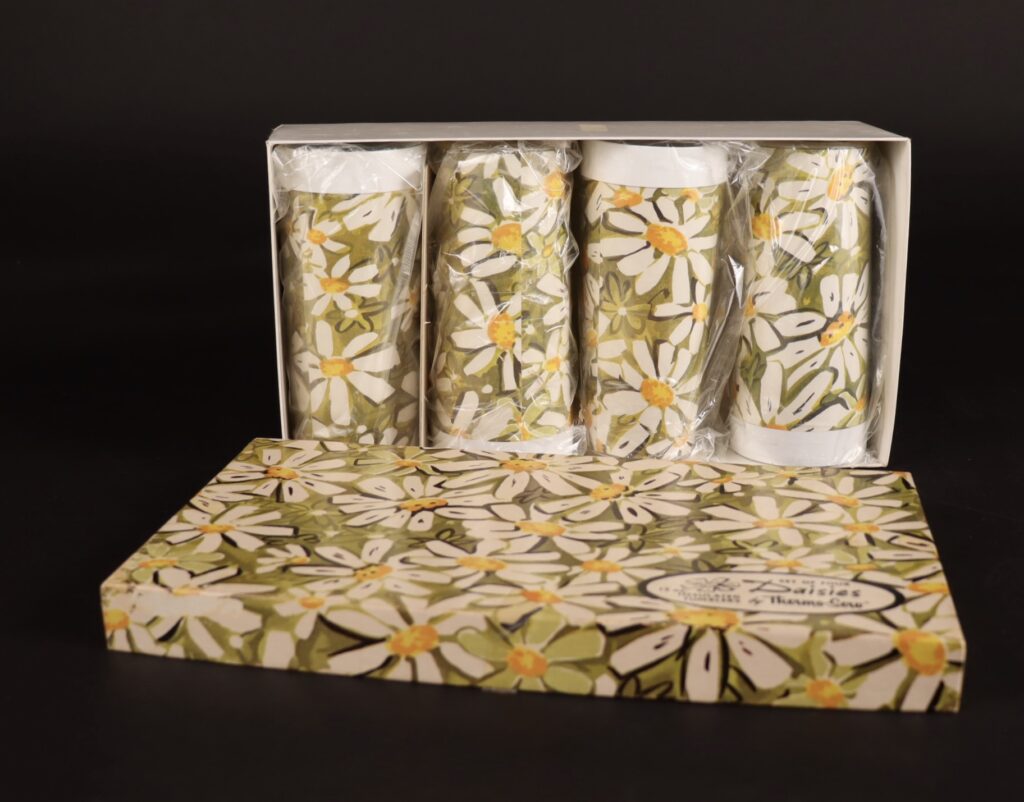
West Bend Thermo-Serv Inc., Anoka, Minnesota (established 1956-)
set of 4 12-ounce Thermo-Serv insulated tumblers with the Daisy pattern in the original box, 1970s
plastic
2025.44 Gift of Rich and Fran Morris-Rosman
Mid-Century Modern Lazy Susan
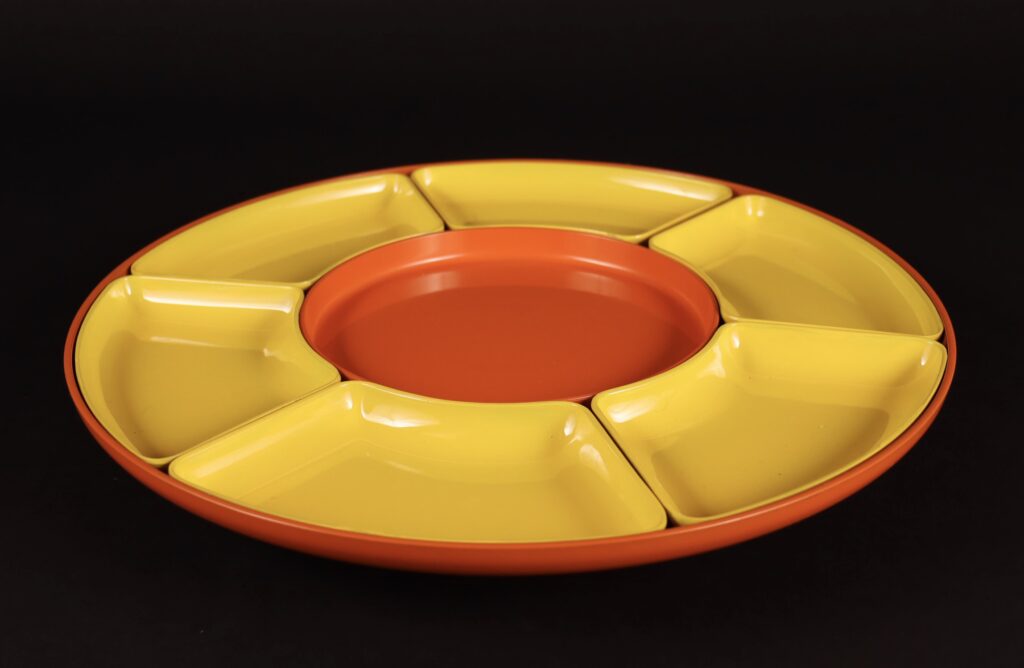
Japan
orange and yellow plastic 16” diameter Mid-Century Modern Lazy Susan divided relish tray made for Lord & Taylor in Japan with original label, with removable trays, popular in the 1960s-1970s
plastic
IMoDD 2025.129 Museum Purchase
Royal Dalton
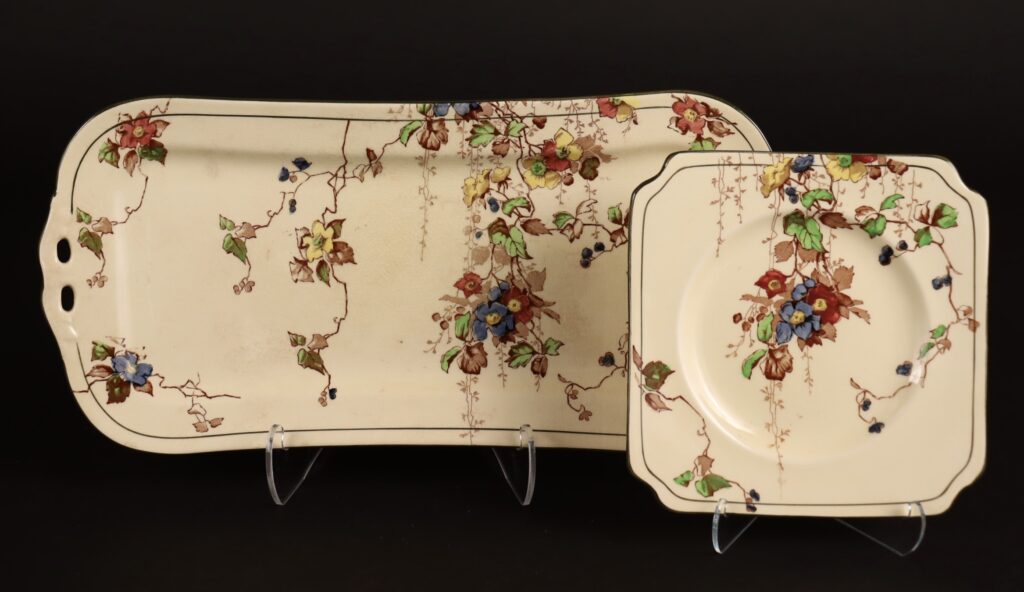
Royal Doulton, England, est. 1815
2 Kew pattern plates,1929-1972
earthenware, glazed, with decals
IMoDD 2025.106 Gift of Ellen Katz
Minton China
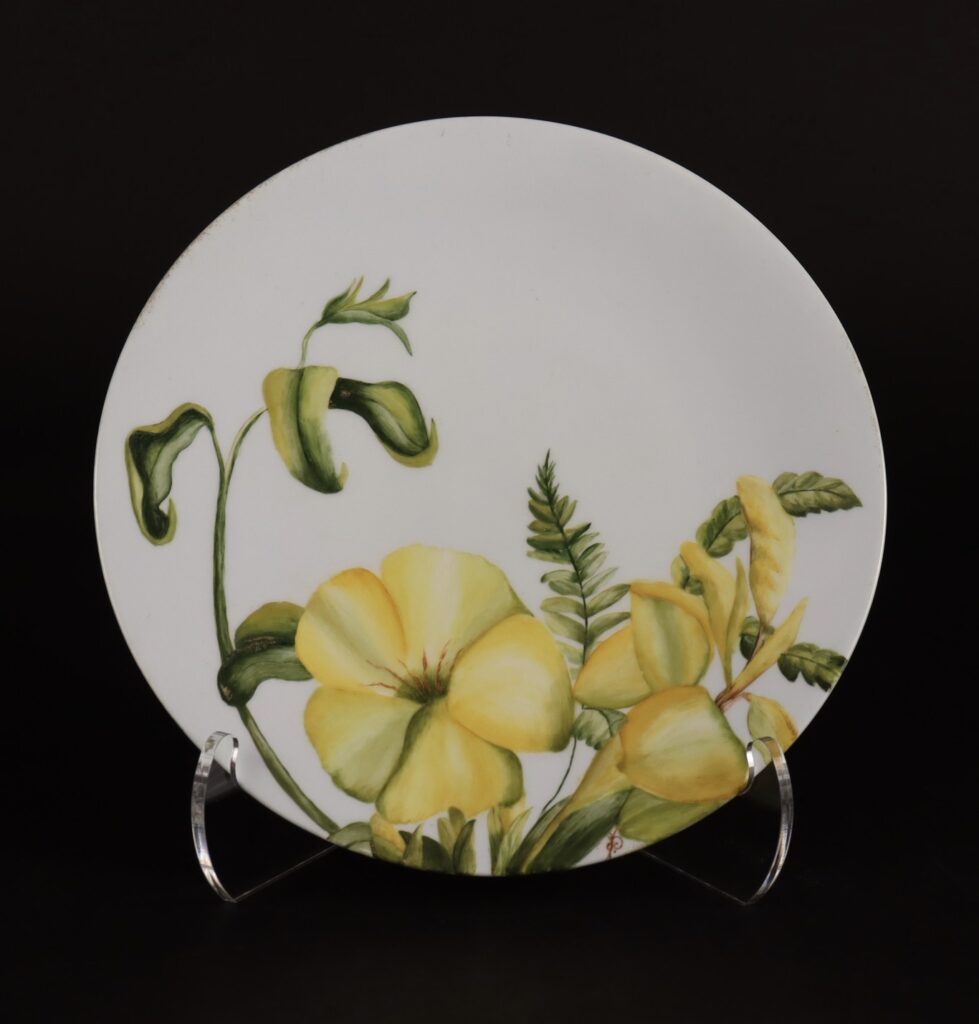
Minton China, Stoke-on-Trent, England (1793-1968 merged with Royal Doulton)
Joyce and Marjorie (Madge) Beaumont, china painters
Minton China china-painted plate, signed, 1880s
porcelain, china-painted
Note: Joyce Beaumont and her sister Marjorie (Madge), who lived in Derbyshire (England) in the 1880s china-painted dishes for the local factory in Staffordshire.
IMoDD 2025.41 Museum Purchase
CEDO, Saigon
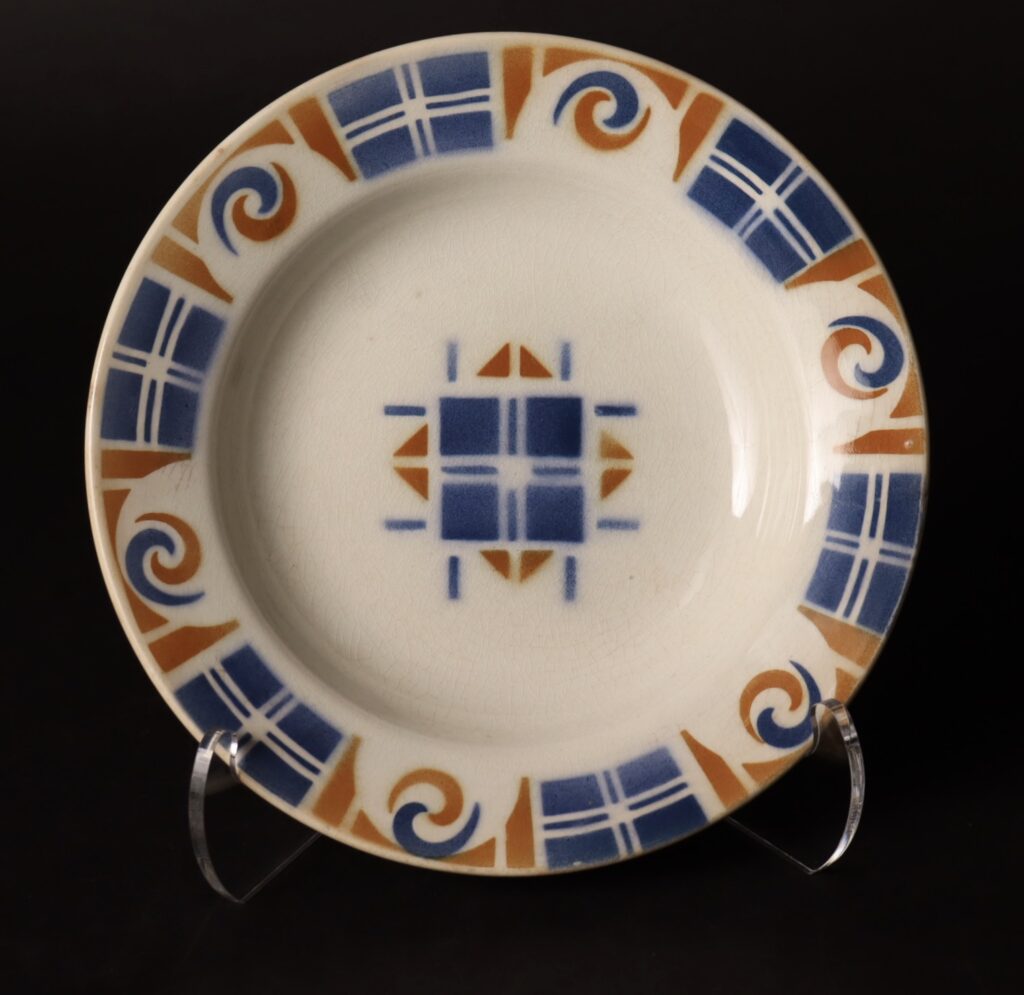
CEDO, Saigon
tan and blue stencil-patterned underglaze earthenware bowl marked “Saigon” and “CEDO” in a triangle on the back, n.d.
earthenware, stencil pattern, glazed
IMoDD 2025.53 Gift of Carol Goldstein
Mirro
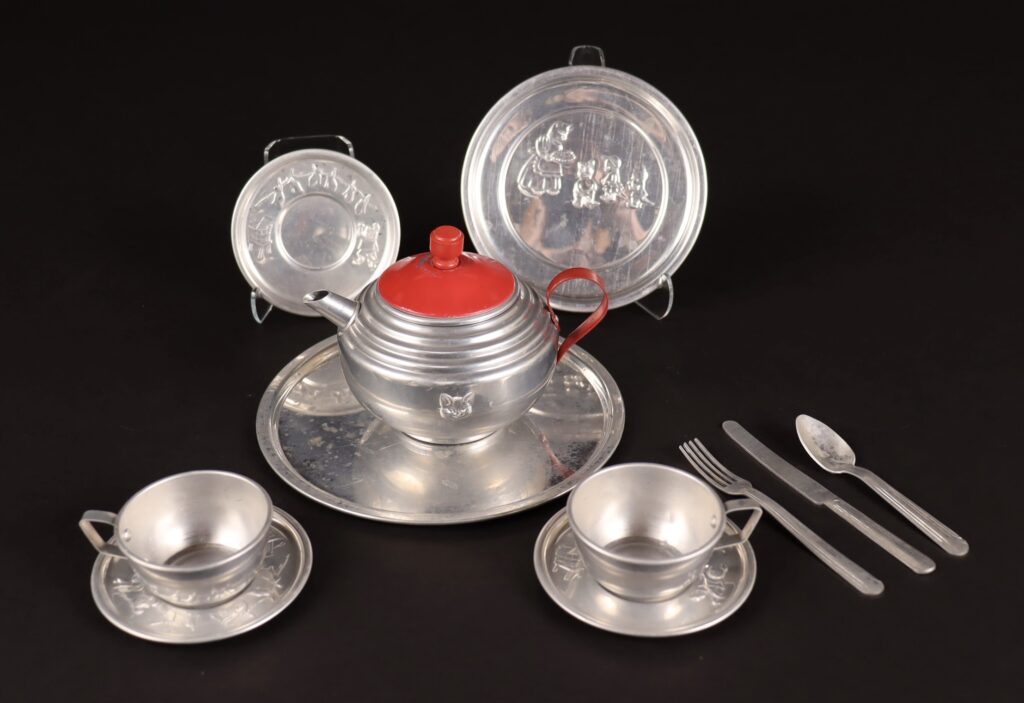
Mirro, Manitowoc, Wisconsin (1909-2003)
21-piece aluminum child’s metal tea set, ca. 1950s
IMoDD 2025.116 Gift of Cynthia Sanford
Phoenicia Diner mug
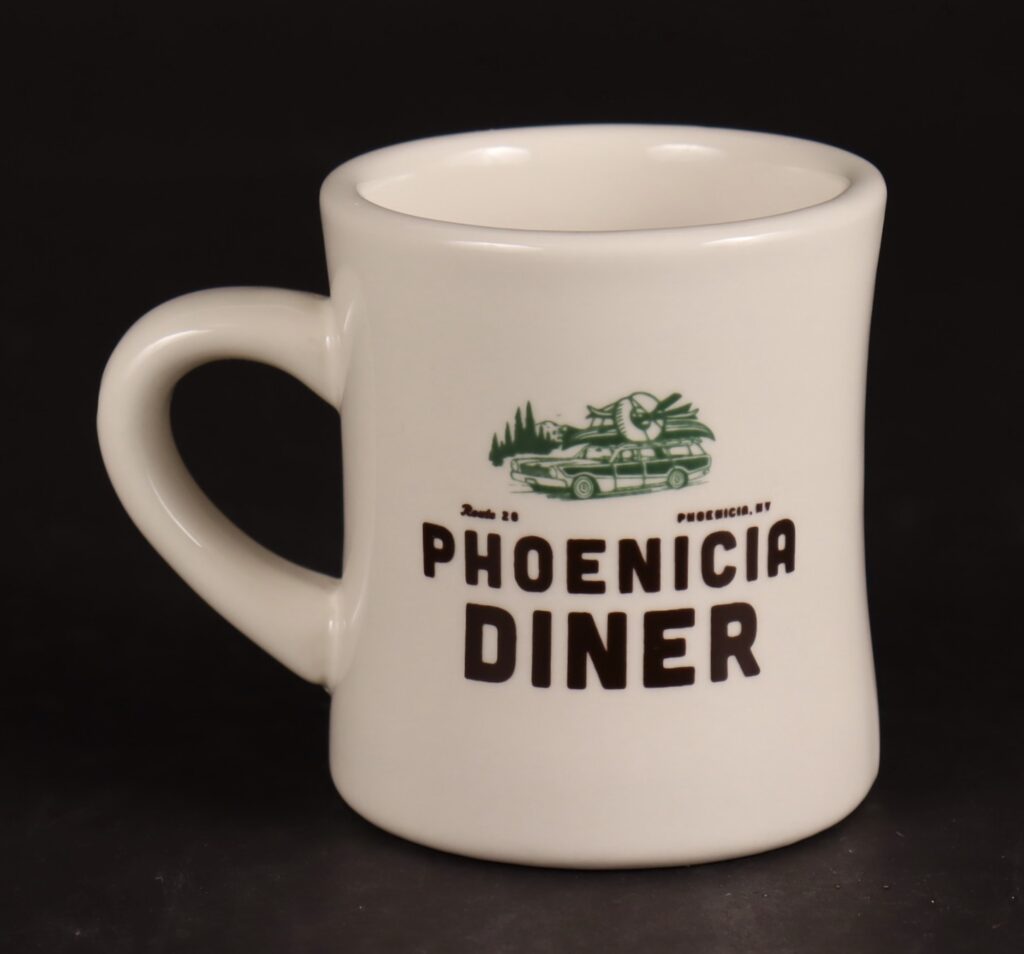
M-Ware CHINA, Toledo, Ohio
heavy restaurant ware Phoenicia Diner white diner mug, 2025
restaurant ware, glazed with decals
IMoDD 2025.39 Museum Purchase
Eva Zeisel Museum prototype cup and saucer
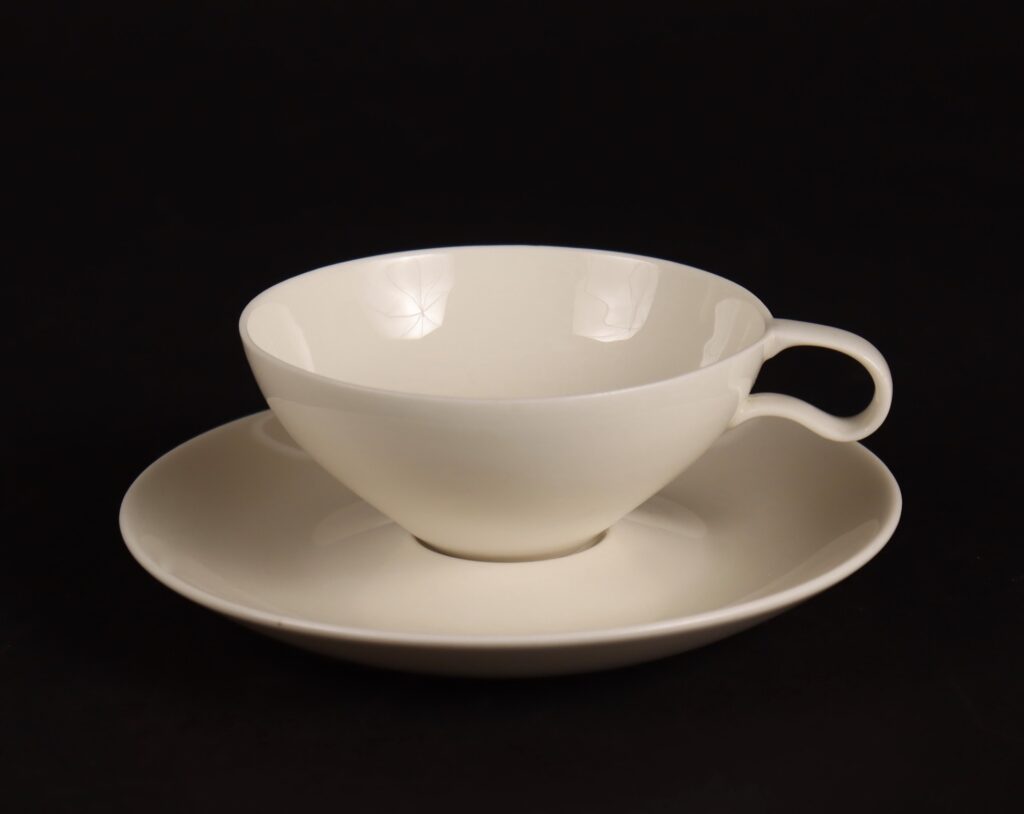
Castleton China Company, New Castle, Pennsylvania (1940-1974)
Shenango Pottery Company, New Castle, Pennsylvania (1901-2009)
Eva Zeisel, designer (American, b. Hungary 1906-2011)
Museum white dinnerware, designed 1942-45, manufactured 1949-74
coffee cup and saucer with prototype drooping handle on cup
porcelain, glazed
IMoDD 2024.47 Gift of Marc Toussaint
Edith Heath
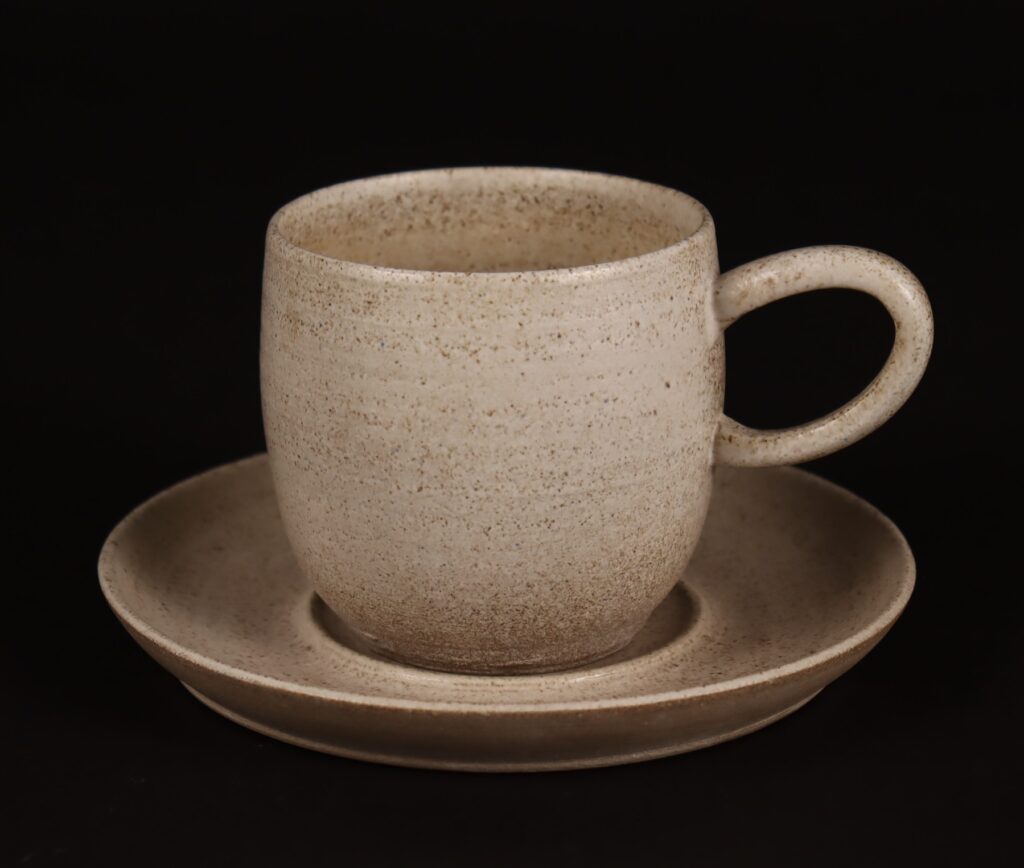
Edith Heath (American, 1911-2005)
hand thrown stoneware matching cup and saucer with speckled gray/beige glaze, unglazed on the bottoms, ca. 1945-47.
IMoDD 2025.113 Gift of Casey O’Connor
Bennington Pottery
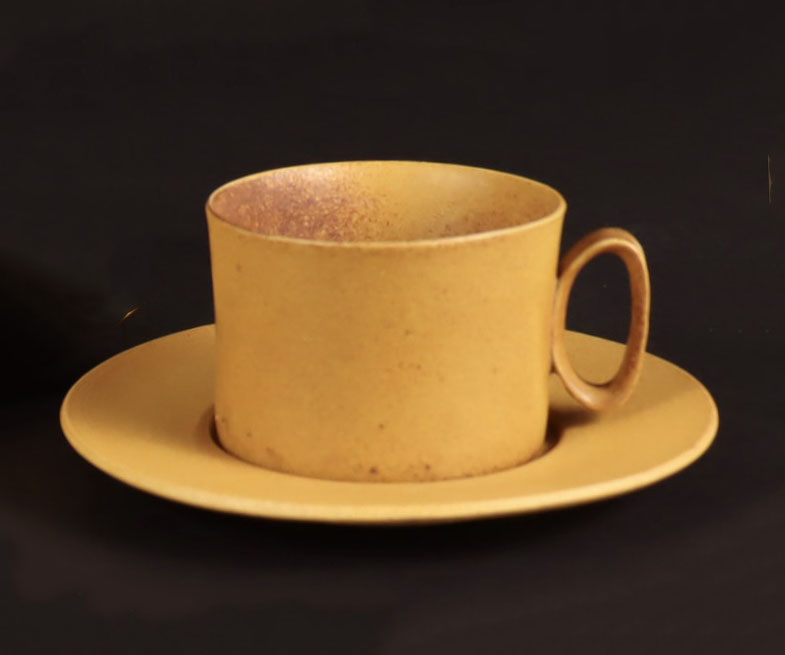
Bennington Pottery/Bennington Potters, Bennington, Vermont (established 1948)
Yusuke Aida, designer, (b. Tokyo 1931)
Classic Bennington Pottery cups ((5) and saucers (3) in matte amber glaze designed by Yusuke Aida ca. 1961, but probably from more recent production line
IMoDD 2025.74 Museum Purchase
Frankoma Pottery
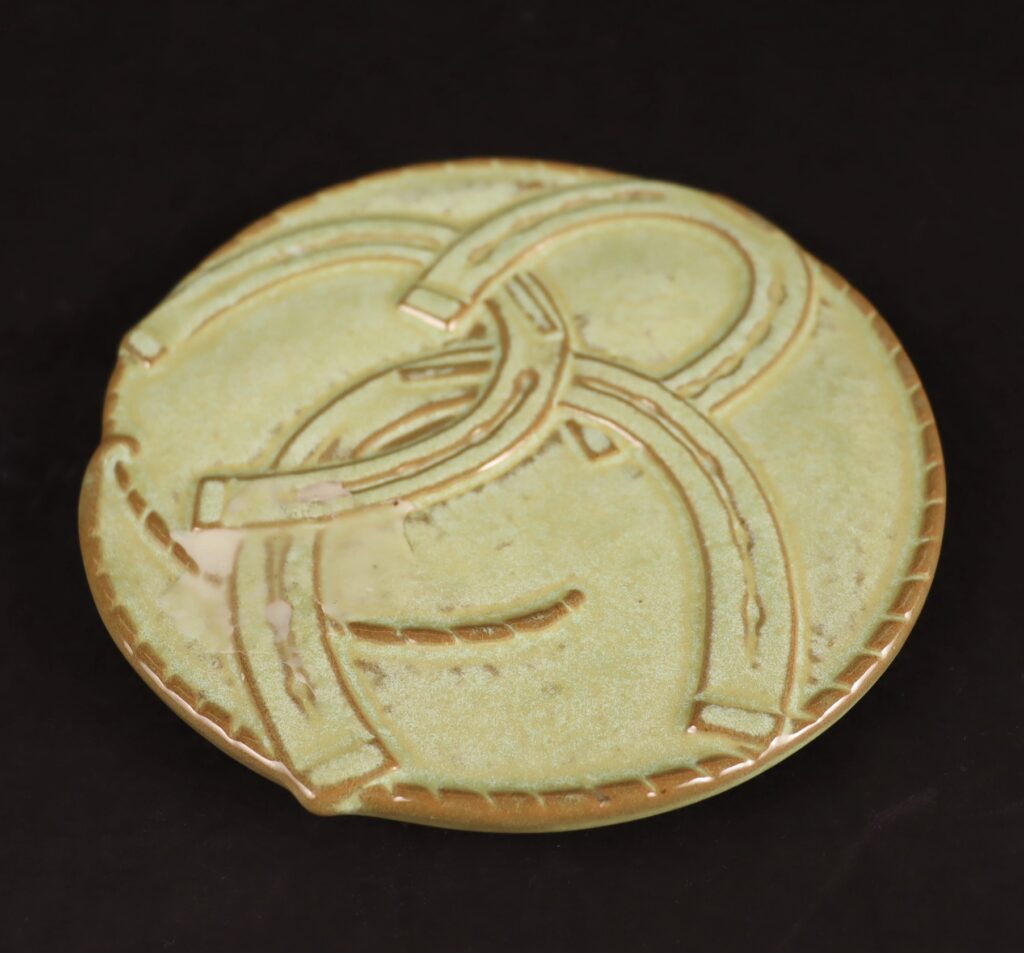
Frankoma Pottery, Norman, Oklahoma (established 1933-2010)
Frankoma Pottery “Good Luck” trivet with green glaze and horseshoe motif
earthenware, glazed
IMoDD 2024.79 Gift of Harris Safier
Air France Concorde bottle opener
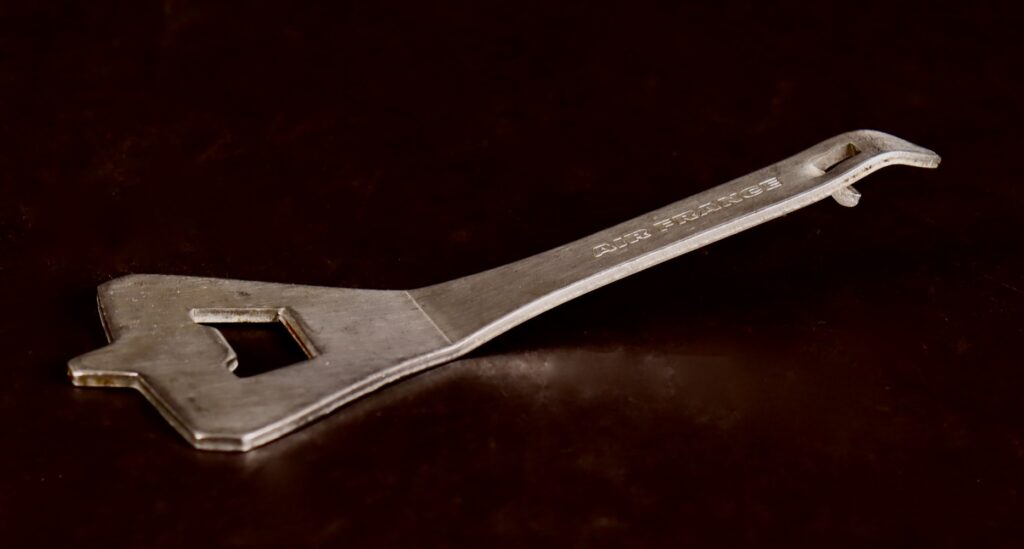
Air France Concorde bottle opener/can opener shaped like the Concorde
stainless steel
IMoDD 2024.50 Museum Purchase
Lalique
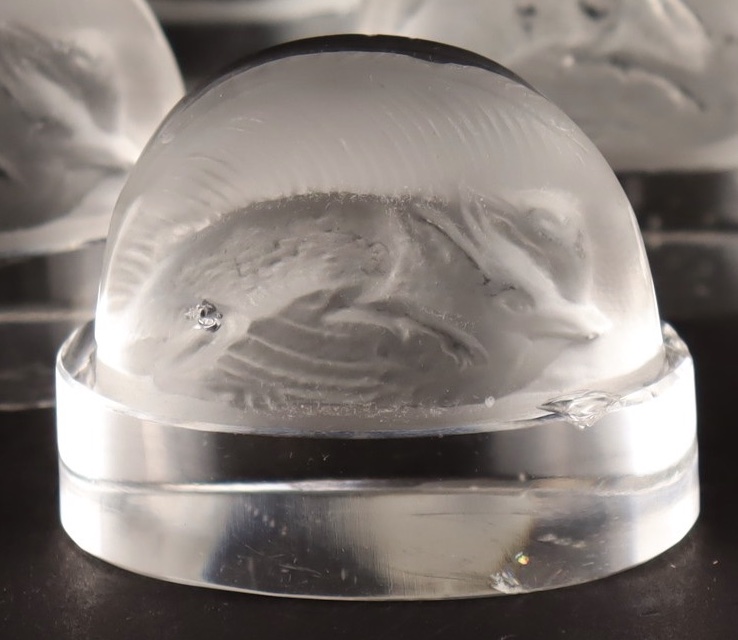
Lalique, Paris, France (established 1888-)
Lalique glass placecard holder, with image of fox with jaws around
neck of a goose, ca. 1924
IMoDD 2025.82 Gift of Harriet Flehinger
Rubbermaid
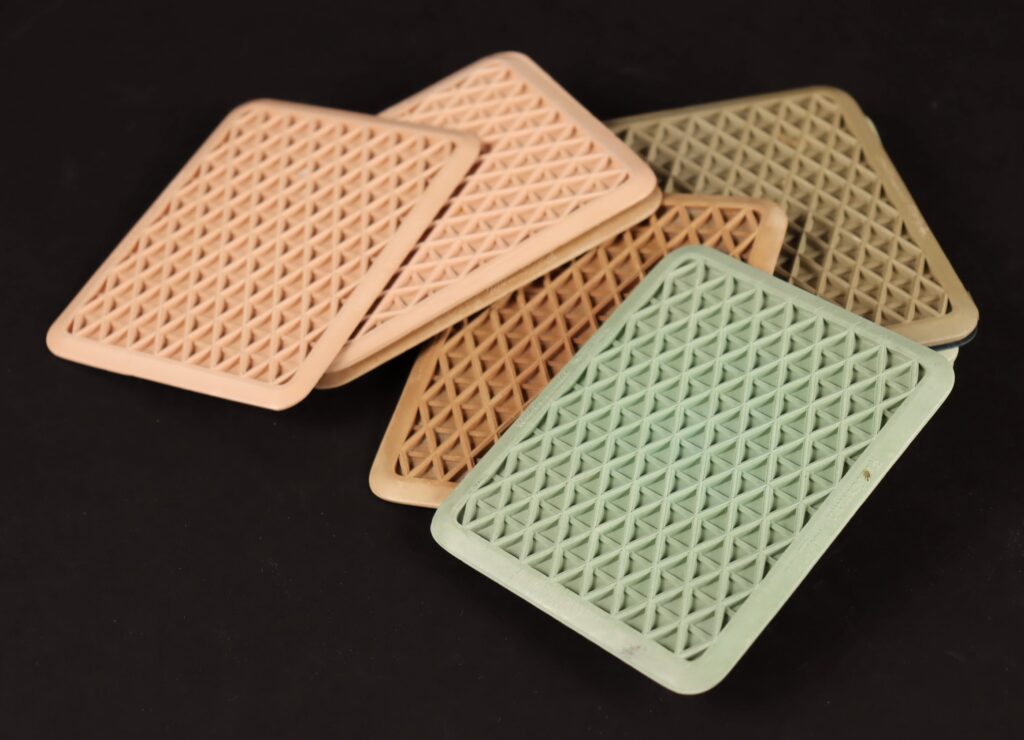
Wooster Rubber Company, Wooster, Ohio (1920-1999)
Rubbermaid coasters, miniature versions of Rubbermaid’s Kar-Rugs, 1950s
Note the company started in 1920, making balloons.
IMoDD 2026.62 Gift of Victoria Matranga
Baby Bunting “Baby’s Plate”
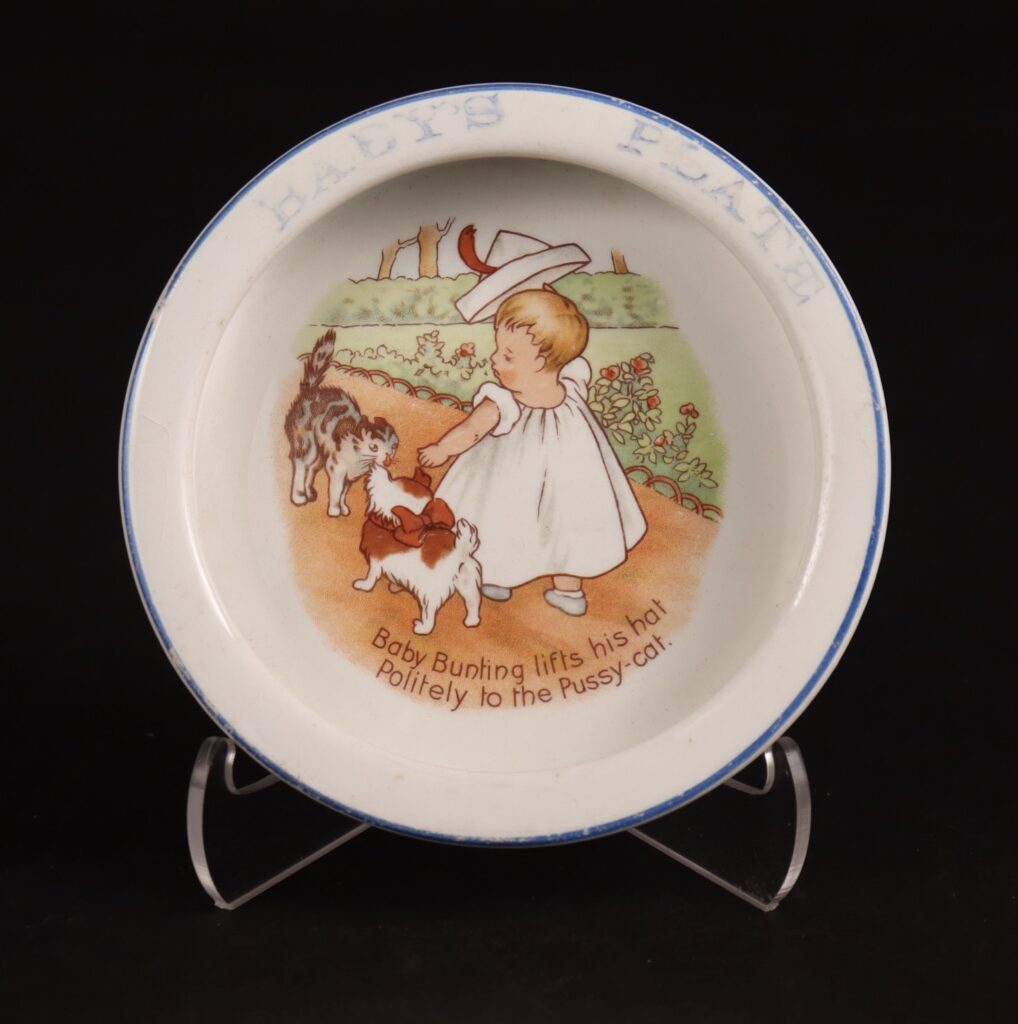
English manufacturer, early 20th century
small 5.25” diameter ceramic Baby Bunting “Baby’s Plate” dish, early 20th century
note: belonged to the father of donor Jane Busch, Stanley Busch (03/29/1917-04/28/2015)
ceramic, decals, glaze
IMoDD 2024.32 Gift of Jane C. Busch
Constantin Boym
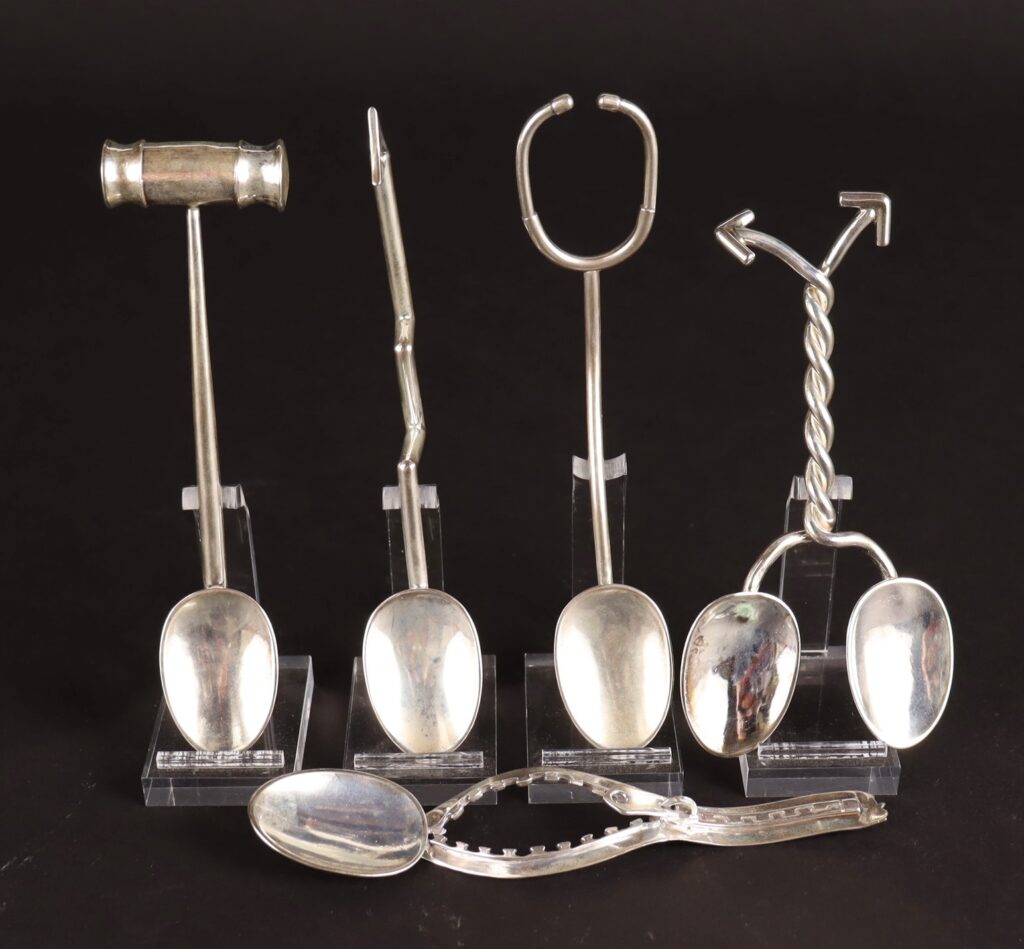
Constantin Boym (American, b. Russia 1955), designer
and Meredith Beau, (American, Little Rock, Arkansas), designer
Bill Clinton’s Sex Scandal Spoon, Stock Market Spoon, Healthcare Bill Spoon, Whitewater Spoon,Gays in the Military Spoon, from the silver souvenir Stirring Spoons series, 1999
silver
IMoDD 2025.88-92 Gifts of Constantin Boym
Constantin Boym
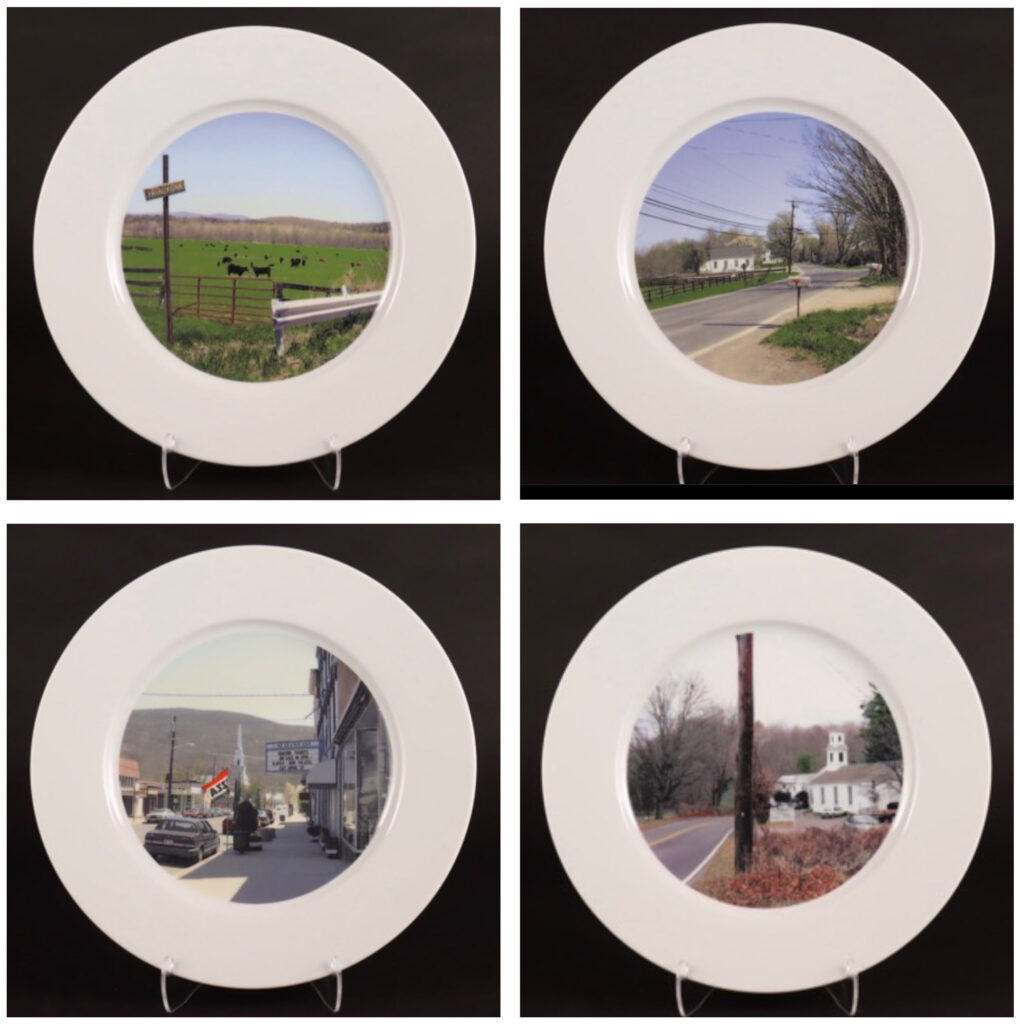
Conduit Group, China, manufacturer
Constantin Boym (American, b. Russia 1955), designer
Upstate Plates Collection porcelain plates featuring decal images of Ellenville, New York with a pizza sign; Kerhonkson, New York with a mailbox; Pataukunk, New York with cows; Kripplebush, New York with a phone pole, 2002 porcelain, with decals, Limited Edition of 300
IMoDD 2025.70-73 Gift of Constantin Boym
Children’s Set
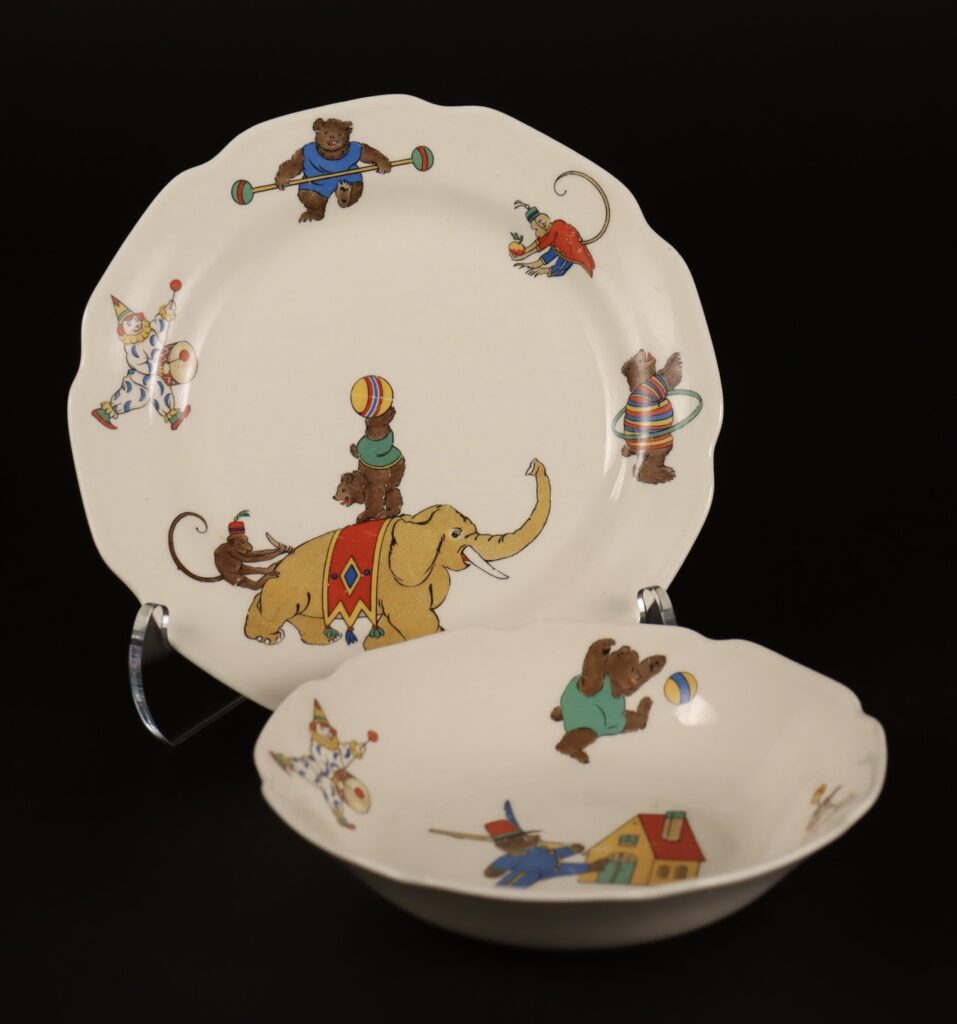
children’s plate and bowl set with fluted rims, early 1930s
earthenware, glazed, with decals
IMoDD 2025.105 Gifts of Cynthia Focarino in Memory of Joseph Focarino
Firestone
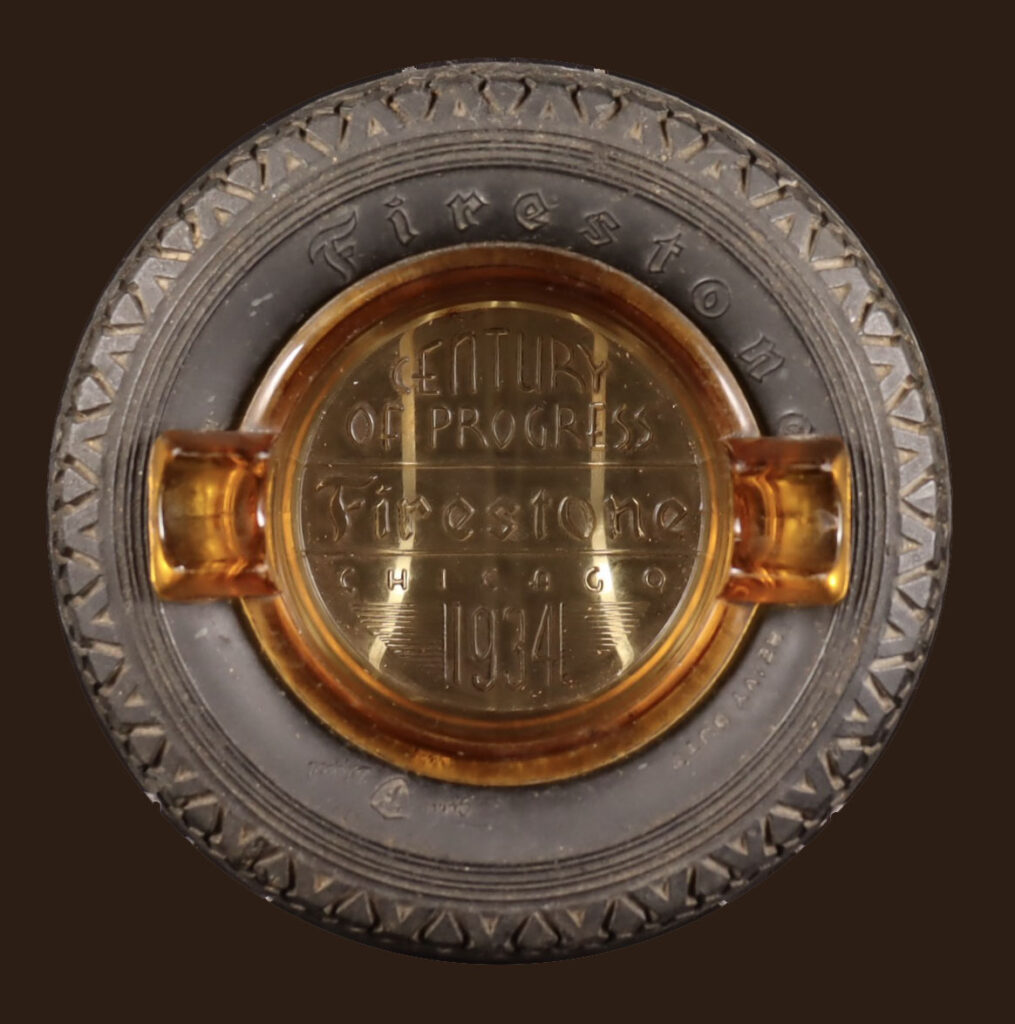
Firestone Chicago World’s Fair Century of Progress 1934 souvenir ashtray designed as a rubber tire with a amber glass insert top marked “Century of Progress Firestone Chicago 1934”
rubber, glass
IMoDD 2026.31 Gift of Susan Wineberg
McDonald’s Frork
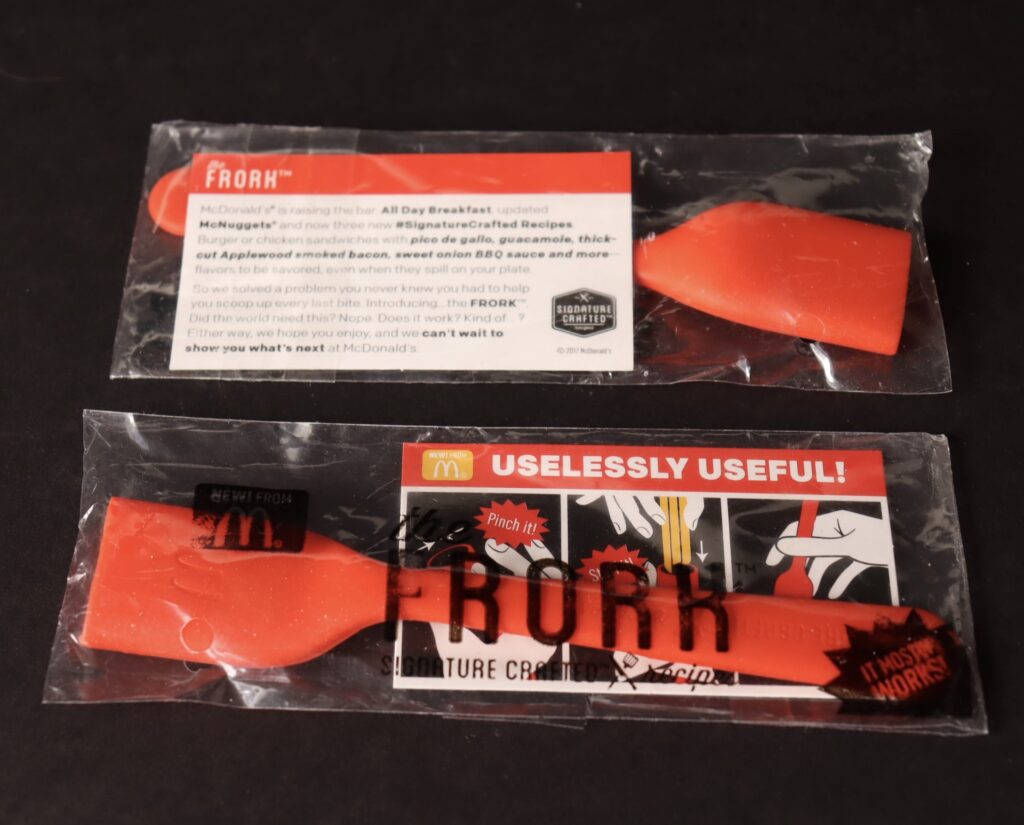
McDonald’s Corporation
McDonald’s red silicone Frork® utensil, May, 2017
IMoDD 2025.96 Museum Purchase
Eva Zeisel Museum with Mandalay pattern
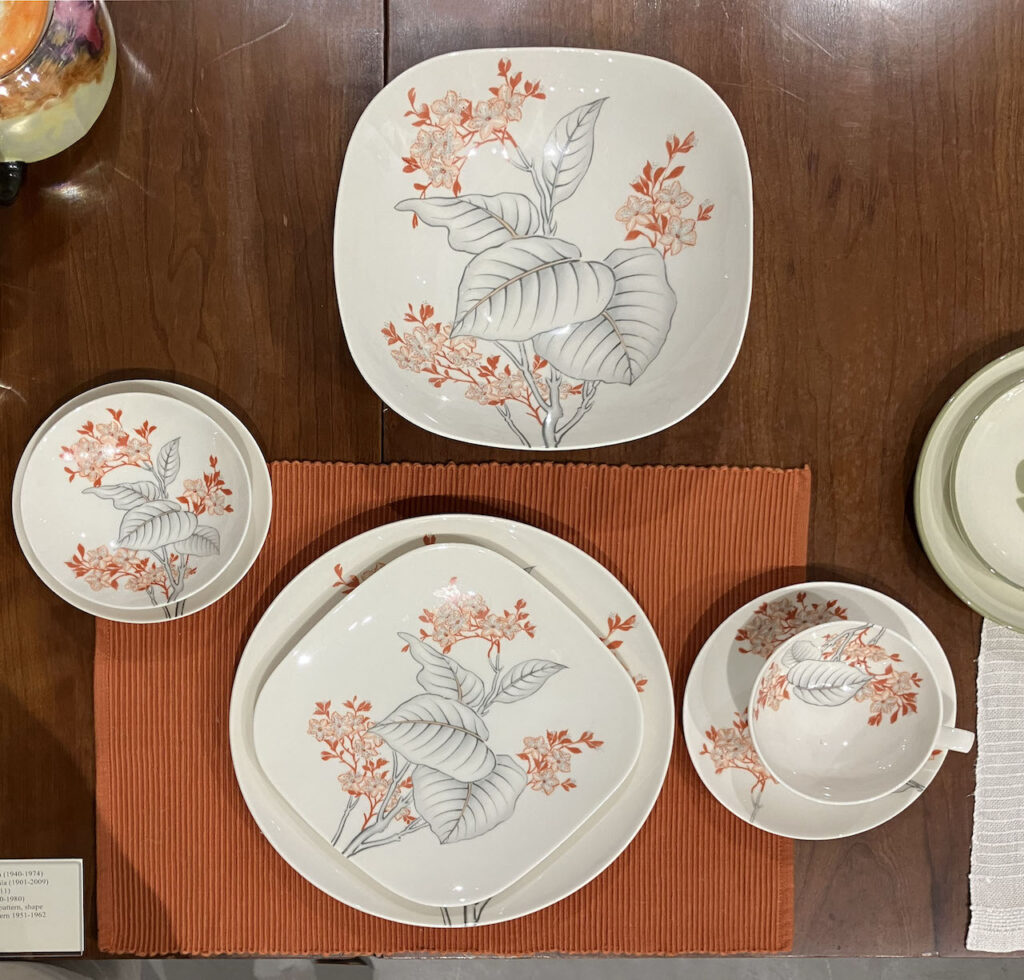
Castleton China Company, New Castle, Pennsylvania (1940-1974)
Shenango Pottery Company, New Castle, Pennsylvania (1901-2009)
Eva Zeisel, designer (American, b. Hungary 1906-2011)
Ching-Chih Yee, pattern designer (b. Hangzhou, 1900-1980)
place setting of Museum dinnerware with Mandalay pattern, shape designed 1942-45, manufactured with Mandalay pattern 1951-1962
porcelain, glazed
IMoDD 2024.25 Gift of Jane C. Busch
Ruth Easterbrook
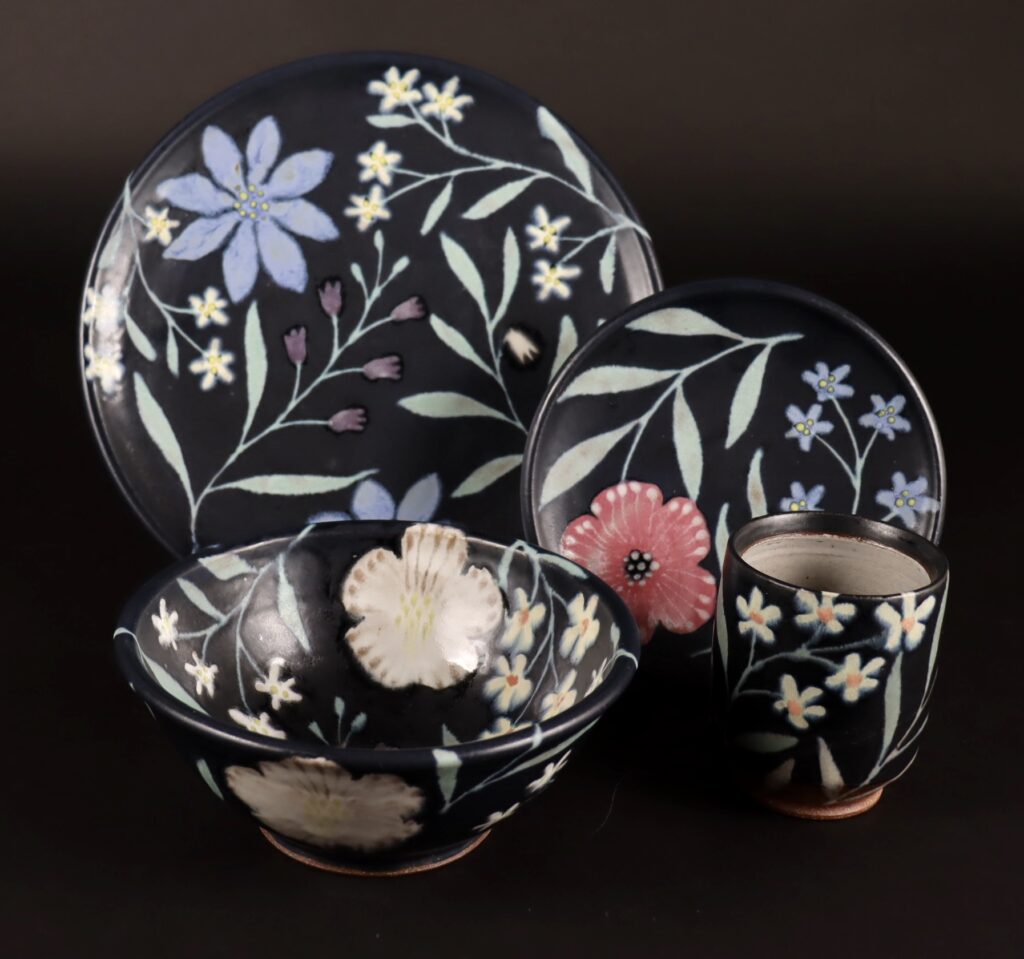
Ruth Easterbrook (American, b. 1984)
4-piece place setting cup, bowl, dessert plate and dinner plate, 2025-2026
wheel thrown mid-range red stoneware, glaze, inlay fired in oxidation to cone 6
IMoDD 2026.14 Museum Purchase
Texas Ware
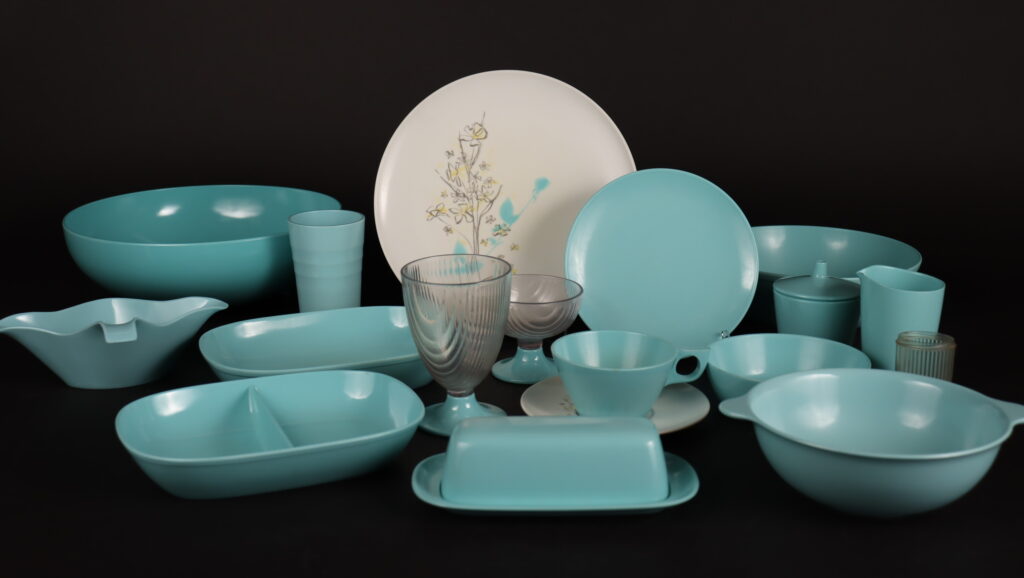
Plastics Manufacturing Company, Dallas, Texas (1940s-1980s)
place setting plastic Texas Ware dinnerware set, including matching stemware, turquoise and white with floral pattern, 1950s
IMoDD 2025.3 Gift of Robert Switzer
John Glick
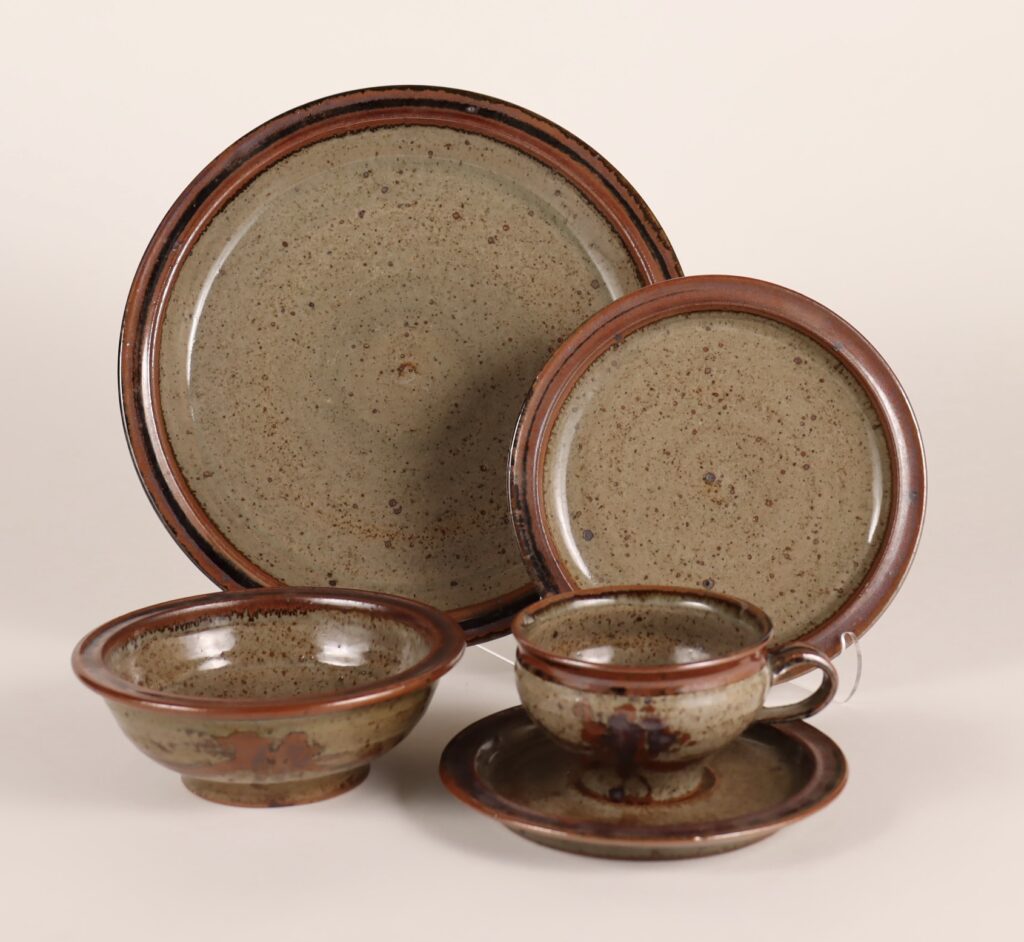
John Glick, (American, 1938-2017)
5-piece handmade stoneware dinnerware set including dinner plate, salad plate, bowl, cup and saucer, 1962
stoneware, reduction fired, oxide wash decoration
IMoDD 2025.147 Gift of Susie Symons
Winfield Pottery
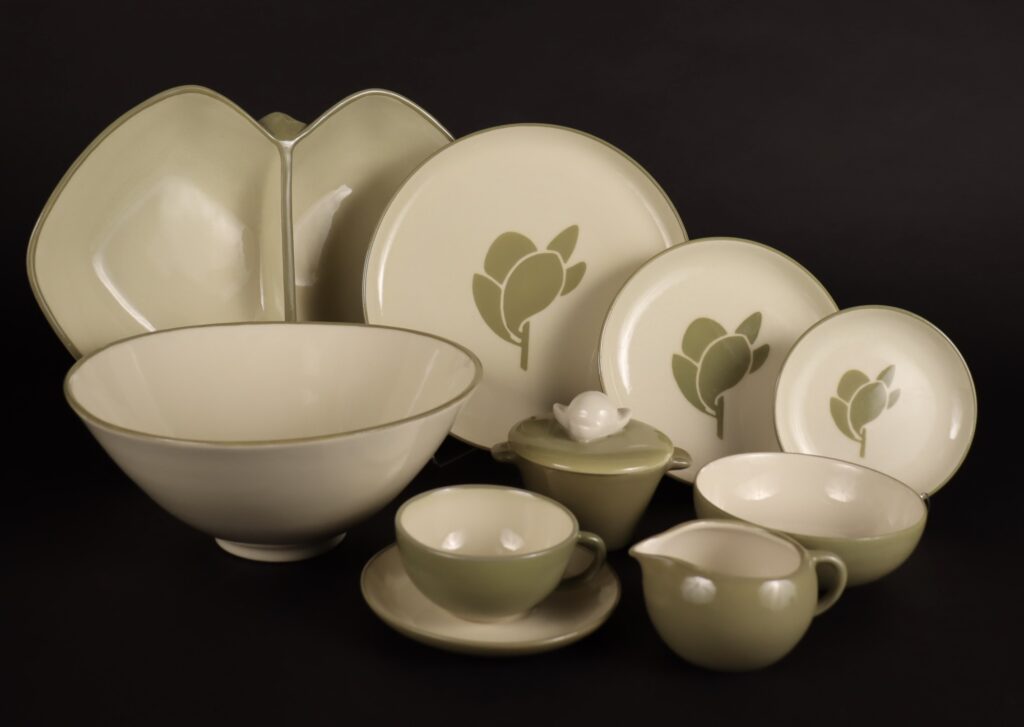
Winfield Pottery of Pasadena, 1929-1946, Santa Monica, 1946-1962
Margaret Mars Gabriel, designer
place setting earthenware Winfield Ware, Avocado, June 1948
IMoDD 2025.101 Gift in Memory of Charles and Jane Schock by their 5 loving children Lynn, Dani, Kerri, Andy, and Cami
Burrite plastic kitchen pitchers
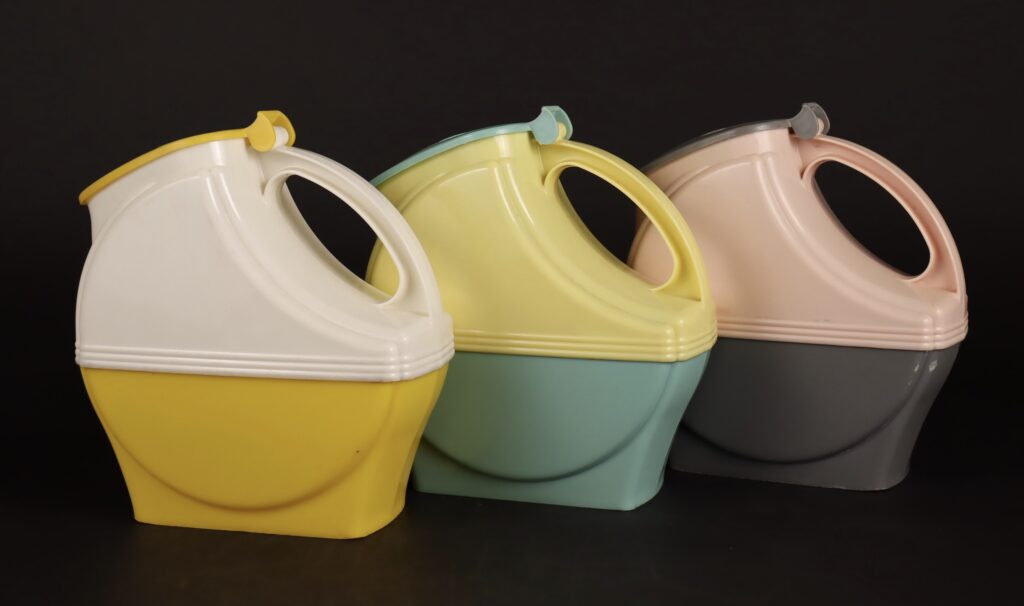
Burroughs Manufacturing Corp., Los Angeles, California
Charles M. Burroughs, designer (American, 1904-1998)
3 Burrite model 337 design two-tone molded plastic kitchenware pitchers, with hinged lid, 1948
IMoDD 2025.16-2025.18 Gifts of Fran Palmieri
Kayserzinn tureen
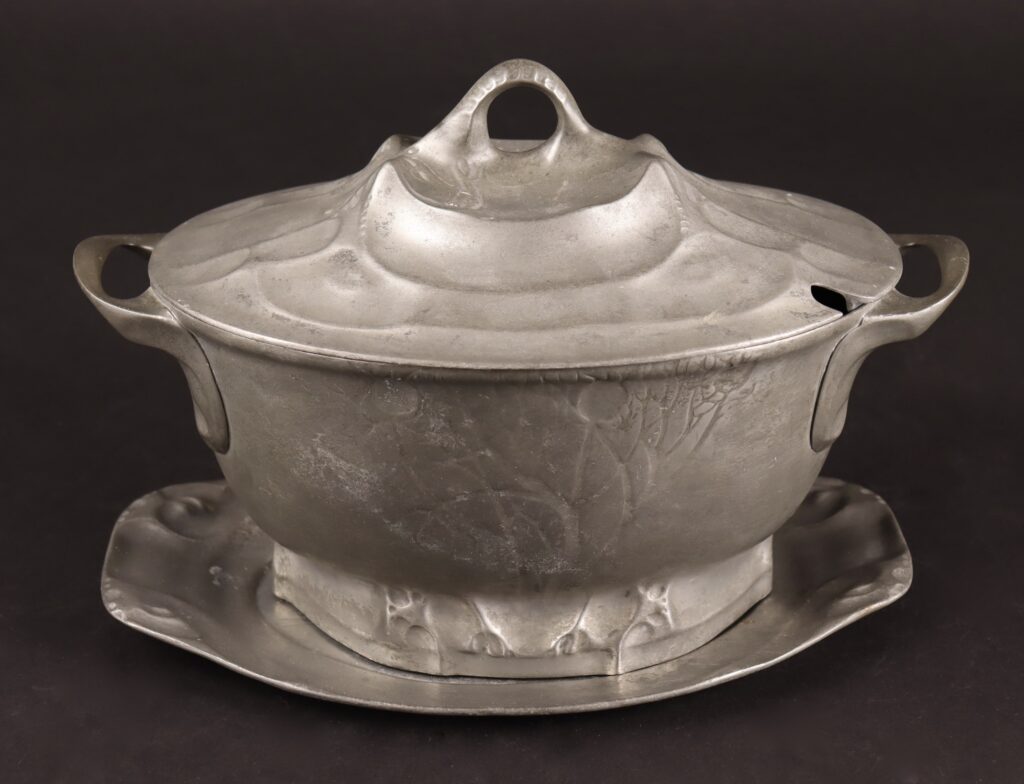
Kayserzinn, Cologne (1894-1925)
Hugo Leven, designer (German, 1974-1956)
Kayserzinn Art Nouveau pewter tureen with lid and underplate, 1890s-1914
IMoDD 2024.101 Gift of Heide and James Klein
Kayserzinn candlesticks
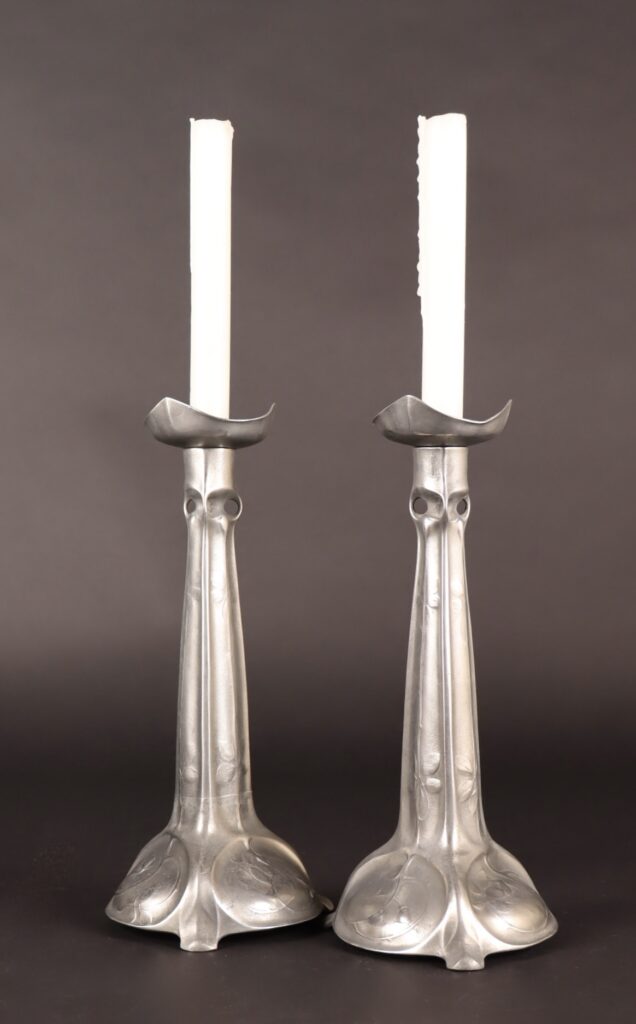
Kayserzinn (J.P. Kayser & Sohn), Germany
Hugo Leven, designer (German, 1874-1956)
pair Kayserzinn pewter German Jugendstil candlesticks,1900-1902
IMoDD 2026.77 Gift of Heide Klein
Kayserzinn Platter
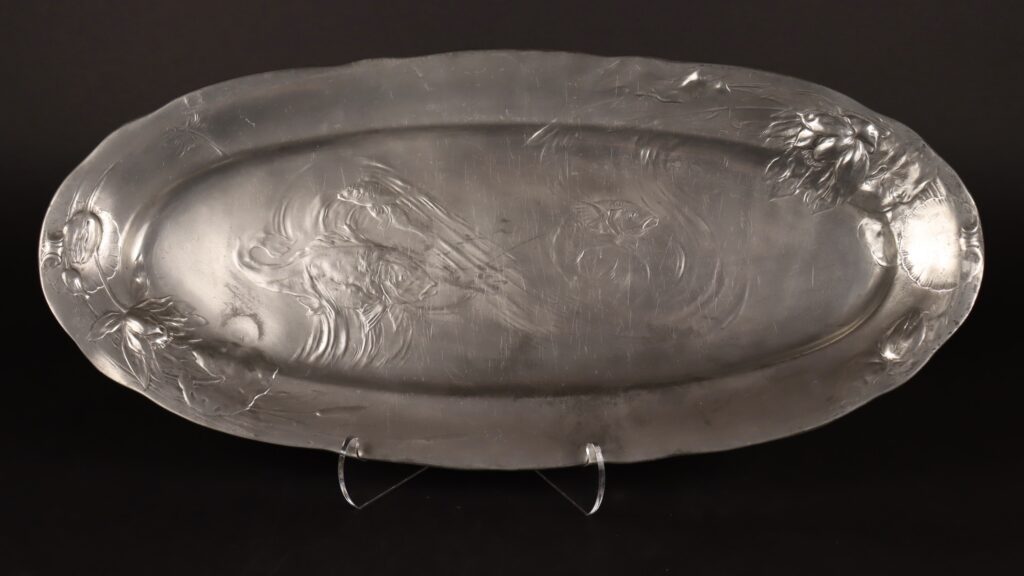
Kayserzinn, Cologne (1894-1925)
Hugo Leven, designer (German, 1974-1956)
Kayserzinn Art Nouveau pewter platter with fish motif
IMoDD 2025.4 Gift of Heide and James Klein
Ella Fitzgerald basket
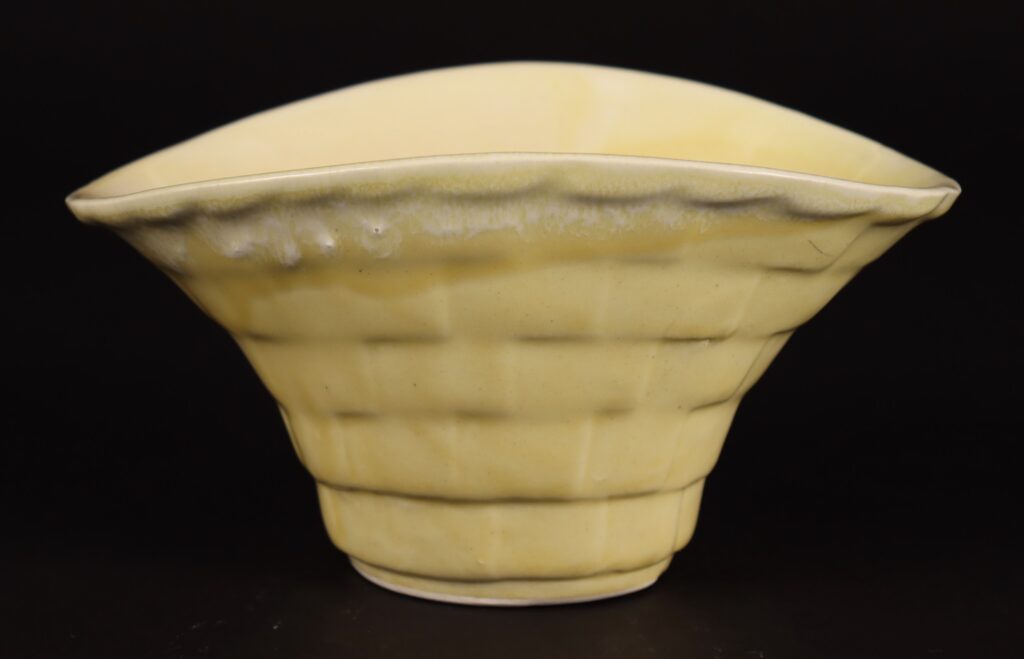
California Pottery, 20th century
yellow earthenware basket with basket weave exterior, once owned by Ella Fitzgerald
IMoDD 2025.139 Gift of Fran Morris Rosman
Eva Zeisel Schramberg
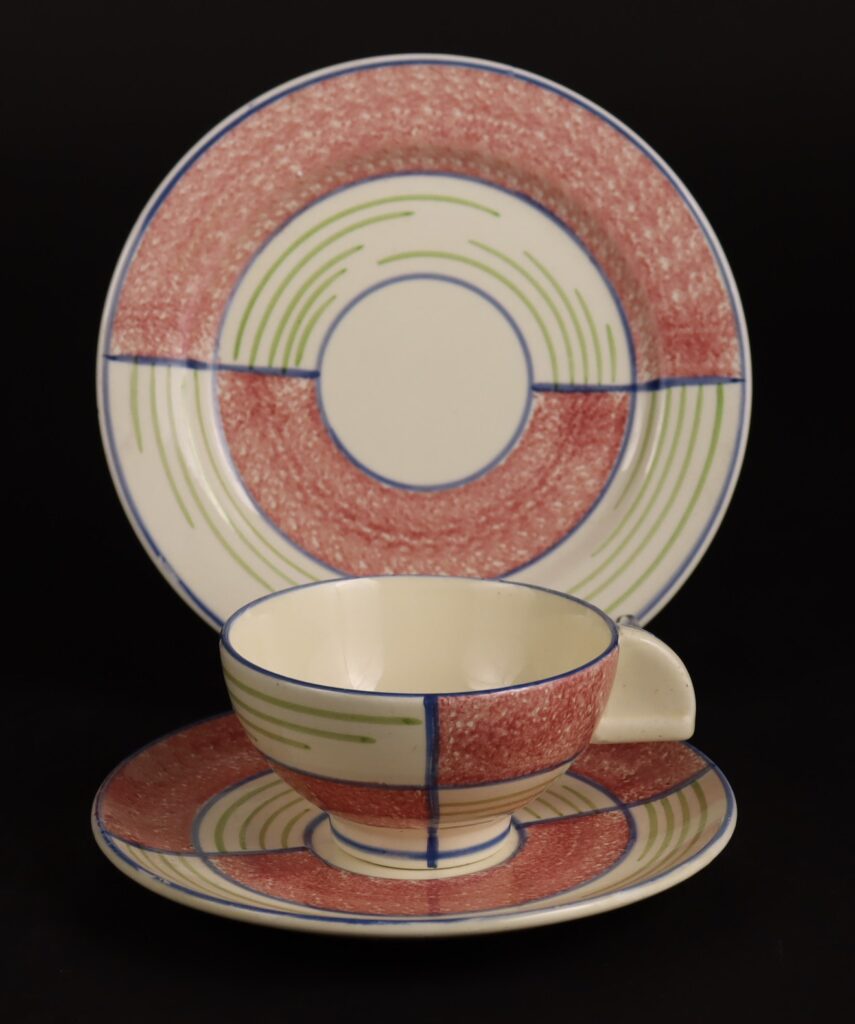
Schramberger Majolikafabrik, Germany (1820-1989)
Eva Zeisel, designer (b. Budapest 1906-2011)
Eva Zeisel designed Schramberg cup, saucer and plate in geometic design, 1928-1930
earthenware, hand-painted and glazed
2025.19 Gift of Charles Salkin
Porzellanfabrik Rudolf Kämpf
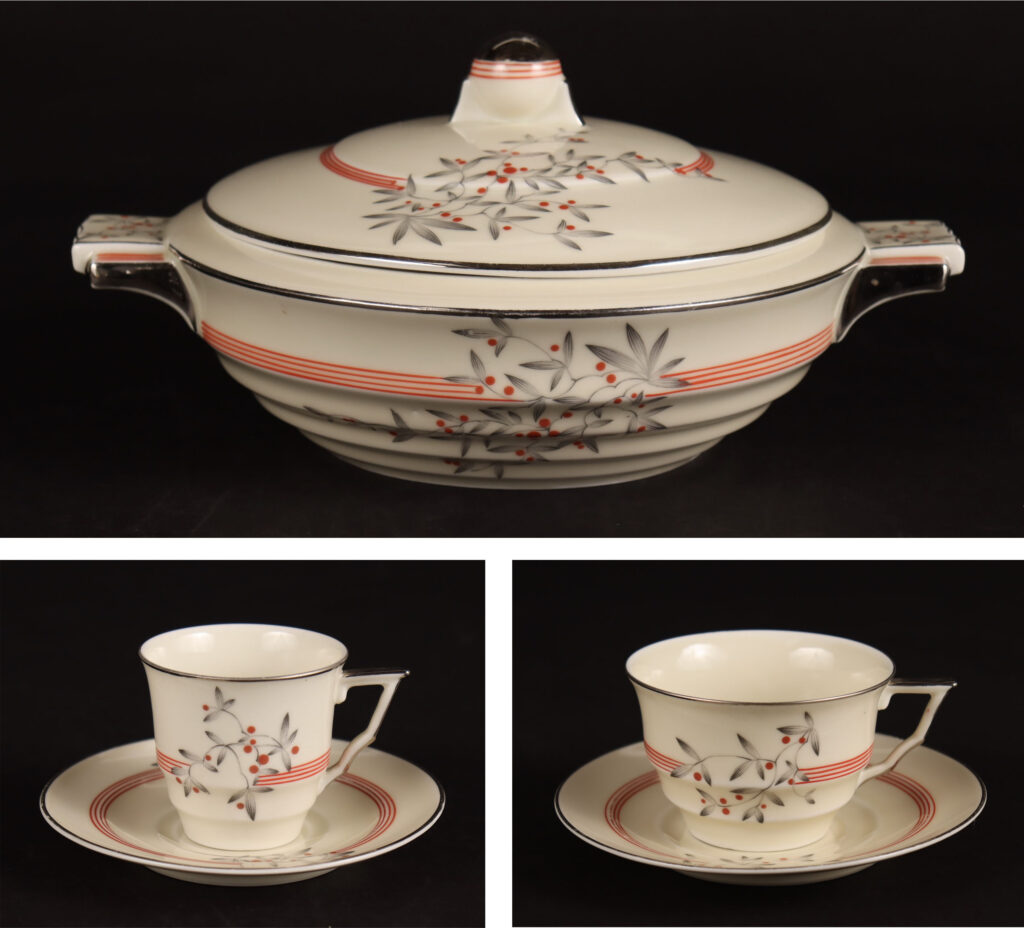
Porzellanfabrik Rudolf Kämpf, Grünlas, Czechoslovakia (established 1907-)
Czech/Bohemian Art Deco/Streamline Modern porcelain, handled casserole with lid, demitasse cup and saucer set, coffee cup and saucer set with French import mark “Tchecoslovaquie” with delicate hand-painted berry and foliage pattern in orange/red and platinum, 1928-1938
IMoDD 2025.50, 2025.61, 2025.62 Gift of Carol Goldstein
Archibald Knox
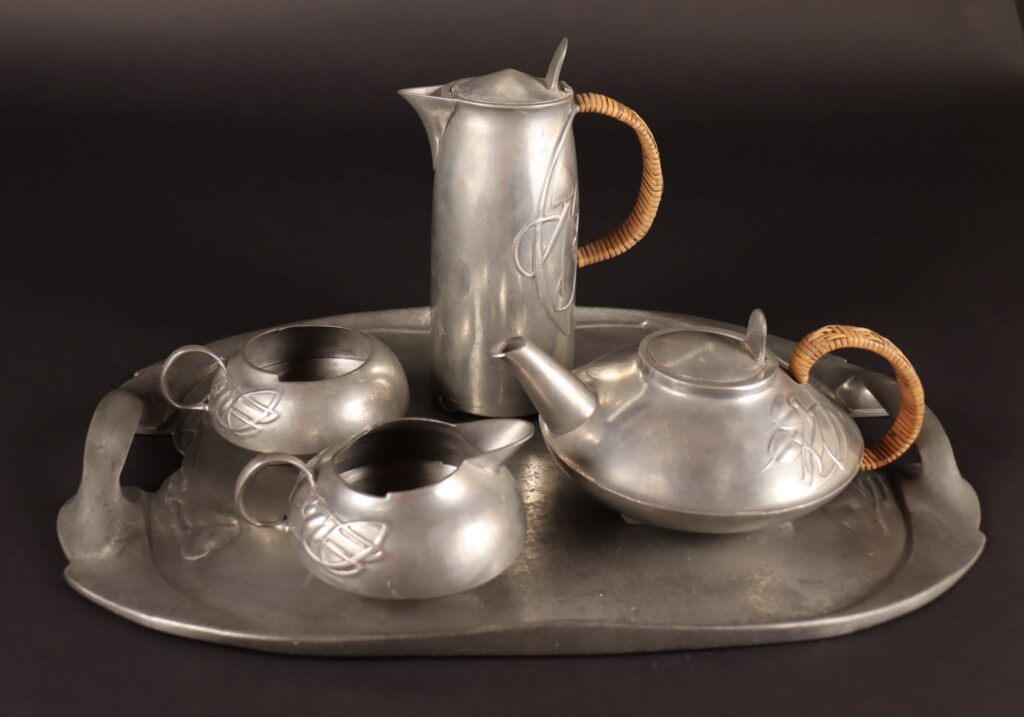
Liberty & Co., London, England (established 1875-)
Archibald Knox (Isle of Man/Scotland, 1864-1922)
5-piece Archibald Knox-designed Liberty Tudric Art Nouveau pewter tea set and tray, circa 1905
Tudric pewter
IMoDD 2026.10 Gift of Charles H. Alexander
Noritake
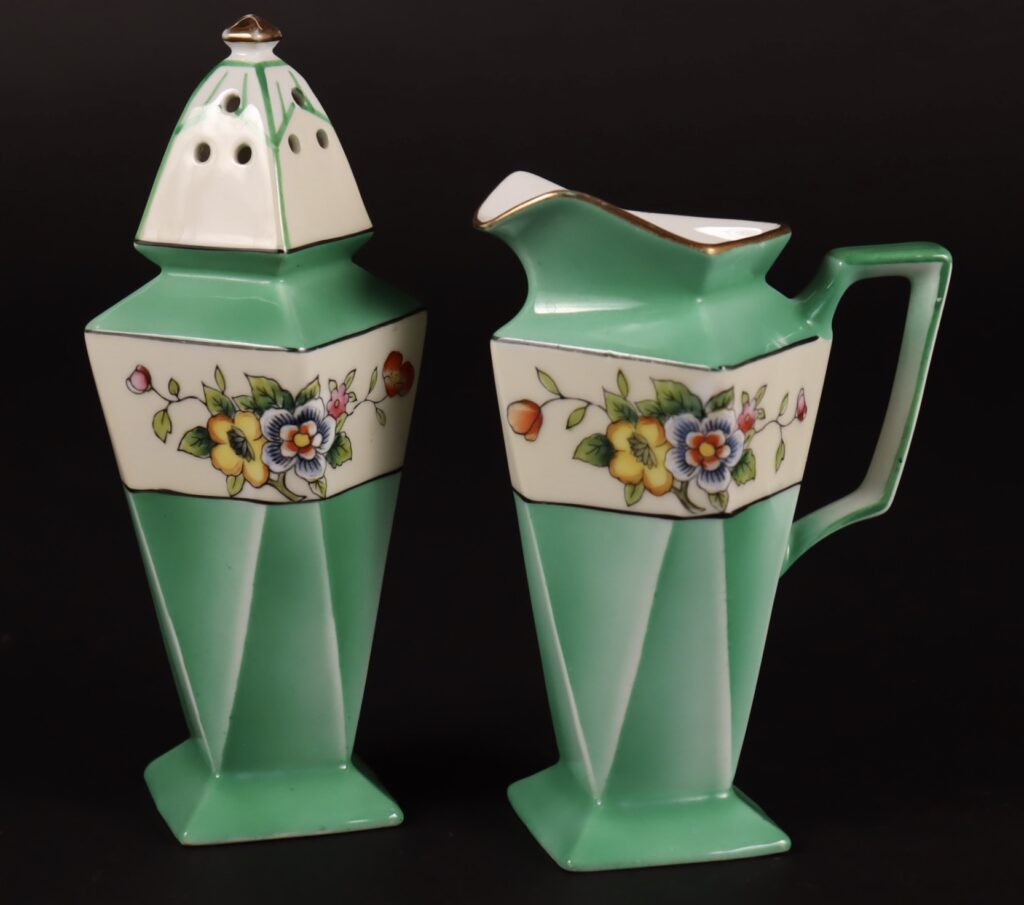
Noritake China, Japan (1904-)
pair Art Deco style Noritake sugar shaker and creamer, ca. 1921-1953
porcelain, hand-decorated
IMoDD 2026.67 Gift of Lynn Renkert
Eva Zeisel Hyalyn
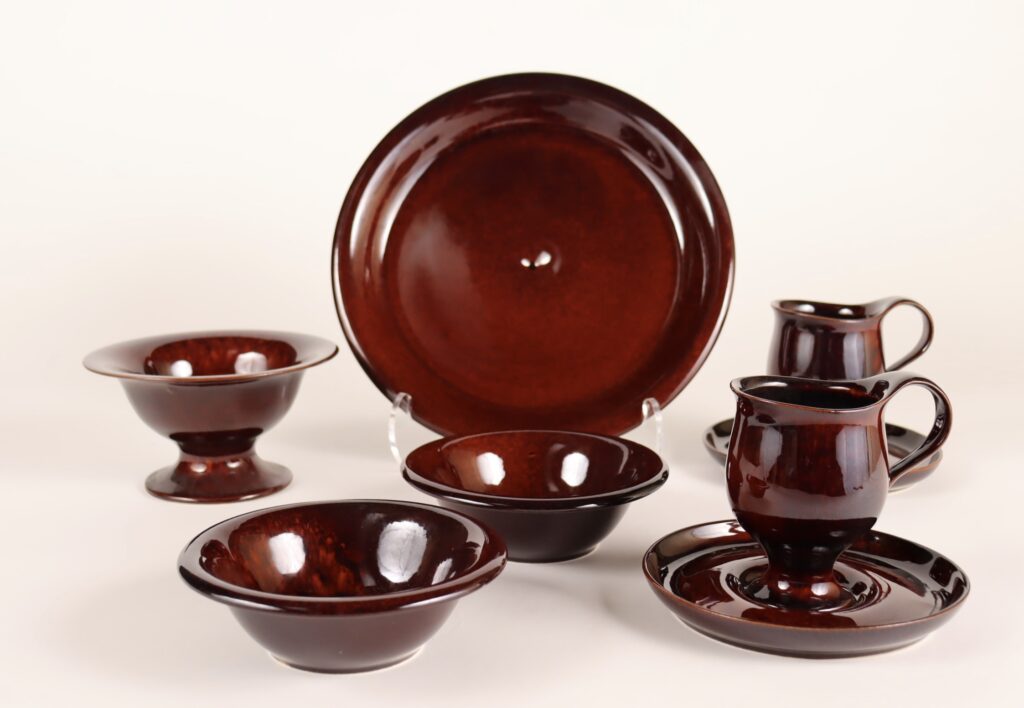
Hyalyn Porcelain, Hickory, North Carolina (1946-1973)
Eva Zeisel, designer (b. Budapest, 1906-2011)
8-piece Hyalyn Porcelain High Fashion Z-Ware in oxblood glaze including 2 cups, 2 saucers, 2 bowls, 1 footed soup bowl, and one dinner plate, ca. 1964
porcelain, glazed
IMoDD 2025.148 Museum Purchase